In many plants, when production targets are increased, attention immediately goes to:
- reactors
- distillation columns
- compressors
- storage systems
But during real revamp studies, a different pattern often appears.
The true limitation is not inside the reactor.
It is not inside the column trays.
It is not in the pump.
It is inside the heat exchanger.
Heat exchangers frequently become plant bottlenecks — quietly, gradually, and often unexpectedly.
This article explains why that happens at equipment level, how exchangers limit throughput, and why they are commonly the first constraint during capacity expansion.
Table of Contents
Heat Exchangers Define Temperature Feasibility
Every major process step requires a temperature target:
- reactor inlet temperature
- column feed temperature
- overhead condensation temperature
- product cooling temperature
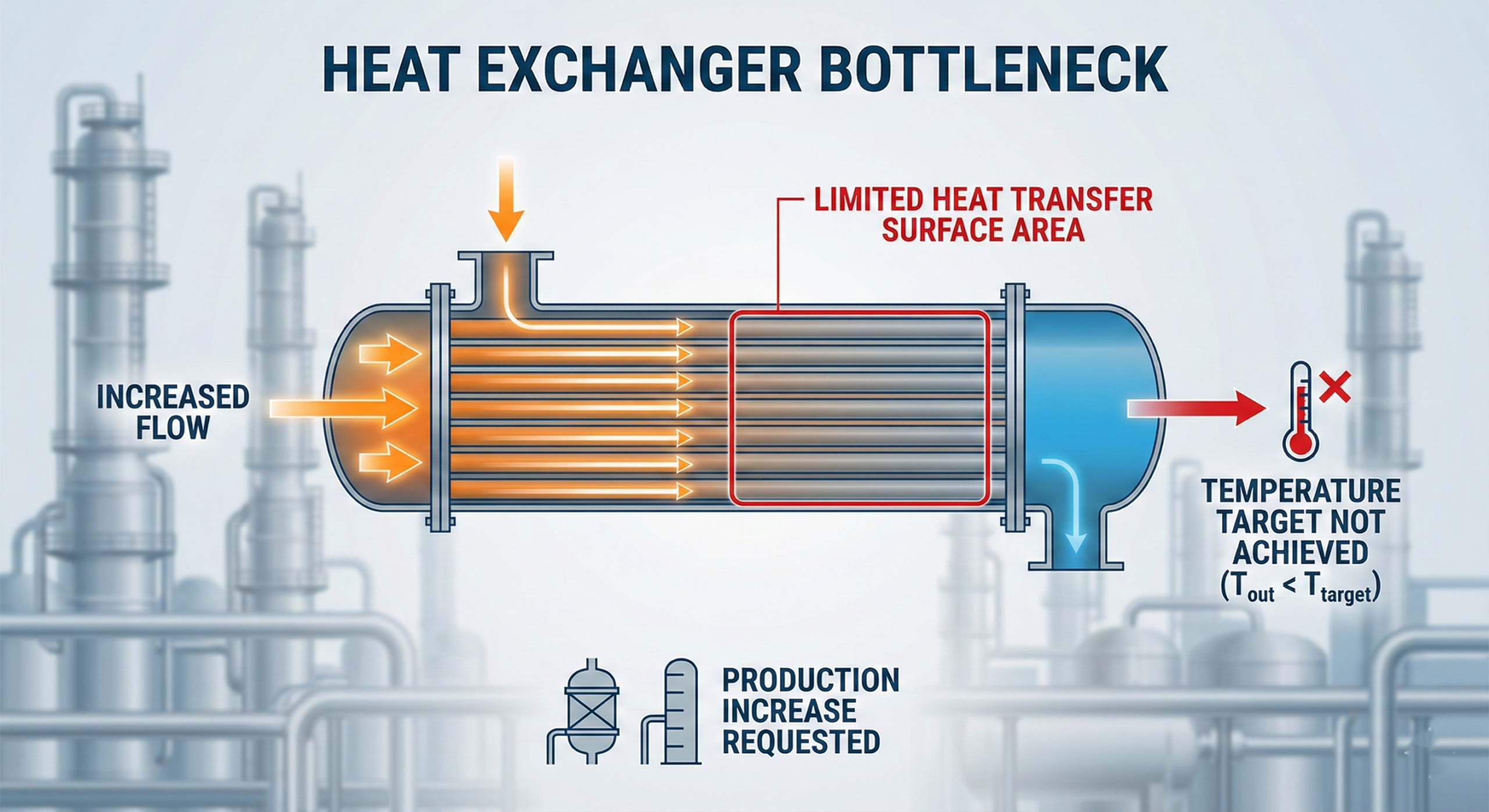
To increase production, flow increases.
But when flow increases, required heat duty increases proportionally.
Why This Creates a Limit
Heat exchangers have:
- fixed surface area
- fixed internal geometry
- limited allowable pressure drop
When flow increases:
- more heat must be transferred
- but surface area remains constant
If required duty exceeds exchanger capability:
- outlet temperature target cannot be achieved
At that point, throughput increase stops.
The exchanger becomes the bottleneck.
Surface Area Is Fixed — Production Is Not
Reactor volume can sometimes tolerate higher flow.
Columns may handle moderate increases.
But exchanger area is physically fixed.
What Happens at Higher Flow
As flow increases:
- temperature difference per unit length reduces
- approach temperature becomes tighter
- required driving force increases
Eventually, the exchanger cannot deliver enough heat exchange within its existing area.
Unlike rotating equipment, exchangers cannot simply “run faster.”
Their capacity is geometry-dependent.
Fouling Reduces Available Capacity
Even if the exchanger was originally sized with margin, fouling changes the picture.
How Fouling Creates Bottlenecks
As fouling builds:
- effective heat transfer reduces
- temperature approach increases
- required utility increases
At original production rates, this may be manageable.
But during production increase:
- the reduced clean capacity is exposed
- margin disappears
An exchanger that was “adequate” at design capacity may become limiting when flow rises by even 10–15%.
Pressure Drop Limits Flow Increase
Throughput increase often means higher velocity.
Higher velocity improves heat transfer to some extent — but also increases pressure drop.
Why Pressure Drop Becomes Critical
Heat exchangers are designed with allowable pressure drop limits.
If flow increases too much:
- pressure drop exceeds pump capability
- upstream pressure increases
- downstream pressure reduces
- hydraulic instability appears
Even if thermal capacity exists, hydraulic constraints may prevent higher flow.
So bottleneck can be thermal or hydraulic — often both.
Utility System Constraints
Many exchangers depend on utilities such as:
- steam
- cooling water
- air
- hot oil
If process load increases:
- steam demand rises
- cooling demand rises
But utility systems may have fixed capacity.
Example
A condenser may handle additional vapor load thermally.
But if cooling water flow or temperature cannot support it:
- column pressure increases
- separation performance drops
The exchanger is not just limited by its design — it is also limited by utility network capacity.
Temperature Approach Shrinks at Higher Loads
Every exchanger operates with a temperature approach — the difference between process outlet and utility temperature.
As load increases:
- this approach becomes smaller
- driving force reduces
When approach becomes too small:
- further duty increase becomes impossible
This is especially common in:
- condensers
- product coolers
- feed preheaters
Once temperature approach reaches a practical minimum, production cannot increase further without equipment modification.
Phase Change Exchangers Hit Limits Quickly
Exchangers handling condensation or boiling are especially sensitive.
When vapor load increases:
- condensation area requirement increases
- film behavior changes
- pressure drop increases
If surface area is insufficient:
- vapor carryover occurs
- pressure rises
- separation efficiency drops
These exchangers often become first bottlenecks in distillation systems.
Maldistribution Worsens at Higher Flow
At design load, minor flow maldistribution may not be noticeable.
At higher load:
- uneven distribution becomes more pronounced
- some tubes overload
- others underperform
This reduces effective area.
The exchanger behaves as if it is smaller than its physical size.
So bottleneck appears earlier than expected.
Air Coolers and Ambient Limits
Air coolers are strongly influenced by ambient temperature.
In summer:
- air inlet temperature increases
- cooling capacity reduces
If production increases simultaneously:
- cooling limitation becomes severe
Unlike steam, ambient air cannot be increased in temperature difference beyond environmental conditions.
So seasonal bottlenecks often originate from air coolers.
Exchangers Are Designed for Design Case — Not Future Expansion
Most exchangers are sized for:
- specified design flow
- specified temperature
- specified fouling margin
They are rarely oversized significantly for future expansion.
So during revamp:
- reactors may tolerate higher load
- but exchangers were never built for that duty
That is why exchanger replacement or addition is common in expansion projects.
Debottlenecking Often Starts With Exchangers
In revamp studies, engineers often:
- Evaluate temperature targets
- Check approach margins
- Review fouling condition
- Examine pressure drop
Very often, the conclusion is:
- exchanger area must increase
- additional exchanger must be added
- utility temperature must change
Because exchangers are thermal gateways.
If they cannot pass enough energy, process flow cannot increase.
Operators Feel the Bottleneck First
Operators may observe:
- outlet temperature drifting from target
- column pressure rising
- product not reaching required temperature
- steam valve fully open but insufficient heating
These are classic signs that an exchanger is at its limit.
The bottleneck appears as thermal instability before it is formally calculated.
Owner Perspective: Exchanger Upgrades Unlock Capacity
In many plants, replacing or upgrading exchangers provides:
- measurable throughput increase
- reduced energy consumption
- improved stability
Compared to modifying reactors or columns, exchanger upgrades are often:
- less complex
- less risky
- more economical
Because they directly address energy transfer limitation.
Why Exchangers Become Bottlenecks More Than Other Equipment
Three main reasons:
- Fixed surface area limits duty.
- Fouling reduces effective performance over time.
- Hydraulic constraints limit flow increase.
Unlike rotating machines, exchangers do not have adjustable capacity beyond minor flow changes.
Their physical structure defines their maximum performance.
How to Identify an Exchanger Bottleneck
Typical indicators:
- Steam valve fully open, but target temperature not reached
- Cooling water outlet temperature unusually high
- Pressure drop increasing with flow
- Temperature approach shrinking significantly
- Increased utility consumption without performance gain
These signals suggest the exchanger has reached its limit.
Final Perspective
Heat exchangers often become plant bottlenecks because they sit at critical energy transition points.
When production increases:
- required heat duty increases
- surface area remains fixed
- pressure drop rises
- utility limits appear
At that point, temperature targets cannot be maintained.
And when temperature targets fail, process performance fails.
Understanding exchanger bottlenecks changes how expansion and troubleshooting are approached.
In many plants, the key to higher throughput is not more reaction volume — it is better heat exchange.
A practicing chemical engineer with 17+ years of experience in process design, project execution, commissioning, and plant operations. Focused on practical engineering judgment beyond textbook explanations.