
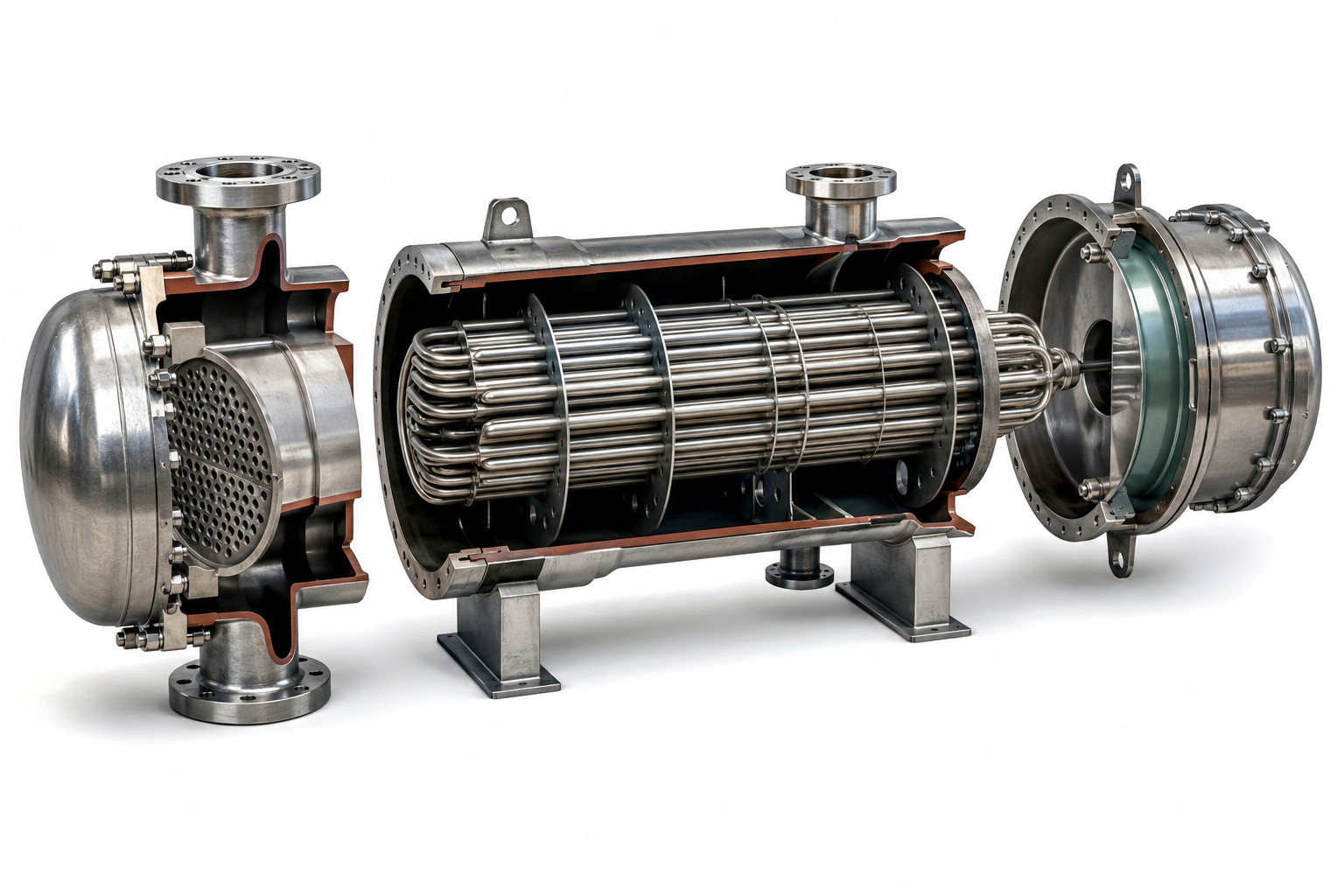
Shell-and-tube heat exchangers are the most widely used heat exchangers in process industries. They are found in almost every major unit operation, including crude distillation units, reactors, condensers, reboilers, feed preheaters, product coolers, and utility systems.
At first glance, many shell-and-tube exchangers appear almost identical. They all have a cylindrical shell, tube bundle, channel heads, nozzles, and supports. However, experienced engineers know that two exchangers performing the same heat duty can have completely different internal construction, maintenance requirements, operating limitations, and lifecycle costs.
The difference is often described using a simple three-letter code.
For example:
- BEM
- BEU
- AES
- AET
- AEP
These letters are not merely equipment names or vendor codes.
They are part of the TEMA (Tubular Exchanger Manufacturers Association) classification system, an internationally recognized standard that defines the mechanical configuration of shell-and-tube heat exchangers.
Understanding TEMA classification is essential for process engineers, mechanical engineers, project engineers, maintenance teams, and anyone involved in specifying, purchasing, operating, or troubleshooting shell-and-tube heat exchangers.
This article introduces the TEMA classification system, explains why it exists, and shows how these three letters influence exchanger selection, maintenance strategy, thermal expansion management, inspection, reliability, and project cost.
Table of Contents
What Is TEMA?
An Industry Standard for Shell-and-Tube Heat Exchangers
TEMA stands for the Tubular Exchanger Manufacturers Association.
It was established to standardize the mechanical design and construction of shell-and-tube heat exchangers used across industries.
Instead of every manufacturer developing its own terminology and construction methods, TEMA provides common standards covering:
- mechanical configuration
- fabrication practices
- dimensional requirements
- inspection provisions
- maintenance accessibility
- allowable tolerances
- recommended design practices
Today, TEMA standards are widely referenced by:
- refineries
- petrochemical plants
- fertilizer plants
- chemical manufacturing facilities
- pharmaceutical industries
- engineering consultants
- EPC contractors
- equipment manufacturers
Although thermal design may vary from project to project, the mechanical configuration is often described using TEMA terminology.
Why TEMA Classification Matters
The Same Heat Duty Can Be Achieved Using Different Mechanical Designs
Imagine two exchangers that both cool a process stream from 180°C to 80°C.
Thermally, both satisfy the process requirement.
Mechanically, however, they may be entirely different.
One exchanger may:
- allow complete tube bundle removal
- accommodate thermal expansion easily
- permit mechanical cleaning on both sides
Another may:
- have fixed tubes
- restrict cleaning access
- require lower initial investment
- suit only clean services
Both exchangers perform the same thermal duty.
But they differ significantly in:
- maintenance effort
- fabrication cost
- operating flexibility
- expected service life
TEMA classification helps engineers understand these differences before equipment is purchased.
Understanding the Three-Letter TEMA Code
Every Letter Represents a Different Section of the Exchanger
A complete TEMA designation consists of three letters.
For example:
- BEM
- AES
- BEU
Each letter identifies a different part of the exchanger.
First Letter
Defines the front head.
Second Letter
Defines the shell type.
Third Letter
Defines the rear head.
Together, these three letters describe the complete mechanical arrangement of the exchanger.
Instead of reading detailed fabrication drawings, experienced engineers can understand the basic construction simply by reading the TEMA code.
What the Front Head Determines
More Than Just the Inlet Connection
The front head is the section where the tube-side fluid enters the exchanger.
Its design influences:
- tube-side flow distribution
- inspection accessibility
- maintenance convenience
- piping arrangement
Different front head designs make maintenance either easier or more difficult depending on the service.
The most commonly used front head types include:
- A
- B
- C
Each has advantages depending on:
- cleaning frequency
- operating pressure
- piping layout
- maintenance philosophy
The next supporting article explores these front head types in detail.
What the Shell Type Determines
The Shell Controls Flow Behavior
The shell is much more than a pressure vessel.
Its configuration determines:
- shell-side flow pattern
- temperature distribution
- pressure drop characteristics
- heat transfer effectiveness
Common shell types include:
- E
- F
- G
- H
- J
- K
Although they all appear similar externally, internally they guide shell-side flow differently.
The shell type is often selected based on:
- thermal performance
- pressure drop limitations
- temperature approach requirements
- process duty
Each shell arrangement serves a specific engineering purpose.
These configurations will be covered in a dedicated support article.
What the Rear Head Determines
Managing Expansion and Maintenance
The rear head may appear to be a simple end closure.
In reality, it largely determines:
- thermal expansion accommodation
- tube bundle removal
- cleaning accessibility
- inspection capability
Typical rear head arrangements include:
- Fixed tube sheet
- U-tube
- Floating head
Selecting the wrong rear head configuration can lead to:
- excessive thermal stress
- maintenance difficulties
- higher lifecycle cost
The rear head is one of the most critical decisions during exchanger specification.
Why TEMA Is More Than a Naming Convention
Many young engineers initially assume that BEM or AES is simply an equipment code.
It is not.
Each configuration reflects a deliberate engineering decision.
Changing only one letter can completely alter:
- fabrication complexity
- maintenance procedure
- cleaning method
- inspection accessibility
- thermal expansion capability
- equipment cost
This is why experienced engineers pay close attention to every letter in a TEMA designation.
How Process Conditions Influence TEMA Selection
Selecting a TEMA type is not based on company habit or personal preference.
It depends on the process conditions the exchanger must handle.
Typical considerations include:
Thermal Expansion
Large temperature differences create expansion between the shell and the tubes.
Some TEMA configurations accommodate this movement better than others.
Fouling Tendency
If tube-side fouling is expected, the exchanger should allow effective mechanical cleaning.
Certain TEMA arrangements provide much better maintenance access.
Pressure Conditions
High-pressure services may require specific channel head and rear head configurations to maintain structural integrity.
Inspection Requirements
Plants with strict inspection schedules often prefer configurations that simplify tube bundle removal.
Why Maintenance Teams Care About TEMA
For maintenance engineers, the TEMA code immediately provides valuable information.
It indicates:
- whether the bundle can be removed
- whether tubes can be mechanically cleaned
- whether shell-side inspection is straightforward
- how long shutdown activities may take
For example, two exchangers with identical thermal performance may require completely different maintenance procedures simply because they have different rear head configurations.
Maintenance planning therefore begins long before the exchanger enters service.
It begins during equipment selection.
Why TEMA Selection Affects Lifecycle Cost
The lowest purchase price does not always result in the lowest lifecycle cost.
A simpler exchanger may cost less initially.
However, if it:
- requires longer shutdowns
- is difficult to clean
- experiences greater thermal stress
- needs frequent repairs
its total ownership cost may become much higher.
A more expensive TEMA configuration may reduce:
- maintenance hours
- production losses
- inspection difficulty
- repair frequency
Good exchanger selection considers both capital cost and operating cost.
Why Process and Mechanical Engineers Must Work Together
Selecting a shell-and-tube exchanger is not the responsibility of one discipline alone.
Process engineers focus on:
- heat duty
- temperature requirements
- pressure drop
- operating conditions
Mechanical engineers focus on:
- fabrication
- expansion
- pressure containment
- maintenance
- code compliance
Operations teams focus on:
- reliability
- accessibility
- cleaning frequency
Owners focus on:
- lifecycle economics
- plant availability
- maintenance budget
The final TEMA configuration represents a balance between all these requirements.
Common TEMA Configurations Seen in Industry
Although many combinations are possible, several configurations appear frequently in industrial plants.
Examples include:
- BEM
- BEU
- AES
- AET
- AEP
Each combination is selected because it provides a particular balance between:
- maintenance
- expansion capability
- fabrication cost
- operational reliability
The upcoming support articles will explain how and why each configuration is used.
Understanding TEMA Makes Datasheets Easier to Read
Heat exchanger datasheets contain dozens of technical parameters.
Among them, the TEMA designation immediately tells an experienced engineer:
- exchanger construction
- maintenance philosophy
- cleaning capability
- expansion arrangement
Without understanding TEMA, much of the datasheet remains only partially understood.
With TEMA knowledge, engineers can visualize the equipment before seeing a drawing.
Final Perspective
Heat transfer calculations determine how much heat an exchanger must transfer.
TEMA classification determines how that exchanger will be built, maintained, inspected, and operated throughout its life.
Every letter in a TEMA code represents an engineering decision.
It influences:
- maintenance accessibility
- thermal expansion management
- cleaning method
- fabrication complexity
- inspection requirements
- project cost
- long-term reliability
That is why experienced engineers never treat TEMA codes as simple abbreviations.
They recognize them as the mechanical language of shell-and-tube heat exchangers.
Understanding that language is one of the most valuable skills an engineer can develop when working with industrial heat exchangers.
Explore the complete series in the Heat Exchanger Engineering Hub.

A practicing chemical engineer with 17+ years of experience in process design, project execution, commissioning, and plant operations. Focused on practical engineering judgment beyond textbook explanations.