Heat exchangers are often discussed as if they all behave the same way.
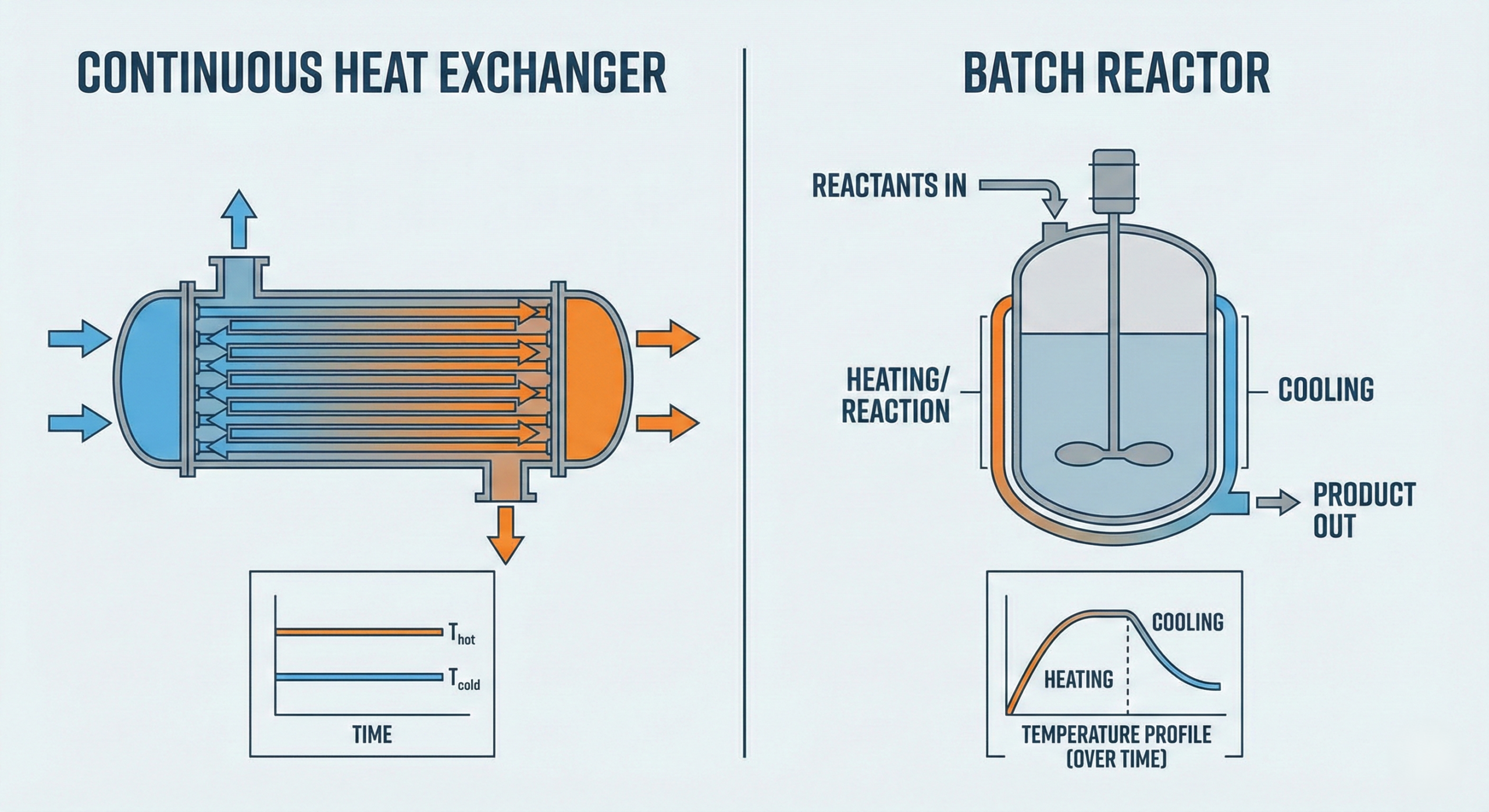
But the way an exchanger performs in a continuous process plant is fundamentally different from how it behaves in a batch system.
The differences are not just operational.
They influence:
- sizing philosophy
- control strategy
- surface selection
- response time expectations
- fouling behavior
- maintenance planning
In continuous plants, exchangers are part of a steady energy network.
In batch systems, they manage dynamic temperature cycles.
This article explains how continuous and batch heat exchange differ at equipment level, and why design and control strategies must reflect those differences.
Table of Contents
Continuous Heat Exchange
What Defines Continuous Operation
In a continuous plant:
- feed flows constantly
- product flows constantly
- temperature targets remain stable
- duty remains relatively steady
Heat exchangers in these systems operate at:
- near steady-state conditions
- predictable flow rates
- defined temperature windows
They are designed for long-term stable performance.
Design Philosophy in Continuous Systems
In continuous service, exchanger design focuses on:
- steady duty capacity
- allowable pressure drop
- long fouling cycles
- energy efficiency
- integration with utility systems
Since flow is constant:
- surface area is sized for design throughput
- margin is included for fouling
- temperature approach is optimized
The assumption is that operating conditions do not change drastically over short periods.
Control Strategy in Continuous Systems
Continuous exchangers are controlled using:
- flow control
- temperature feedback loops
- utility valve modulation
For example:
- steam valve adjusts to maintain outlet temperature
- cooling water flow increases when process temperature rises
The system aims for stability.
Small deviations are corrected smoothly.
Response speed is important — but stability is more important.
Operational Behavior
In continuous mode:
- metal temperature remains stable
- thermal expansion stabilizes
- fouling develops gradually
The exchanger operates in a predictable environment.
This allows performance monitoring through trend analysis.
Batch Heat Exchange
What Defines Batch Operation
In batch systems:
- material is processed in discrete quantities
- temperature changes over time
- heating and cooling phases alternate
- duty varies significantly within one cycle
Heat exchangers here are often:
- jackets around vessels
- coil systems
- recirculation loop exchangers
They do not operate at steady conditions.
They operate in cycles.
Design Philosophy in Batch Systems
Batch exchanger design must consider:
- maximum heating rate
- maximum cooling rate
- rapid temperature ramping
- thermal cycling stress
Unlike continuous systems, sizing is often based on:
- required time to reach target temperature
- worst-case heat removal rate
- peak exothermic reaction conditions
Surface area is chosen to meet time-based performance targets.
Not steady-state throughput.
Control Strategy in Batch Systems
Batch heat exchange control is more dynamic.
Control must handle:
- rapid heating
- sudden cooling
- reaction heat release
- phase transitions
Instead of maintaining a constant outlet temperature, control focuses on:
- ramp rates
- temperature profiles over time
- preventing overshoot
For example:
- steam flow may be aggressive during initial heating
- then reduced to prevent overshoot
- then cooling water introduced suddenly during quenching
Control response must be fast and adaptive.
Thermal Cycling and Mechanical Impact
Batch exchangers experience:
- repeated heating and cooling
- expansion and contraction
- fluctuating thermal gradients
This creates:
- higher fatigue stress
- gasket wear
- joint stress
Continuous exchangers operate at stable temperature and experience less cycling.
So mechanical design considerations differ significantly.
Surface Utilization Differences
In continuous operation:
- entire surface area is typically active
- duty remains relatively uniform
In batch operation:
- duty varies over time
- early phase may require maximum surface use
- later phase may require only small duty
So exchanger behavior changes within each batch cycle.
This affects how performance is evaluated.
Fouling Behavior Differences
Continuous exchangers:
- foul gradually
- performance declines slowly
- cleaning intervals can be scheduled predictably
Batch exchangers:
- may experience fouling spikes
- especially during specific reaction phases
- deposits may form during cooling or concentration steps
Cleaning strategy must reflect operating pattern.
Utility Demand Differences
Continuous systems:
- require stable steam and cooling supply
- utility load is predictable
Batch systems:
- create fluctuating utility demand
- steam demand may spike during heating phase
- cooling demand may spike during quenching
This affects utility system design and sizing.
Temperature Control Precision
Continuous processes often require:
- tight temperature control
- minimal oscillation
Batch systems may tolerate:
- controlled ramping
- broader temporary deviations
But they must avoid overshoot during reaction.
So control objectives differ even if hardware looks similar.
Equipment Selection Differences
Continuous systems often use:
- shell-and-tube exchangers
- plate exchangers
- large fixed installations
Batch systems often use:
- jacketed vessels
- coil-in-vessel systems
- external loop heat exchangers
The equipment selection reflects operational philosophy.
Energy Efficiency Perspective
In continuous plants:
- energy integration is common
- process-to-process recovery reduces utility cost
In batch plants:
- integration is more complex
- fluctuating timing makes recovery harder
So batch systems often rely more on utility-based heating and cooling.
Why Misunderstanding the Difference Causes Problems
If a continuous exchanger is applied in batch-style operation:
- it may experience excessive cycling
- control instability may appear
If a batch-style exchanger is used in continuous service:
- it may be oversized or inefficient
- pressure drop may be high
Understanding operating mode prevents design mismatch.
Operator Perspective
In continuous plants, operators monitor:
- steady outlet temperature
- pressure drop trends
- approach temperature
In batch plants, operators monitor:
- heating time
- cooling time
- ramp control
- peak reaction temperature
Different monitoring parameters reflect different operating behavior.
Owner Perspective
Continuous systems prioritize:
- energy efficiency
- long run stability
- low maintenance frequency
Batch systems prioritize:
- flexibility
- product changeover
- controlled reaction profile
Investment decisions must align with operating mode.
Why This Distinction Matters in Heat Exchanger Strategy
As we move deeper into the Heat Exchanger Cluster, understanding operating mode becomes critical.
Continuous exchangers:
- define throughput and energy balance.
Batch exchangers:
- define reaction safety and cycle time.
They may look similar externally.
But their design logic and control philosophy are very different.
Final Perspective
Continuous and batch heat exchange differ not just in operation, but in design thinking.
Continuous systems demand:
- stable duty
- predictable performance
- optimized energy use
Batch systems demand:
- flexible response
- rapid heating and cooling
- tolerance to cycling stress
Understanding these differences ensures that heat exchangers are selected, designed, and controlled according to how the plant actually operates — not just how temperature needs to change.

A practicing chemical engineer with 17+ years of experience in process design, project execution, commissioning, and plant operations. Focused on practical engineering judgment beyond textbook explanations.