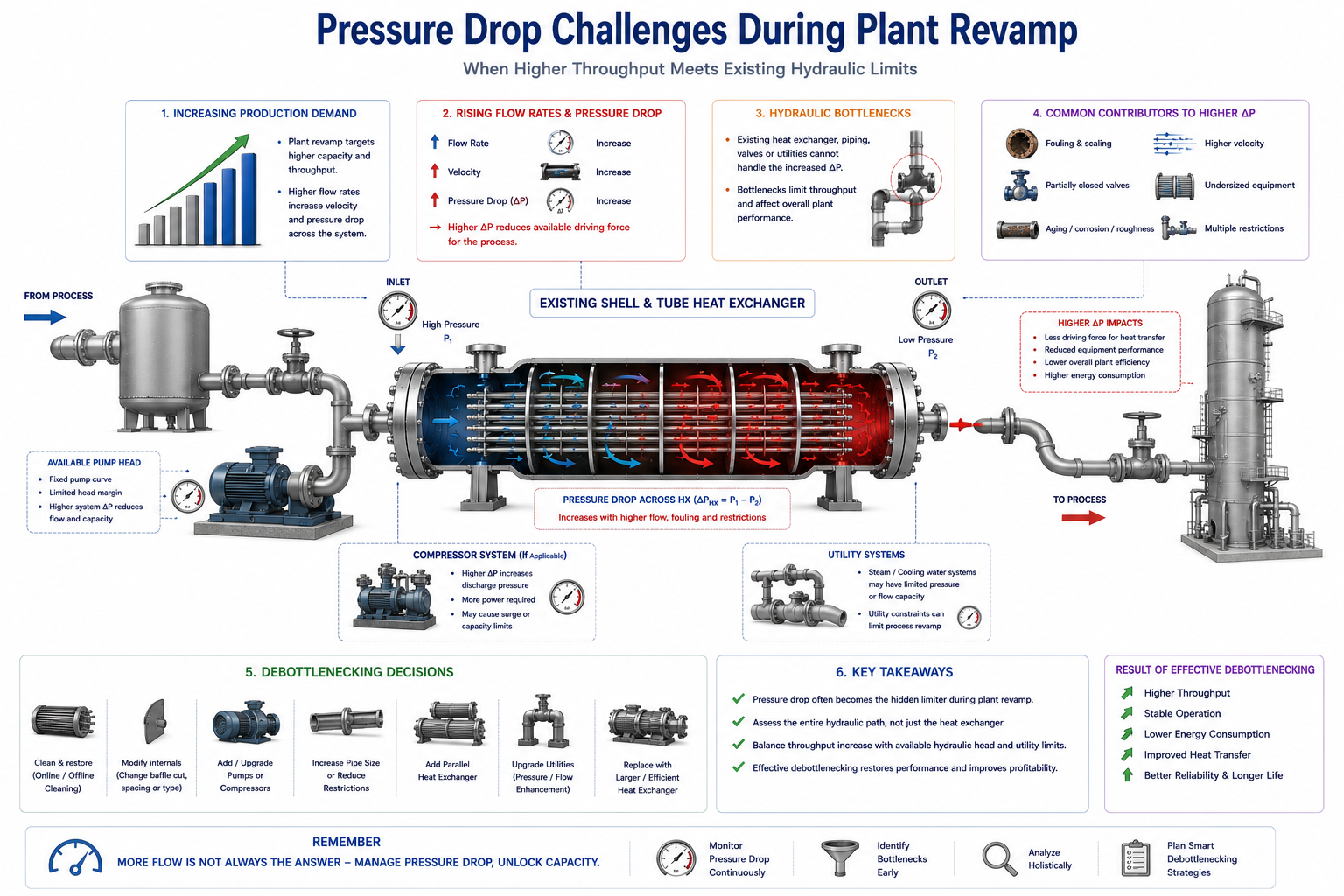
A heat exchanger that performed perfectly when the plant was commissioned may become a hydraulic bottleneck during a revamp. In most plant expansion projects, heat transfer is only part of the challenge. Increased flow rates often push the exchanger beyond its original pressure drop limits, making hydraulic performance one of the first constraints engineers must evaluate before increasing production.
Most industrial heat exchangers are designed for a specific operating capacity based on the process requirements at the time of the project.
Years later, those requirements often change.
A refinery increases crude throughput.
A pharmaceutical plant expands production.
A chemical plant introduces a new product grade.
A fertilizer plant undergoes debottlenecking.
In many cases, engineers initially assume that the existing heat exchanger simply needs to transfer more heat.
However, the first limitation encountered is frequently not thermal performance but hydraulic performance.
As process flow increases, pressure drop rises much faster than many engineers expect. Pumps begin operating closer to their limits, compressors require more energy, and control valves lose available pressure.
An exchanger that once operated comfortably within its hydraulic limits may suddenly become the restricting element in the entire process.
Understanding these hydraulic challenges before implementing a plant revamp helps engineers avoid expensive modifications, production delays, and unexpected operating problems.
Table of Contents
Why Plant Revamps Create Hydraulic Challenges
Most revamps increase flow rates, and higher flow almost always means higher pressure drop.
The objective of many revamp projects is straightforward:
Produce more product using as much of the existing equipment as possible.
For a heat exchanger, higher production generally means:
- higher process flow,
- greater heat duty,
- increased utility demand.
While the exchanger may still possess sufficient heat transfer area, its hydraulic capacity may already be close to the original design limit.
Even a moderate increase in flow can significantly increase:
- tube-side pressure drop,
- shell-side pressure drop,
- pumping requirements,
- compressor loading.
Hydraulic performance therefore becomes one of the first parameters reviewed during every revamp study.
Existing Exchangers Were Designed for Different Conditions
The original design basis may no longer represent current plant operation.
When the exchanger was originally designed, engineers selected:
- design flow rates,
- allowable pressure drop,
- utility conditions,
- process properties.
Years later, many of these assumptions have changed.
Examples include:
- higher production targets,
- different feed composition,
- modified utility systems,
- new operating philosophy.
Although the exchanger itself has not changed, the process surrounding it has evolved.
Hydraulic limitations that were insignificant during the original project may now become major operational constraints.
Pressure Drop Increases Faster Than Production
A small increase in production can create a disproportionately larger increase in hydraulic resistance.
One common misunderstanding during revamps is assuming that a 10% increase in production produces approximately a 10% increase in pressure drop.
In reality, hydraulic resistance often increases much more rapidly because higher flow produces:
- higher velocity,
- greater friction,
- increased turbulence,
- larger local losses.
As a result:
- pumps consume more power,
- differential pressure rises,
- available system pressure decreases.
This explains why exchangers often become hydraulic bottlenecks before they become thermal bottlenecks.
Pumps May Reach Their Operating Limits
The exchanger cannot be evaluated independently of the pumping system.
Higher exchanger pressure drop directly affects pump performance.
During revamp studies, engineers evaluate whether existing pumps can still provide:
- required flow,
- sufficient discharge pressure,
- acceptable operating margin.
If pump capability is already close to its limit, increasing exchanger pressure drop may result in:
- reduced process flow,
- operation away from the Best Efficiency Point (BEP),
- higher motor loading,
- reduced pump reliability.
In some revamp projects, replacing the pump becomes more expensive than modifying the exchanger itself.
Compressors Can Also Become Hydraulically Limited
Gas systems are often even more sensitive to pressure drop than liquid systems.
In gas services, additional pressure loss reduces the pressure available to downstream equipment.
Consequences may include:
- lower compressor capacity,
- increased compression ratio,
- higher power consumption,
- reduced process efficiency.
For low-pressure gas systems, even relatively small increases in exchanger pressure drop may significantly affect plant operation.
Fouling Reduces Available Hydraulic Margin
Older exchangers rarely operate under clean design conditions.
A revamp typically evaluates equipment that has already been operating for many years.
During that time:
- fouling develops,
- corrosion products accumulate,
- flow passages become partially restricted.
The exchanger therefore begins the revamp with less available hydraulic capacity than it had when originally commissioned.
Ignoring this condition often produces overly optimistic revamp calculations.
Experienced engineers review historical operating data before assuming the exchanger can accommodate higher flow.
Utility Systems May Also Become Limiting
Increasing process capacity affects both process fluids and utilities.
Higher production usually requires:
- more cooling water,
- more steam,
- greater condensate flow,
- higher air-cooler capacity.
These utility systems have their own hydraulic limitations.
Even if the exchanger itself can tolerate additional pressure drop, the utility network may not.
Successful revamp studies therefore evaluate the entire hydraulic system rather than only the exchanger.
Existing Exchanger Geometry Cannot Be Changed Easily
Unlike a new design, a revamp must work within physical limitations.
During a greenfield project, engineers can modify:
- shell diameter,
- tube count,
- tube length,
- baffle arrangement,
- nozzle sizes.
During a revamp, the exchanger already exists.
Its physical dimensions are fixed.
Available modifications may therefore be limited to:
- cleaning,
- retubing,
- changing baffle spacing,
- replacing the tube bundle,
- installing a new exchanger in parallel,
- replacing the exchanger entirely.
These practical constraints often determine the final revamp strategy.
Thermal Rating Becomes More Important Than Thermal Design
Revamps usually begin by evaluating the performance of the existing exchanger rather than designing a new one.
Unlike greenfield projects, revamp studies typically start with a thermal rating.
Engineers compare:
- current operating conditions,
- existing exchanger geometry,
- expected future operating conditions.
The objective is to determine:
- whether the exchanger can meet the new duty,
- whether pressure drop remains acceptable,
- what modifications, if any, are required.
This evaluation frequently identifies hydraulic limitations before thermal limitations.
Common Revamp Solutions for Pressure Drop Problems
There is rarely a single solution to hydraulic limitations.
Depending on the process, engineers may consider:
- installing a larger exchanger,
- adding another exchanger in parallel,
- replacing the tube bundle,
- modifying tube passes,
- changing baffle spacing,
- increasing pump capacity,
- upgrading utility systems.
The preferred solution depends on:
- available plot space,
- shutdown duration,
- project budget,
- long-term operating strategy.
Each option involves balancing capital investment against future operating benefits.
Hydraulic Flexibility Should Be Considered During Original Design
Today’s spare hydraulic capacity may become tomorrow’s production opportunity.
Plants rarely remain at their original production level throughout their operating life.
If future expansion is reasonably expected, experienced designers often consider providing modest hydraulic flexibility.
This does not mean excessive oversizing.
It means avoiding designs that operate at the absolute hydraulic limit on the first day of operation.
Reasonable flexibility often simplifies future revamps and reduces lifecycle cost.
Common Mistakes During Revamp Studies
Many revamp problems result from evaluating only thermal performance.
Assuming Existing Equipment Has Spare Capacity
An exchanger that appears thermally adequate may already be hydraulically limited.
Both aspects must be evaluated.
Ignoring Historical Pressure Drop Trends
Current differential pressure often reveals how much hydraulic margin remains.
Ignoring historical operating data may produce unrealistic revamp expectations.
Evaluating Only the Heat Exchanger
Pressure drop affects:
- pumps,
- compressors,
- control valves,
- upstream equipment,
- downstream equipment.
The complete hydraulic system should always be reviewed.
Assuming Cleaning Solves Every Problem
Cleaning may temporarily reduce pressure drop.
However, if the exchanger was originally undersized for the new production rate, cleaning alone will not eliminate the hydraulic limitation.
Operator Perspective
Operators are often the first to recognize that an exchanger is limiting increased production.
Typical observations include:
- pumps operating at higher load,
- increasing differential pressure,
- reduced process flow,
- inability to achieve target production,
- unstable control valves.
These symptoms frequently appear during production increases and provide valuable information during revamp planning.
Owner Perspective
A successful revamp improves production without creating long-term operating penalties.
For plant owners, evaluating hydraulic performance before increasing production helps achieve:
- reliable capacity expansion,
- lower project risk,
- reduced energy consumption,
- fewer unexpected shutdowns,
- better return on investment.
Spending time on hydraulic evaluation during the engineering phase is usually far less expensive than correcting hydraulic bottlenecks after startup.
Final Perspective
Plant revamps are rarely limited by heat transfer alone.
As production increases, pressure drop often becomes the first parameter to reach its allowable limit.
An exchanger that once met every design requirement may no longer provide sufficient hydraulic capacity for expanded plant operation.
Successful revamp projects therefore begin by asking two questions:
- Can the existing exchanger transfer the additional heat?
- Can the existing hydraulic system handle the additional flow?
Only when both answers are yes can a revamp deliver sustainable production increases without introducing new operating constraints.
Explore the complete series in the Heat Exchanger Engineering Hub.
A practicing chemical engineer with 17+ years of experience in process design, project execution, commissioning, and plant operations. Focused on practical engineering judgment beyond textbook explanations.