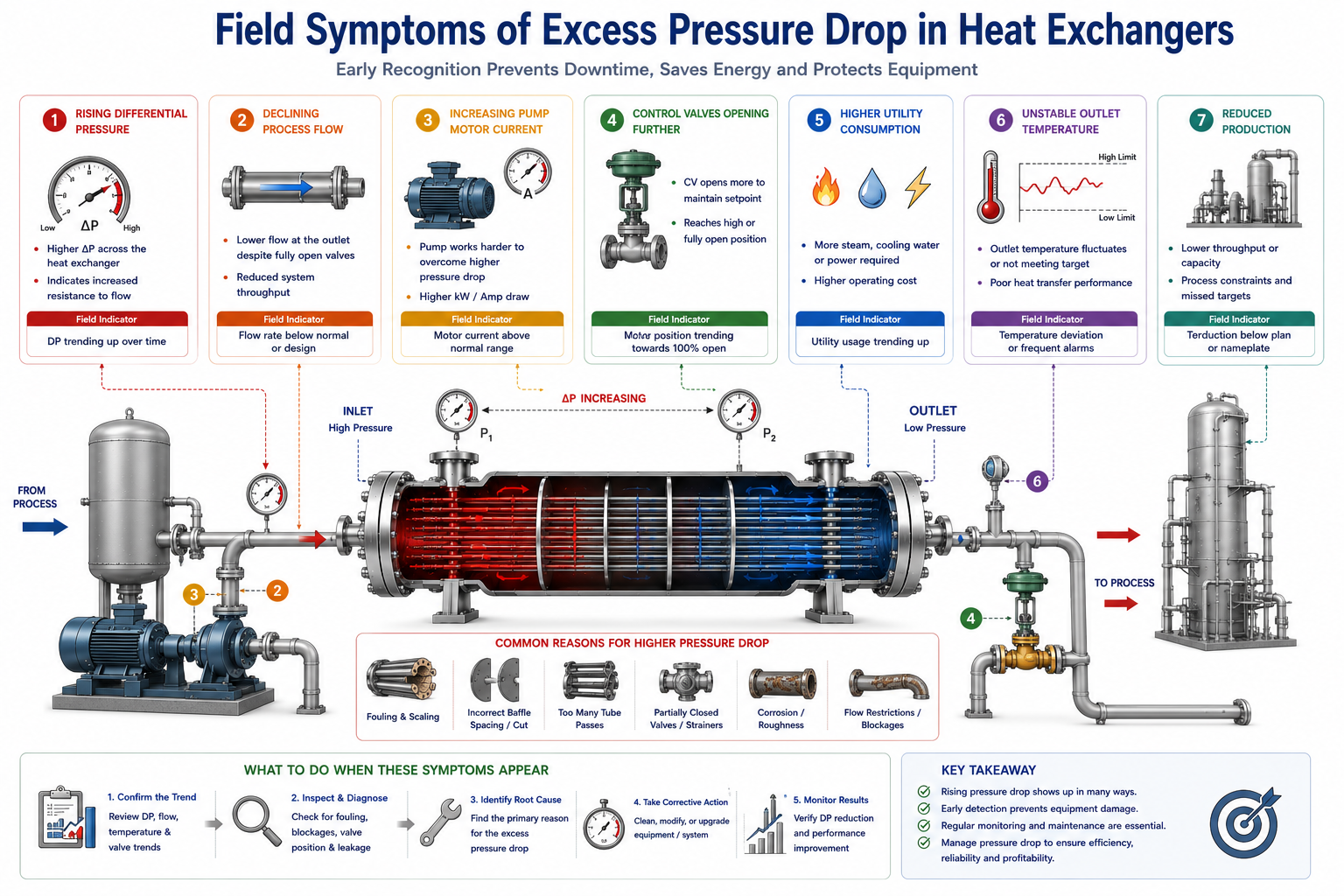
Excess pressure drop rarely appears as a single alarm in the control room. Instead, it reveals itself through a combination of operational symptoms such as declining flow, rising pump power, unstable temperatures, and reduced production. Recognizing these field symptoms early allows engineers and operators to solve hydraulic problems before they develop into major reliability or production issues.
A heat exchanger does not suddenly fail because its pressure drop becomes too high.
In most cases, hydraulic problems develop gradually.
A small increase in differential pressure may go unnoticed for weeks.
Operators compensate by opening control valves further.
Pump current slowly rises.
Cooling performance begins to deteriorate.
Eventually, production targets become difficult to achieve.
At this stage, the heat exchanger is often blamed for “poor performance.”
In reality, the exchanger has usually been providing warning signs for a long time.
Experienced operators rarely diagnose excessive pressure drop by looking only at one pressure gauge.
Instead, they observe changes throughout the process:
- process flow,
- pump behaviour,
- utility consumption,
- outlet temperatures,
- control valve position,
- differential pressure trends.
These operating observations often identify hydraulic problems much earlier than shutdown inspections.
This article explains the most common field symptoms of excessive pressure drop and how they help engineers distinguish hydraulic problems from purely thermal issues.
Table of Contents
Increasing Differential Pressure Across the Exchanger
A gradual rise in differential pressure is usually the earliest indication that hydraulic resistance is increasing.
The most direct way to identify excessive pressure drop is by monitoring:
- inlet pressure,
- outlet pressure,
- differential pressure.
When the exchanger is clean, differential pressure normally remains close to its expected operating value.
As fouling develops or flow restrictions increase:
- pressure loss gradually rises,
- available hydraulic margin decreases.
Trending differential pressure over time often provides valuable information long before production is affected.
This is why many plants routinely monitor exchanger differential pressure.
Declining Process Flow Without Equipment Changes
Reduced flow is often the first operating consequence of excessive pressure drop.
Suppose the upstream pump and downstream process remain unchanged.
If exchanger pressure drop increases, the available pressure driving the process decreases.
Operators may observe:
- lower process flow,
- slower filling rates,
- reduced circulation,
- declining production.
Because these changes occur gradually, they are sometimes mistaken for pump problems.
In reality, the exchanger may simply be creating more hydraulic resistance than before.
Rising Pump Motor Current
Higher pressure drop forces pumps to work harder to maintain the same flow.
As exchanger resistance increases, centrifugal pumps require more energy.
Control room operators may notice:
- increasing motor current,
- higher power consumption,
- reduced operating margin,
- pump running closer to its design limit.
These symptoms often develop before noticeable changes in heat transfer occur.
For this reason, pump operating data frequently provide early warning of hydraulic deterioration.
Control Valves Operating Near Fully Open Position
A control valve that gradually opens further may be compensating for increasing exchanger resistance.
Automatic control systems continuously attempt to maintain the required process flow.
As pressure drop increases, control valves may progressively open wider.
Eventually:
- the valve approaches its fully open position,
- flow can no longer be maintained,
- production begins to decrease.
Operators sometimes investigate the control valve itself.
However, the real cause may lie inside the heat exchanger.
Higher Utility Consumption
Plants often compensate for declining exchanger performance by using more utilities.
When hydraulic restrictions reduce effective heat transfer, operators frequently increase utility flow.
Examples include:
- higher cooling water flow,
- increased steam consumption,
- greater chilled water demand.
Initially, this may restore process temperatures.
Eventually, utility systems also approach their operating limits.
Higher utility consumption therefore becomes an indirect indicator that exchanger performance is deteriorating.
Outlet Temperatures Begin to Drift
Temperature changes often appear after hydraulic problems have already developed.
As pressure drop increases because of fouling or flow restriction:
- process flow may decrease,
- heat transfer becomes less effective,
- outlet temperatures gradually deviate from design values.
Typical observations include:
- hotter product leaving a cooler,
- colder product leaving a heater,
- reduced condenser performance,
- unstable reactor temperature.
Although these appear to be thermal problems, the underlying cause may be hydraulic.
Production Capacity Gradually Declines
Many exchangers become hydraulic bottlenecks before they become thermal bottlenecks.
Operators may notice:
- inability to increase production,
- flow restrictions,
- reduced equipment capacity.
The heat exchanger still transfers heat.
However, excessive pressure drop limits how much fluid can pass through it.
This situation commonly occurs after years of operation or during plant revamps.
Frequent Pump Problems
Hydraulic restrictions inside the exchanger often affect rotating equipment throughout the process.
Increasing exchanger pressure drop may contribute to:
- frequent pump trips,
- unstable pump operation,
- cavitation risk,
- operation away from the Best Efficiency Point (BEP),
- increased maintenance.
Although the pump receives attention, the exchanger may be the component creating the additional hydraulic load.
Increasing Time Between Process Adjustments Becomes Shorter
Operators may find themselves making more frequent corrections to maintain stable operation.
When hydraulic conditions deteriorate:
- temperature control becomes less stable,
- flow fluctuates,
- process response becomes slower.
Operators compensate by making more frequent adjustments.
If these adjustments gradually become routine, the exchanger should be investigated as a possible source of hydraulic instability.
Fouling Often Produces Multiple Symptoms Together
One operating symptom rarely tells the complete story.
Consider an exchanger experiencing progressive fouling.
Operators may observe:
- increasing differential pressure,
- declining flow,
- rising pump current,
- increasing cooling water demand,
- higher outlet temperature.
Individually, each symptom may appear unrelated.
Together, they strongly suggest increasing hydraulic resistance inside the exchanger.
Looking for symptom patterns rather than isolated measurements often leads to faster troubleshooting.
Distinguishing Hydraulic Problems from Thermal Problems
Not every temperature problem originates from insufficient heat transfer area.
A useful troubleshooting question is:
Is the exchanger unable to transfer heat, or is it unable to pass enough fluid?
If pressure drop has increased significantly, the problem may be hydraulic rather than thermal.
Typical hydraulic indicators include:
- rising differential pressure,
- declining flow,
- increasing pump load,
- control valves approaching full open position.
Thermal problems without hydraulic changes often involve:
- incorrect utility temperature,
- process property changes,
- insufficient heat transfer area.
Separating these two possibilities speeds up root-cause analysis.
What Operators Should Check First
Simple operating data often reveal more than complex calculations.
Before assuming the exchanger requires replacement, operators should review:
- differential pressure trends,
- process flow history,
- pump current,
- utility consumption,
- inlet and outlet temperatures,
- recent production changes,
- maintenance history.
These records frequently identify whether the problem developed gradually or appeared suddenly.
That distinction helps narrow the possible causes.
Common Misunderstandings About Field Symptoms
Many operating problems are incorrectly attributed to equipment failure when the real issue is increasing hydraulic resistance.
“Higher Outlet Temperature Means the Exchanger Has Failed”
Not necessarily.
Reduced flow caused by excessive pressure drop may produce the same symptom.
“The Pump Is Drawing More Power, So the Pump Must Be Faulty”
The pump may simply be responding to increased hydraulic resistance elsewhere in the system.
“Opening the Control Valve Solves the Problem”
Opening the valve only compensates temporarily.
If exchanger pressure drop continues increasing, production will eventually be affected.
“Cleaning Should Wait Until Heat Transfer Declines”
Waiting for noticeable thermal deterioration often means hydraulic performance has already degraded significantly.
Differential pressure trends usually provide earlier warning.
Operator Perspective
Operators are the first line of defence against hydraulic deterioration.
By routinely monitoring:
- differential pressure,
- process flow,
- pump behaviour,
- utility usage,
- temperature trends,
operators can detect developing hydraulic problems long before they require emergency shutdowns.
Their observations are often more valuable than a single inspection during a planned maintenance outage.
Owner Perspective
Early identification of hydraulic problems protects both production and maintenance budgets.
For plant owners, recognizing field symptoms early helps achieve:
- fewer unplanned shutdowns,
- improved production reliability,
- lower energy consumption,
- better maintenance planning,
- longer exchanger service life.
Trend monitoring is usually one of the least expensive methods of improving exchanger reliability.
Final Perspective
Excess pressure drop rarely develops overnight.
It usually announces itself through a series of small operational changes that become more noticeable over time.
Increasing differential pressure.
Declining process flow.
Higher pump current.
Greater utility consumption.
Reduced production.
Individually, these symptoms may seem unrelated.
Together, they tell the story of an exchanger gradually losing its hydraulic performance.
The most successful plants do not wait until the exchanger becomes a bottleneck.
They monitor these field symptoms continuously, investigate changes early, and correct hydraulic problems before they affect safety, production, and profitability.
Explore the complete series in the Heat Exchanger Engineering Hub.
A practicing chemical engineer with 17+ years of experience in process design, project execution, commissioning, and plant operations. Focused on practical engineering judgment beyond textbook explanations.