
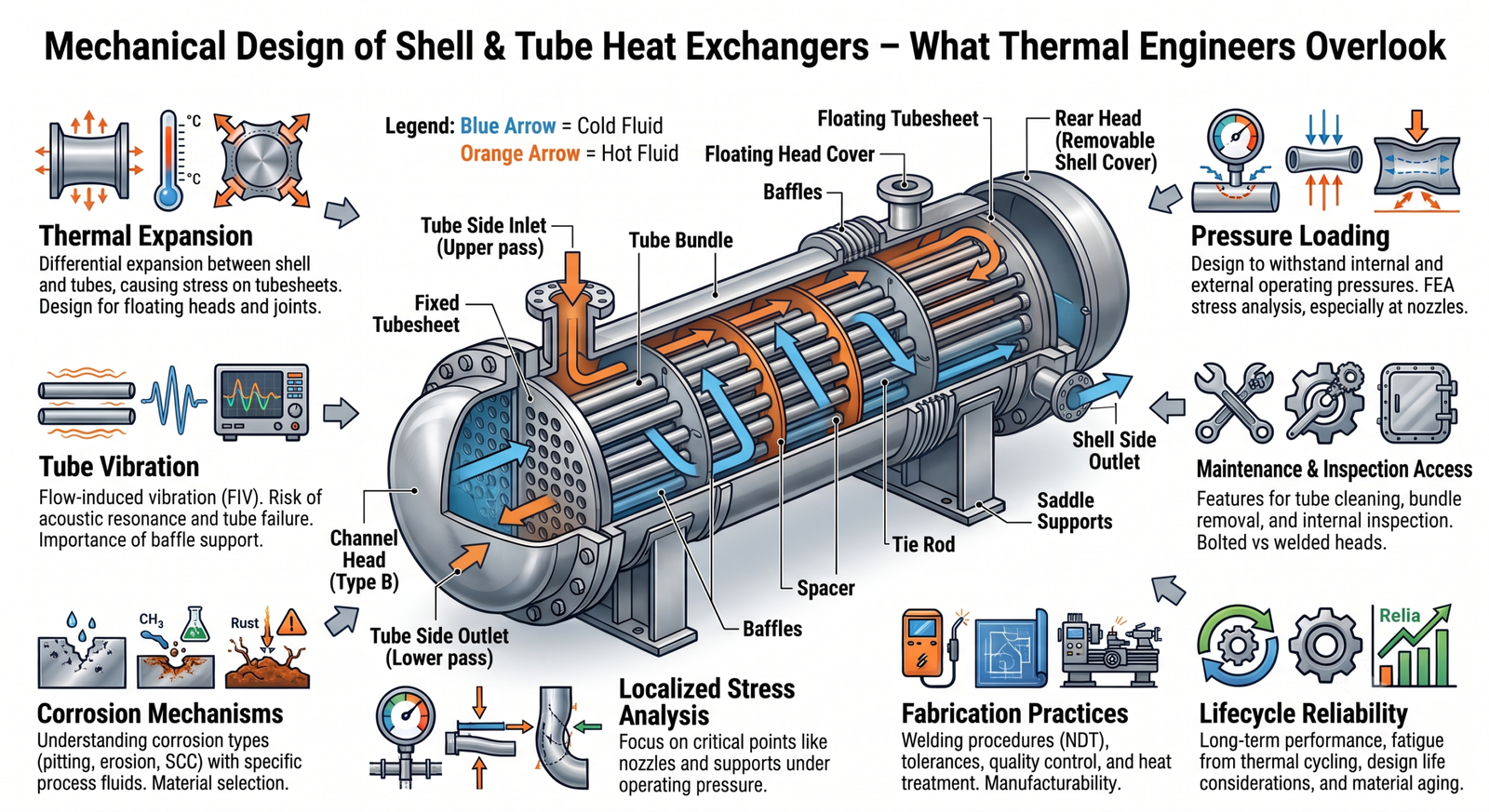
A shell-and-tube heat exchanger is considered successful only when its thermal, hydraulic, and mechanical designs work together. While thermal calculations determine how much heat can be transferred and hydraulic calculations ensure acceptable pressure drop, mechanical design determines whether the exchanger can survive decades of pressure, temperature changes, thermal expansion, vibration, corrosion, maintenance, and real plant operation. Understanding these mechanical aspects helps process engineers make better design decisions and avoid problems that calculations alone cannot predict.
A heat exchanger is often viewed as a piece of equipment whose primary purpose is to transfer heat from one process stream to another.
From a thermal engineer’s perspective, success is usually measured by parameters such as:
- heat duty,
- outlet temperatures,
- LMTD,
- overall heat transfer coefficient,
- pressure drop.
If all these values satisfy the process requirements, it is tempting to conclude that the exchanger has been successfully designed.
In reality, that conclusion is incomplete.
Many heat exchangers that are thermally perfect never achieve long-term operational success because their mechanical design cannot adequately handle the conditions encountered in the plant.
An exchanger may satisfy every thermal calculation but still fail because:
- tubes expand differently from the shell,
- excessive vibration damages the tubes,
- maintenance becomes impossible,
- materials are unsuitable for the service,
- internal components cannot withstand long-term operation.
This is why mechanical design is far more than the responsibility of mechanical engineers alone.
Process engineers who understand the mechanical limitations of heat exchangers make better equipment selections, review vendor documents more effectively, communicate more confidently with multidisciplinary teams, and avoid expensive problems during commissioning and operation.
This pillar introduces the mechanical engineering principles behind shell-and-tube heat exchangers from the perspective of a process engineer. Rather than focusing on detailed stress calculations or pressure vessel codes, it explains the practical mechanical decisions that influence reliability, maintainability, safety, lifecycle cost, and overall plant performance.
Table of Contents
Why Thermal Design Alone Does Not Guarantee a Successful Heat Exchanger
Meeting the required heat duty is only one requirement. The exchanger must also remain mechanically reliable throughout its operating life.
Imagine two shell-and-tube heat exchangers.
Both achieve:
- identical heat duty,
- identical outlet temperatures,
- acceptable pressure drop,
- identical overall heat transfer coefficient.
On paper, they appear equally successful.
Five years after startup, however, one exchanger continues operating with minimal maintenance while the other experiences:
- repeated tube failures,
- excessive vibration,
- leaking gaskets,
- thermal expansion problems,
- difficult maintenance,
- frequent shutdowns.
The thermal calculations were correct in both cases.
The difference lies in the mechanical design.
Mechanical design determines whether the exchanger can withstand years of real industrial operation—not merely perform well during the design calculations.
Mechanical Design Protects the Equipment Throughout Its Life
The shell-and-tube exchanger is also a pressure vessel subjected to continuous mechanical loading.
Unlike many pieces of process equipment, a heat exchanger simultaneously experiences:
- internal pressure,
- external loads,
- temperature differences,
- thermal expansion,
- cyclic operation,
- vibration,
- corrosion,
- maintenance activities.
Every operating day places mechanical stress on:
- the shell,
- tubes,
- tubesheets,
- baffles,
- supports,
- nozzles,
- gaskets.
Mechanical design ensures these components remain safe and reliable throughout thousands of operating hours.
Mechanical Design and Thermal Design Are Closely Connected
Many thermal decisions create mechanical consequences, and many mechanical decisions influence thermal performance.
Consider increasing tube length.
Thermally, longer tubes may:
- increase heat transfer area,
- improve exchanger effectiveness.
Mechanically, longer tubes may also:
- increase vibration risk,
- complicate bundle removal,
- increase fabrication challenges,
- require additional supports.
Similarly, reducing baffle spacing may:
Thermally:
- improve shell-side heat transfer.
Mechanically:
- increase pressure drop,
- increase vibration loading,
- complicate fabrication.
Successful exchanger design always balances these competing requirements.
Every Major Mechanical Component Exists for a Reason
The internal components of a shell-and-tube exchanger are not simply structural parts—they each solve a specific engineering problem.
For example:
Tubesheets:
- support the tubes,
- separate the two fluids,
- withstand pressure differences.
Baffles:
- support long tubes,
- reduce vibration,
- direct shell-side flow.
Tie rods and spacers:
- maintain baffle alignment,
- strengthen the tube bundle,
- preserve internal geometry.
Floating heads:
- accommodate thermal expansion,
- simplify maintenance.
Every component represents a solution to a specific mechanical challenge.
Understanding these purposes helps engineers appreciate why exchanger construction varies between services.
Mechanical Design Determines Maintenance Effort
An exchanger that performs well but cannot be maintained becomes an expensive operating problem.
Mechanical design influences maintenance through decisions such as:
- tube bundle removal,
- nozzle orientation,
- cleaning access,
- inspection space,
- lifting requirements.
During design, these considerations may seem secondary.
During a shutdown, they often become the most important factors affecting maintenance duration and cost.
Experienced engineers therefore evaluate maintainability during the design stage rather than after installation.
Material Selection Is More Than Corrosion Protection
Materials are selected to satisfy mechanical as well as chemical requirements.
Many engineers associate material selection primarily with corrosion resistance.
In reality, materials must also withstand:
- operating pressure,
- design temperature,
- thermal expansion,
- fabrication processes,
- welding,
- fatigue loading,
- long-term mechanical stress.
Choosing the correct material therefore requires balancing several engineering considerations rather than simply selecting the most corrosion-resistant alloy.
Thermal Expansion Is One of the Largest Mechanical Challenges
Different parts of the exchanger rarely expand by the same amount.
When the exchanger heats up:
- tubes expand,
- shells expand,
- tubesheets deform,
- supports experience additional loading.
If these movements are not accommodated, excessive stress may develop.
Mechanical solutions include:
- floating heads,
- U-tubes,
- expansion joints,
- flexible supports.
These features are not optional additions.
They are essential design solutions for managing thermal expansion safely.
Vibration Is Often an Invisible Failure Mechanism
Many tube failures develop gradually because of repeated vibration rather than excessive pressure or temperature.
High-velocity shell-side flow can produce:
- flow-induced vibration,
- tube wear,
- fatigue cracking,
- tube-to-baffle damage.
These failures often occur even though the exchanger operates within its thermal design conditions.
Proper mechanical design minimizes vibration by considering:
- tube support,
- baffle spacing,
- velocity,
- natural frequency.
Mechanical Design Influences Lifecycle Cost
The lowest purchase price rarely produces the lowest lifetime cost.
A mechanically robust exchanger may initially cost more because of:
- improved materials,
- floating heads,
- additional supports,
- better maintenance accessibility.
However, over twenty or thirty years of operation, these features often reduce:
- maintenance cost,
- shutdown duration,
- tube replacement,
- production losses,
- operating risk.
Lifecycle economics therefore favor well-engineered mechanical design rather than minimum capital cost.
Process Engineers Benefit from Understanding Mechanical Design
Process engineers do not need to perform mechanical stress calculations, but they should understand the engineering logic behind mechanical decisions.
This knowledge helps during:
- equipment specification,
- datasheet preparation,
- vendor discussions,
- HAZOP studies,
- design reviews,
- plant troubleshooting,
- revamp projects.
Understanding why a mechanical engineer recommends a floating head instead of a fixed tubesheet—or why additional bundle pull clearance is necessary—improves collaboration and leads to better engineering decisions.
Why This Knowledge Is Often Overlooked
Many process engineers interact with mechanical design without fully understanding its impact on exchanger performance.
University courses typically emphasize:
- heat transfer,
- fluid mechanics,
- thermodynamics.
Mechanical topics such as:
- tube support,
- vibration,
- fabrication,
- maintenance accessibility,
- thermal stress,
are often introduced only briefly.
In industry, however, these issues frequently determine whether a heat exchanger becomes a reliable asset or a recurring maintenance problem.
Understanding them bridges the gap between theoretical design and practical engineering.
Final Perspective
A shell-and-tube heat exchanger is much more than a device that transfers heat.
It is a mechanically engineered system designed to operate safely and reliably under demanding industrial conditions for many years.
Thermal calculations determine what the exchanger must achieve.
Hydraulic calculations determine how efficiently fluids can move through it.
Mechanical design determines whether the exchanger can continue achieving those objectives throughout its operating life.
The engineers who consistently deliver successful heat exchangers understand that thermal, hydraulic, and mechanical design are not separate disciplines.
They are three interconnected parts of the same engineering solution.
Explore the complete series in the Heat Exchanger Engineering Hub.

A practicing chemical engineer with 17+ years of experience in process design, project execution, commissioning, and plant operations. Focused on practical engineering judgment beyond textbook explanations.