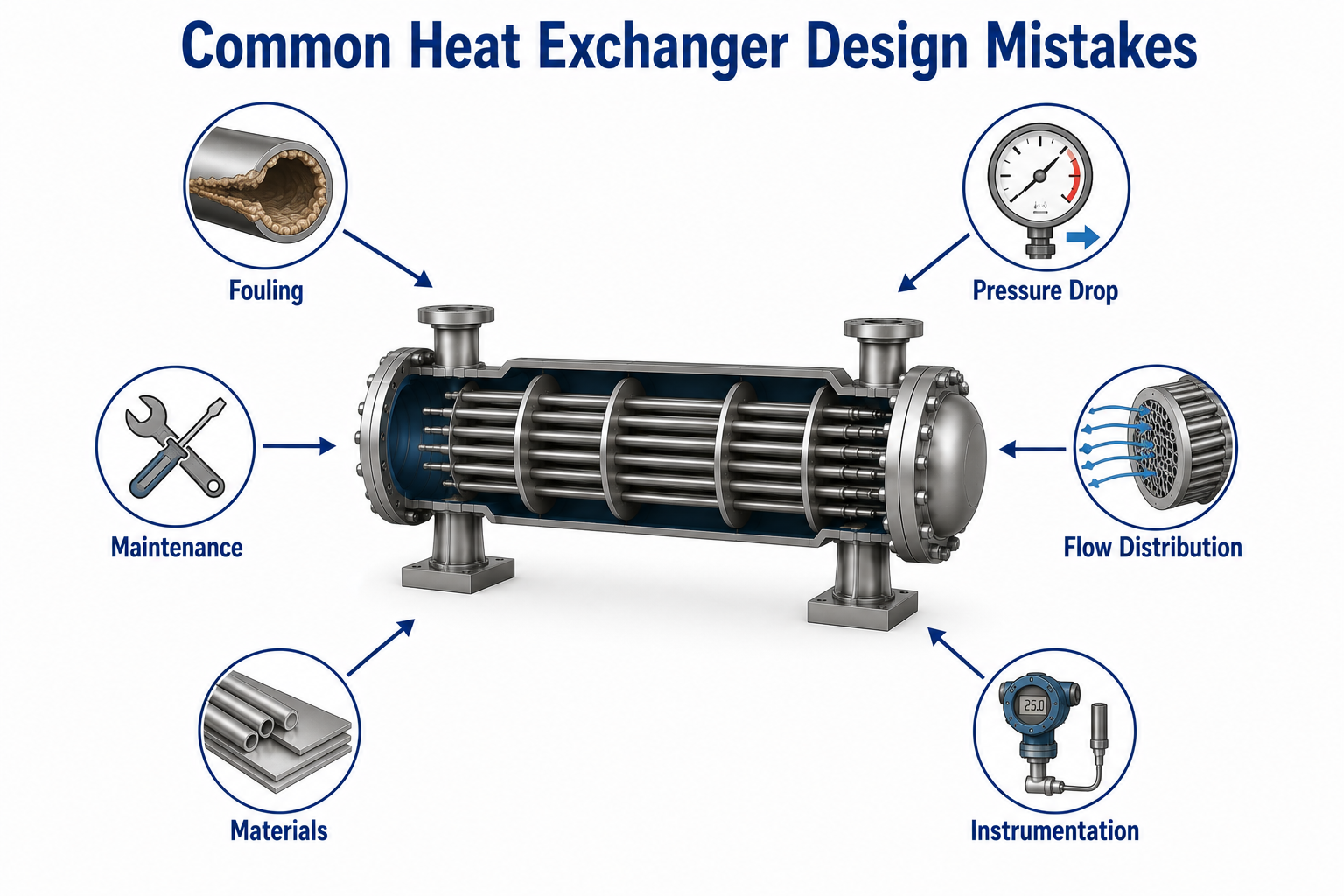
A heat exchanger may comply with design codes, satisfy thermal calculations, and pass factory testing, yet still create persistent operating problems because of avoidable design mistakes. In industry, poor exchanger performance is often not caused by a single major error but by a series of small engineering decisions that overlook maintenance, process variability, hydraulic balance, or long-term operation. Recognizing these common design mistakes helps engineers build heat exchangers that perform reliably throughout their entire service life rather than only under ideal design conditions.
Every heat exchanger begins its life on an engineer’s drawing board.
During design, engineers carefully calculate:
- heat duty,
- heat transfer area,
- pressure drop,
- allowable velocity,
- mechanical strength,
- material compatibility.
Modern design software performs thousands of calculations within seconds.
Industry standards provide detailed guidance.
Experienced engineers review the final design.
Despite all of this, operating plants continue to experience exchangers that:
- never achieve design duty,
- foul rapidly,
- require frequent cleaning,
- develop excessive pressure drop,
- become difficult to maintain,
- consume more utilities than expected.
These problems rarely result from poor engineering knowledge.
More often, they occur because the design focused primarily on achieving thermal performance under design conditions while underestimating the realities of long-term plant operation.
Good heat exchanger design is therefore much more than solving thermal equations.
It requires anticipating how the exchanger will behave after years of continuous industrial service.
Table of Contents
Mistake 1: Designing Only for Clean Operating Conditions
The biggest design mistake is assuming the exchanger will continue operating under clean conditions throughout its life.
Thermal calculations typically begin with:
- clean surfaces,
- ideal flow distribution,
- expected fluid properties.
However, operating plants experience:
- fouling,
- corrosion,
- process variation,
- equipment ageing.
Designs that leave little performance margin often lose effectiveness rapidly as operating conditions change.
Successful designs recognize that performance gradually deteriorates and provide sufficient flexibility for long-term operation.
Mistake 2: Underestimating Process Variability
Many exchangers are designed for one operating point even though the plant rarely operates there continuously.
Actual plants experience:
- varying production rates,
- changing feed composition,
- seasonal utility temperatures,
- product campaign changes,
- startup and shutdown cycles.
If the exchanger performs well only at one design condition, it may struggle throughout normal plant operation.
Design should consider the expected operating range rather than only the design point.
Mistake 3: Focusing Only on Thermal Performance
Excellent heat transfer does not always produce the best exchanger.
An exchanger with maximum heat transfer may also experience:
- excessive pressure drop,
- difficult maintenance,
- higher pumping costs,
- increased fouling,
- vibration problems.
Thermal optimization should always be balanced against:
- hydraulic performance,
- mechanical reliability,
- operating flexibility,
- lifecycle cost.
The most efficient thermal design is not always the most successful plant design.
Mistake 4: Ignoring Maintenance Requirements
An exchanger that is difficult to clean eventually becomes expensive to own.
Common maintenance-related design oversights include:
- insufficient bundle removal space,
- inaccessible channel covers,
- inadequate lifting clearance,
- difficult tube access,
- poor isolation arrangements.
Although these decisions may reduce initial installation cost, they often increase maintenance time during every future shutdown.
Designing for maintenance should begin during equipment layout—not after construction.
Mistake 5: Selecting Inappropriate Fluid Velocity
Fluid velocity influences both heat transfer and long-term reliability.
Low velocity may encourage:
- fouling,
- sediment deposition,
- poor heat transfer.
Excessively high velocity may increase:
- erosion,
- vibration,
- pressure drop,
- pumping cost.
Good engineering identifies the velocity range that balances thermal performance with long-term equipment reliability.
Mistake 6: Inadequate Consideration of Thermal Expansion
Temperature differences create mechanical forces that must be accommodated safely.
Ignoring thermal expansion may result in:
- tubesheet stress,
- shell distortion,
- gasket leakage,
- tube failure,
- fatigue damage.
Selecting the appropriate exchanger configuration—such as floating head or U-tube construction where necessary—helps accommodate differential expansion and improves long-term reliability.
Mistake 7: Choosing Materials Based Only on Initial Cost
The least expensive material is not always the most economical choice.
Material selection should consider:
- corrosion resistance,
- erosion resistance,
- process chemistry,
- cleaning methods,
- expected service life,
- maintenance cost.
Choosing materials solely to reduce procurement cost may significantly increase lifecycle expenses.
Mistake 8: Poor Flow Distribution
Uneven flow reduces both thermal efficiency and equipment life.
Poor distribution may create:
- stagnant regions,
- localized fouling,
- hot spots,
- excessive vibration,
- uneven tube loading.
Good nozzle design, appropriate baffle arrangement, and proper channel geometry help ensure uniform flow throughout the exchanger.
Mistake 9: Neglecting Future Process Expansion
Many exchangers become undersized because plants grow beyond their original design capacity.
Years after commissioning, production often increases.
The original exchanger may then become:
- thermally overloaded,
- hydraulically restricted,
- difficult to debottleneck.
Considering potential future expansion during design may significantly reduce later modification costs.
Mistake 10: Designing Without Considering Instrumentation
Reliable operation depends on accurate performance monitoring.
Some exchanger installations lack sufficient instrumentation to monitor:
- inlet temperatures,
- outlet temperatures,
- differential pressure,
- utility flow,
- process flow.
Without reliable measurements, engineers struggle to identify developing performance problems.
Instrumentation should therefore be considered part of the exchanger design rather than an afterthought.
Mistake 11: Treating Every Service the Same
Successful exchanger design always reflects the specific process service.
For example:
A refinery exchanger handling crude oil requires different design priorities than:
- an API reactor cooler,
- a pharmaceutical water heater,
- a cooling water exchanger,
- a food processing heat recovery unit.
Using standard designs without considering service-specific conditions frequently leads to unnecessary operating problems.
Mistake 12: Optimizing Initial Cost Instead of Lifecycle Cost
The lowest purchase price rarely produces the lowest total ownership cost.
Lifecycle cost includes:
- utility consumption,
- maintenance,
- cleaning,
- production losses,
- spare parts,
- equipment availability.
Design decisions should therefore evaluate long-term economic performance rather than procurement cost alone.
Characteristics of Well-Designed Heat Exchangers
Successful exchangers balance multiple engineering objectives simultaneously.
Good industrial designs generally provide:
- reliable thermal performance,
- acceptable pressure drop,
- effective fouling management,
- easy maintenance access,
- suitable materials,
- operating flexibility,
- reliable instrumentation,
- long service life.
No single parameter should dominate the design process.
Instead, the exchanger should satisfy the overall needs of the process plant throughout its lifecycle.
Common Misunderstandings About Heat Exchanger Design
Many operating problems originate from unrealistic expectations established during design.
“If the Thermal Calculations Are Correct, the Design Is Complete”
Thermal calculations represent only one aspect of successful exchanger design.
Mechanical, hydraulic, operational, and maintenance considerations are equally important.
“More Heat Transfer Area Always Improves Performance”
Additional surface area may increase:
- equipment size,
- capital cost,
- maintenance effort,
- pressure drop.
Proper optimization is more valuable than simply increasing area.
“Meeting the Datasheet Guarantees Good Plant Performance”
Datasheets define expected operating conditions.
Real plants frequently operate outside those conditions.
Successful designs accommodate operational variability rather than relying solely on ideal assumptions.
“Maintenance Can Solve Design Problems Later”
Good maintenance improves equipment condition but cannot fully compensate for:
- poor accessibility,
- incorrect materials,
- inadequate hydraulic design,
- insufficient operating flexibility.
Many design decisions remain permanent throughout the exchanger’s life.
Operator Perspective
Operators experience the consequences of design decisions every day.
Design choices affecting:
- cleaning accessibility,
- operating flexibility,
- instrumentation quality,
- pressure drop,
directly influence the ease with which operators maintain stable and efficient plant performance.
Designing with the operator in mind improves both safety and reliability.
Owner Perspective
For plant owners, successful design minimizes total lifecycle cost rather than initial procurement cost.
Well-designed exchangers provide:
- lower utility consumption,
- reduced maintenance,
- fewer shutdowns,
- improved reliability,
- greater production availability,
- longer equipment life.
The financial benefits of good engineering often continue for decades after installation.
Final Perspective
Most heat exchanger problems do not begin during operation—they begin during design.
A decision that appears minor on a drawing, such as tube velocity, bundle accessibility, material selection, or nozzle arrangement, may influence maintenance effort, operating cost, and reliability for the next twenty years.
The most successful engineers therefore design with the operating plant in mind rather than focusing only on design calculations.
They recognize that thermal performance is only one measure of success.
A truly successful heat exchanger is one that continues to deliver reliable, economical, and maintainable performance despite changing process conditions, inevitable fouling, and the practical realities of industrial operation.
Ultimately, the best heat exchanger design is not the one that performs perfectly on paper—it is the one that continues performing effectively long after the project has been handed over to the operating plant.
Explore the complete series in the Heat Exchanger Engineering Hub.

A practicing chemical engineer with 17+ years of experience in process design, project execution, commissioning, and plant operations. Focused on practical engineering judgment beyond textbook explanations.