Many heat exchanger performance problems originate during startup rather than after years of operation. Even a well-designed and correctly installed exchanger can experience premature fouling, thermal stress, mechanical damage, or unstable performance if startup is not properly planned and executed. Because startup establishes the exchanger’s initial operating condition, mistakes made during the first few hours or days can influence reliability, efficiency, and maintenance requirements throughout its service life. Understanding common startup problems helps engineers commission heat exchangers safely and achieve stable long-term operation.
Completing construction does not mean a heat exchanger is ready for successful operation.
Before entering routine service, every exchanger passes through one of the most critical phases of its lifecycle—startup.
During this period:
- equipment experiences its first thermal expansion,
- process fluids begin flowing,
- utilities are introduced,
- control systems are tuned,
- operators establish normal operating conditions.
Unlike steady-state operation, startup involves rapidly changing temperatures, pressures, and flow rates.
These transient conditions create challenges that are not fully represented in thermal design calculations.
If startup is rushed or poorly controlled, problems may appear immediately or develop gradually over the following months.
Examples include:
- excessive thermal stress,
- tube leakage,
- vibration,
- unstable temperature control,
- rapid fouling,
- failure to achieve design duty.
For this reason, experienced engineers treat startup as an engineering activity requiring careful planning rather than simply the beginning of production.
Table of Contents
Why Startup Is More Challenging Than Normal Operation
During startup, almost every operating parameter changes simultaneously.
Unlike stable plant operation, startup involves:
- increasing process flow,
- changing temperatures,
- varying pressures,
- fluctuating utility demand,
- control loop adjustments,
- operator intervention.
These changing conditions make heat transfer behavior far more complex than during normal operation.
Small mistakes during this period may create long-term operating problems.
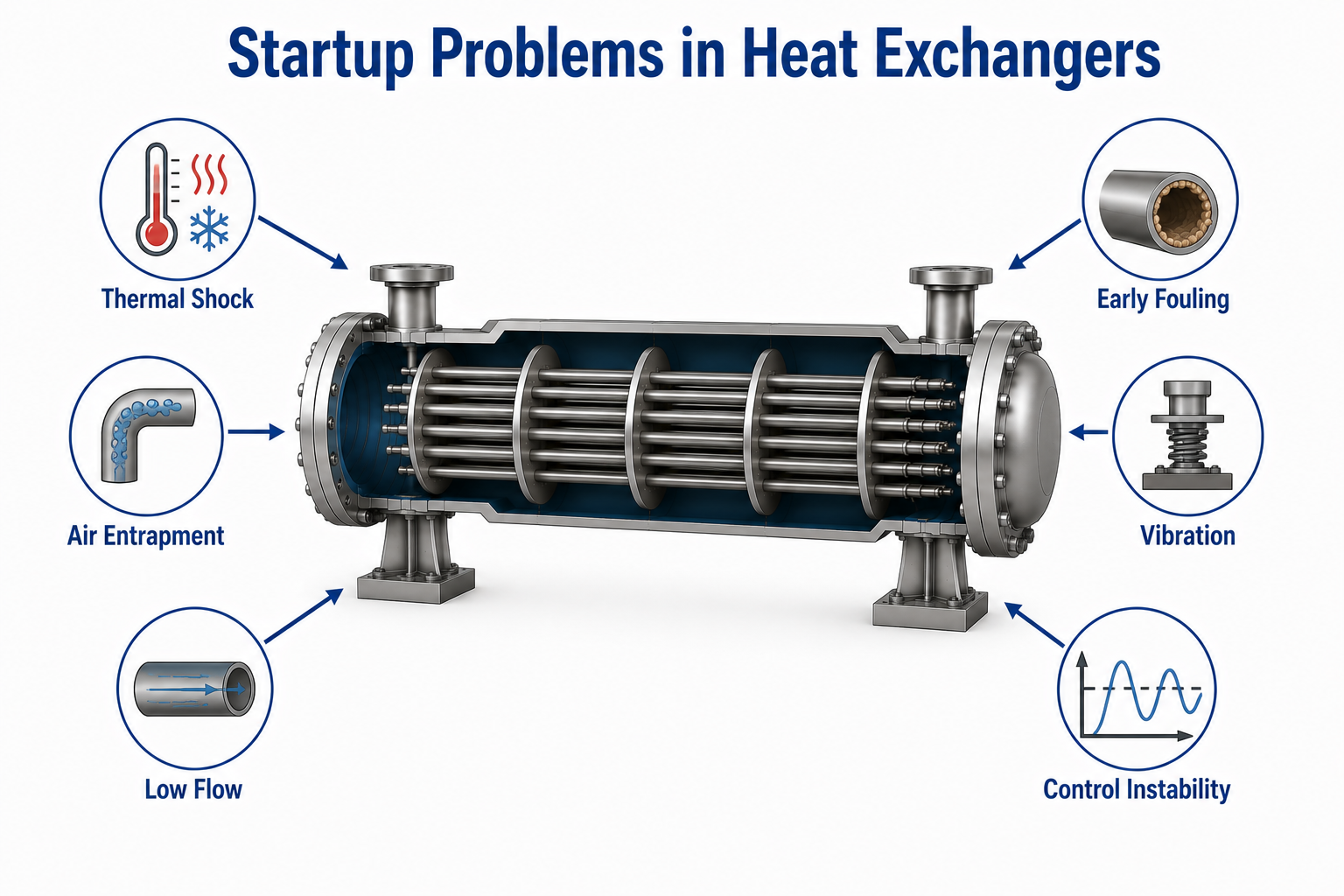
Problem 1: Excessive Thermal Shock
Rapid temperature changes create large thermal stresses within the exchanger.
When hot fluid is introduced into cold equipment too quickly:
- shell and tubes expand at different rates,
- tubesheets experience high stress,
- gaskets may leak,
- mechanical distortion may occur.
The risk is particularly significant for shell-and-tube exchangers handling large temperature differences.
Good Engineering Practice
Introduce hot and cold fluids gradually.
Allow equipment temperature to stabilize before increasing flow to full operating conditions.
Problem 2: Air Entrapment Inside the Exchanger
Air pockets reduce heat transfer and may create unstable operation.
During startup, trapped air may:
- reduce effective heat transfer area,
- interrupt fluid circulation,
- cause temperature fluctuations,
- promote localized corrosion.
Air accumulation is particularly common after maintenance shutdowns.
Good Engineering Practice
Properly vent the exchanger before establishing normal flow.
Confirm that vents remain open until air has been completely removed.
Problem 3: Inadequate Flow During Initial Heating
Low flow rates combined with high temperatures create unfavorable operating conditions.
Insufficient circulation may result in:
- localized overheating,
- poor temperature distribution,
- increased fouling,
- thermal degradation of process fluids.
Some operators attempt to reduce flow to simplify startup.
This often creates more problems than it solves.
Good Engineering Practice
Maintain the minimum recommended circulation while gradually increasing temperature.
Problem 4: Utility Introduced Before Process Flow
Applying heating or cooling utilities before process flow is established can damage equipment and reduce performance.
Examples include:
- admitting steam before process liquid enters,
- starting chilled water before circulation begins,
- applying hot oil without adequate process flow.
These situations may create:
- severe thermal gradients,
- localized boiling,
- freezing,
- unnecessary thermal stress.
Good Engineering Practice
Whenever possible, establish stable process flow before introducing utilities.
Follow the approved startup sequence developed during commissioning.
Problem 5: Unstable Temperature Control
Control systems often require adjustment during startup.
Initially, controllers operate under rapidly changing conditions.
Common issues include:
- excessive control valve movement,
- temperature oscillations,
- unstable outlet temperatures,
- frequent operator intervention.
These conditions may be mistaken for equipment problems.
In many cases, the exchanger performs correctly while the control system requires tuning.
Good Engineering Practice
Allow process conditions to stabilize before making significant controller adjustments.
Problem 6: Early Fouling During Startup
Some exchangers begin fouling within the first few hours of operation.
Possible reasons include:
- construction debris,
- process contamination,
- stagnant flow,
- low operating velocity,
- unstable temperatures.
Early deposits frequently become the foundation for more severe fouling later in the operating cycle.
Good Engineering Practice
Flush systems thoroughly before startup and establish stable operating conditions as quickly as practical.
Problem 7: Unexpected Pressure Drop
Pressure drop during startup may differ significantly from design expectations.
Possible causes include:
- partially closed valves,
- temporary strainers,
- trapped air,
- debris,
- incorrect flow paths.
Without investigation, operators may incorrectly conclude that the exchanger has become fouled.
Good Engineering Practice
Verify valve positions, remove temporary restrictions when appropriate, and confirm flow paths before diagnosing exchanger problems.
Problem 8: Vibration During Startup
Flow-induced vibration often appears during transient operating conditions.
Rapid changes in:
- flow rate,
- fluid density,
- vapor formation,
- operating pressure,
may temporarily excite tube vibration.
Although vibration sometimes disappears after stable operation is achieved, persistent vibration requires investigation.
Good Engineering Practice
Monitor abnormal noise and vibration throughout commissioning rather than assuming they will disappear automatically.
Problem 9: Failure to Achieve Design Duty Immediately
Many exchangers require stable operating conditions before reaching their expected performance.
During startup:
- process temperatures continue changing,
- utilities stabilize gradually,
- control systems adjust,
- production rates increase.
Expecting full heat duty immediately after introducing flow is often unrealistic.
Good Engineering Practice
Evaluate exchanger performance only after operating conditions have reached steady state.
Problem 10: Incomplete Commissioning Checks
Some startup problems originate before process fluids ever enter the exchanger.
Examples include:
- incorrect valve alignment,
- missing blinds,
- improperly installed gaskets,
- instrumentation wiring errors,
- incorrect flow direction,
- bypass valves left open.
These issues frequently create symptoms that resemble thermal performance problems.
Good Engineering Practice
Complete detailed commissioning checklists before introducing process fluids.
Systematic verification prevents many avoidable startup issues.
Why Startup Procedures Matter More Than Many Engineers Realize
A disciplined startup often determines the exchanger’s long-term reliability.
Proper startup helps minimize:
- thermal stress,
- premature fouling,
- mechanical damage,
- unnecessary shutdowns,
- operator interventions.
Well-developed startup procedures transform commissioning from a reactive exercise into a controlled engineering process.
Common Misunderstandings About Heat Exchanger Startup
Many startup problems result from incorrect assumptions rather than equipment deficiencies.
“If the Exchanger Passed Hydrotesting, Startup Will Be Easy”
Hydrotesting verifies mechanical integrity.
It does not confirm thermal performance or operational readiness.
“Full Utility Can Be Applied Immediately”
Rapid heating or cooling increases thermal stress and may damage equipment.
Controlled temperature changes are generally safer.
“Poor Startup Performance Means Poor Design”
Many startup problems originate from temporary operating conditions rather than permanent design deficiencies.
Performance should be evaluated after stable operation has been established.
“Startup Ends When Production Begins”
Successful startup continues until:
- temperatures stabilize,
- control systems operate reliably,
- heat duty reaches expected values,
- operating data confirms normal performance.
Commissioning is complete only when the exchanger performs consistently under routine operating conditions.
Operator Perspective
Operators play a critical role in preventing startup-related problems.
Careful observation of:
- temperature trends,
- pressure changes,
- unusual vibration,
- valve movement,
- utility consumption,
allows abnormal conditions to be identified before equipment damage occurs.
Following approved startup procedures consistently is one of the most effective ways to improve long-term exchanger reliability.
Owner Perspective
For plant owners, disciplined startup protects both equipment and investment.
A well-executed commissioning process can:
- reduce early maintenance,
- extend equipment life,
- improve energy efficiency,
- minimize production delays,
- lower lifecycle operating costs.
The time invested in proper startup is usually far less costly than correcting avoidable failures after the plant begins routine operation.
How This Article Fits into the Failures & Performance Problems Pillar
The previous article explained why heat exchangers often fail to achieve their design duty during routine operation due to changing process conditions and operating realities.
This article examined the unique challenges encountered during startup, demonstrating how commissioning practices influence long-term thermal performance, mechanical reliability, and maintenance requirements.
The next support article explores shutdown and transient operating issues, showing that many of the same engineering principles apply whenever heat exchangers move away from steady-state operation.
Final Perspective
Startup is more than the moment when an exchanger begins transferring heat—it is the stage where design assumptions meet operational reality for the first time.
The way temperatures are increased, utilities are introduced, flow is established, and control systems are stabilized has a lasting influence on equipment performance.
Many failures attributed to poor design are actually the result of hurried commissioning, incomplete checks, or operating practices that expose the exchanger to unnecessary stress before steady-state conditions are reached.
Successful engineers therefore view startup as a carefully managed engineering process rather than a simple operational milestone.
When startup is planned systematically, monitored closely, and executed with discipline, the heat exchanger begins its service life under the best possible conditions, laying the foundation for years of reliable, efficient, and trouble-free operation.
Explore the complete series in the Heat Exchanger Engineering Hub.
A practicing chemical engineer with 17+ years of experience in process design, project execution, commissioning, and plant operations. Focused on practical engineering judgment beyond textbook explanations.