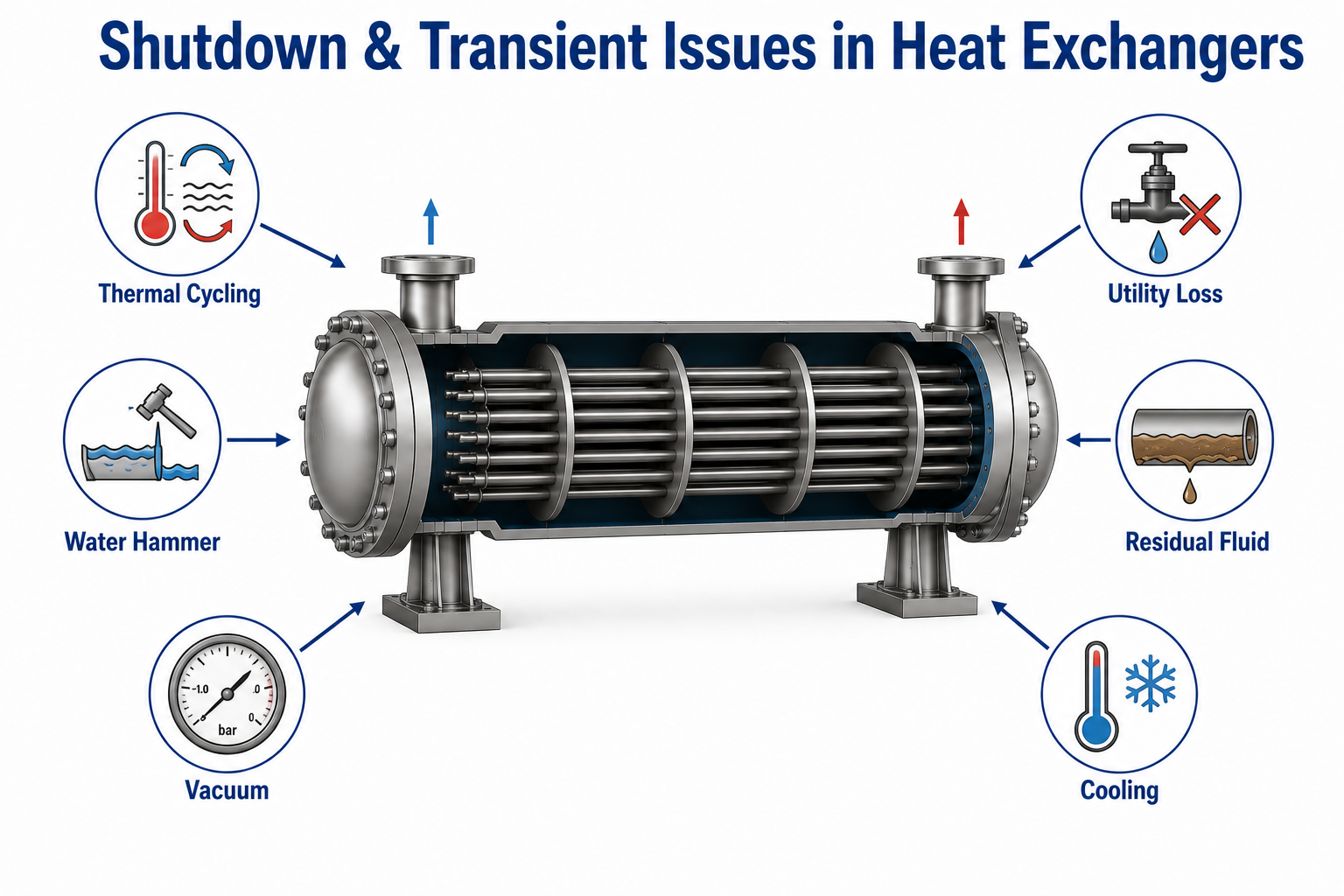
Heat exchangers are designed primarily for steady-state operation, but real process plants rarely operate under perfectly stable conditions. Planned shutdowns, emergency trips, load changes, utility interruptions, and process transitions expose exchangers to rapidly changing temperatures, pressures, and flow rates that differ significantly from their normal operating environment. These transient conditions can create thermal stress, flow instability, mechanical fatigue, and unexpected performance problems that gradually reduce equipment reliability. Understanding shutdown and transient behavior helps engineers protect heat exchangers throughout their operating life rather than focusing only on normal production conditions.
When engineers evaluate heat exchanger performance, they usually concentrate on normal plant operation.
This approach is understandable because most thermal calculations assume:
- steady flow rates,
- stable temperatures,
- constant utility conditions,
- predictable fluid properties.
Real plants, however, spend a considerable amount of time outside these ideal conditions.
Heat exchangers experience transient events during:
- plant startup,
- planned shutdown,
- emergency shutdown,
- production rate changes,
- utility failures,
- equipment switching,
- process disturbances.
During these periods, temperatures, pressures, and flow rates may change much faster than during routine operation.
Although these events may last only minutes or hours, they often produce stresses that influence equipment reliability for many years.
Experienced engineers therefore pay as much attention to transient operation as they do to steady-state performance.
Table of Contents
What Are Transient Operating Conditions?
Transient conditions occur whenever the heat exchanger moves from one operating state to another.
Unlike steady-state operation, transient conditions involve continuously changing process variables.
Examples include:
- heating up,
- cooling down,
- increasing production,
- reducing plant load,
- switching utilities,
- emergency isolation.
During these transitions, heat transfer continuously changes as the exchanger adjusts to new operating conditions.
The equipment may temporarily experience conditions that were never intended during normal design operation.
Why Shutdown Conditions Can Be More Severe Than Normal Operation
A controlled shutdown may create larger thermal gradients than continuous operation.
During shutdown:
- utilities may be isolated,
- process flow decreases,
- equipment cools unevenly,
- pressure gradually falls,
- trapped fluids remain inside the exchanger.
Different parts of the exchanger cool at different rates.
The resulting differential expansion and contraction create mechanical stresses that are absent during stable operation.
Repeated shutdown cycles gradually contribute to equipment ageing.
Issue 1: Differential Thermal Contraction
Cooling components contract at different rates as temperature decreases.
The shell, tubes, tubesheets, and channel covers do not cool uniformly.
This may result in:
- mechanical stress,
- gasket relaxation,
- flange leakage,
- fatigue loading.
Repeated thermal cycling accelerates long-term mechanical deterioration.
Good Engineering Practice
Whenever practical, reduce temperatures gradually rather than allowing rapid cooling.
Controlled cooldown minimizes thermal gradients throughout the exchanger.
Issue 2: Utility Isolation at the Wrong Time
Incorrect shutdown sequence can expose equipment to unnecessary thermal stress.
Examples include:
- stopping process flow before removing steam,
- isolating cooling water while hot process fluid remains inside,
- shutting down circulation pumps before utilities are isolated.
These situations may produce:
- localized overheating,
- boiling,
- freezing,
- excessive thermal expansion or contraction.
Good Engineering Practice
Follow approved shutdown procedures that sequence utilities and process flow correctly.
Issue 3: Residual Fluids Left Inside the Exchanger
Fluids remaining inside idle exchangers can create unexpected problems.
Depending on the service, residual fluids may:
- solidify,
- polymerize,
- crystallize,
- corrode internal surfaces,
- freeze,
- promote biological growth.
Extended shutdown periods increase these risks.
Good Engineering Practice
Drain, flush, or preserve exchangers according to the process service and expected shutdown duration.
Issue 4: Water Hammer During Shutdown
Rapid valve operation may create damaging pressure surges.
Water hammer may occur when:
- valves close too quickly,
- condensate movement becomes unstable,
- steam collapses rapidly,
- pumps stop suddenly.
Pressure waves generated during these events may damage:
- tubes,
- gaskets,
- piping,
- supports,
- nozzles.
Good Engineering Practice
Operate valves gradually and ensure condensate removal systems function properly throughout shutdown.
Issue 5: Vacuum Formation Inside the Exchanger
Cooling trapped fluids may generate internal vacuum conditions.
Vacuum formation may occur when:
- steam condenses inside isolated equipment,
- vents remain closed,
- cooling continues after isolation.
Excessive vacuum can deform equipment designed primarily for internal pressure rather than external pressure.
Good Engineering Practice
Provide appropriate venting and vacuum protection where required by the design.
Issue 6: Frequent Thermal Cycling
Repeated heating and cooling gradually reduce equipment life.
Plants operating in batch or campaign mode may experience hundreds or thousands of thermal cycles.
Over time, cycling contributes to:
- fatigue,
- gasket degradation,
- bolt relaxation,
- weld stress,
- tube expansion joint deterioration.
These failures often appear long after commissioning.
Good Engineering Practice
Consider expected thermal cycling frequency during equipment selection and maintenance planning.
Issue 7: Utility Interruptions
Unexpected utility loss creates uncontrolled transient conditions.
Examples include:
- steam supply failure,
- cooling water interruption,
- chilled water outage,
- hot oil circulation failure.
The exchanger immediately begins responding to changing thermal conditions.
Operators may incorrectly interpret the resulting temperature changes as equipment failure.
Good Engineering Practice
Operating procedures should define clear responses to utility interruptions before they occur.
Issue 8: Load Changes and Production Ramp-Up
Changing production rates continuously alter exchanger performance.
During capacity changes:
- flow velocity changes,
- temperature driving force varies,
- pressure drop changes,
- heat transfer coefficients adjust.
Large or rapid production changes may temporarily reduce exchanger effectiveness until a new steady state is reached.
Good Engineering Practice
Increase or decrease production gradually whenever process constraints permit.
Issue 9: Shutdown Fouling
Deposits often develop while equipment is out of service rather than during operation.
During idle periods:
- stagnant fluids remain inside,
- suspended solids settle,
- corrosion products accumulate,
- biological growth develops in water systems.
The exchanger may restart with reduced performance even though it operated normally before shutdown.
Good Engineering Practice
Proper preservation and flushing procedures minimize deterioration during extended outages.
Issue 10: Restarting Without Proper Inspection
Problems created during shutdown often become apparent only during the next startup.
Examples include:
- damaged gaskets,
- blocked tubes,
- valve misalignment,
- trapped debris,
- instrument drift.
Skipping post-shutdown inspections increases the likelihood of repeated operating problems.
Good Engineering Practice
Inspect critical equipment before returning the exchanger to service, particularly after major maintenance or extended shutdowns.
Why Transient Conditions Are Often Overlooked
Most design calculations emphasize steady-state performance rather than short-duration operating events.
Transient events may represent only a small percentage of the exchanger’s operating time.
However, they frequently account for a disproportionate share of:
- thermal fatigue,
- mechanical stress,
- gasket failures,
- maintenance requirements,
- unexpected reliability issues.
Designing and operating with transient conditions in mind significantly improves long-term equipment performance.
Common Misunderstandings About Shutdown and Transient Operation
Many reliability problems arise because transient conditions are considered less important than normal operation.
“Shutdown Is Less Demanding Than Startup”
Shutdown can create thermal gradients and mechanical stresses equal to—or sometimes greater than—those experienced during startup.
“Once Production Stops, the Exchanger Is No Longer at Risk”
Many mechanical problems develop after process flow has stopped because temperatures and pressures continue changing.
“Short Utility Interruptions Cannot Damage Equipment”
Even brief losses of steam or cooling water may expose equipment to rapid temperature changes and unstable operating conditions.
“Transient Events Are Too Short to Affect Equipment Life”
Repeated transient events accumulate over years of operation and contribute significantly to fatigue, gasket ageing, and mechanical deterioration.
Operator Perspective
Operators play a key role in protecting exchangers during shutdown and process transitions.
Careful control of:
- valve sequencing,
- utility isolation,
- cooling rates,
- draining,
- venting,
helps prevent avoidable thermal and mechanical damage.
Following established shutdown procedures consistently is one of the most effective ways to extend exchanger service life.
Owner Perspective
For plant owners, well-managed shutdowns reduce both maintenance costs and production losses.
Controlled transient operation helps:
- extend equipment life,
- reduce emergency repairs,
- minimize leakage,
- improve restart reliability,
- shorten shutdown duration,
- lower lifecycle costs.
Investing time in disciplined shutdown procedures often prevents expensive failures that would otherwise appear months later.
Final Perspective
Heat exchangers are not challenged only by continuous operation—they are tested every time the plant changes operating conditions.
Every startup, shutdown, utility interruption, and production change introduces transient forces that influence thermal performance, mechanical integrity, and long-term reliability.
Although these events occupy only a small fraction of the exchanger’s total operating time, they often determine how the equipment ages over decades of service.
Successful engineers therefore design procedures—not just equipment.
They recognize that careful management of transient conditions is as important as accurate thermal design, ensuring that the exchanger can safely withstand not only normal operation but also the inevitable transitions that occur throughout the life of every process plant.
Explore the complete series in the Heat Exchanger Engineering Hub.
A practicing chemical engineer with 17+ years of experience in process design, project execution, commissioning, and plant operations. Focused on practical engineering judgment beyond textbook explanations.