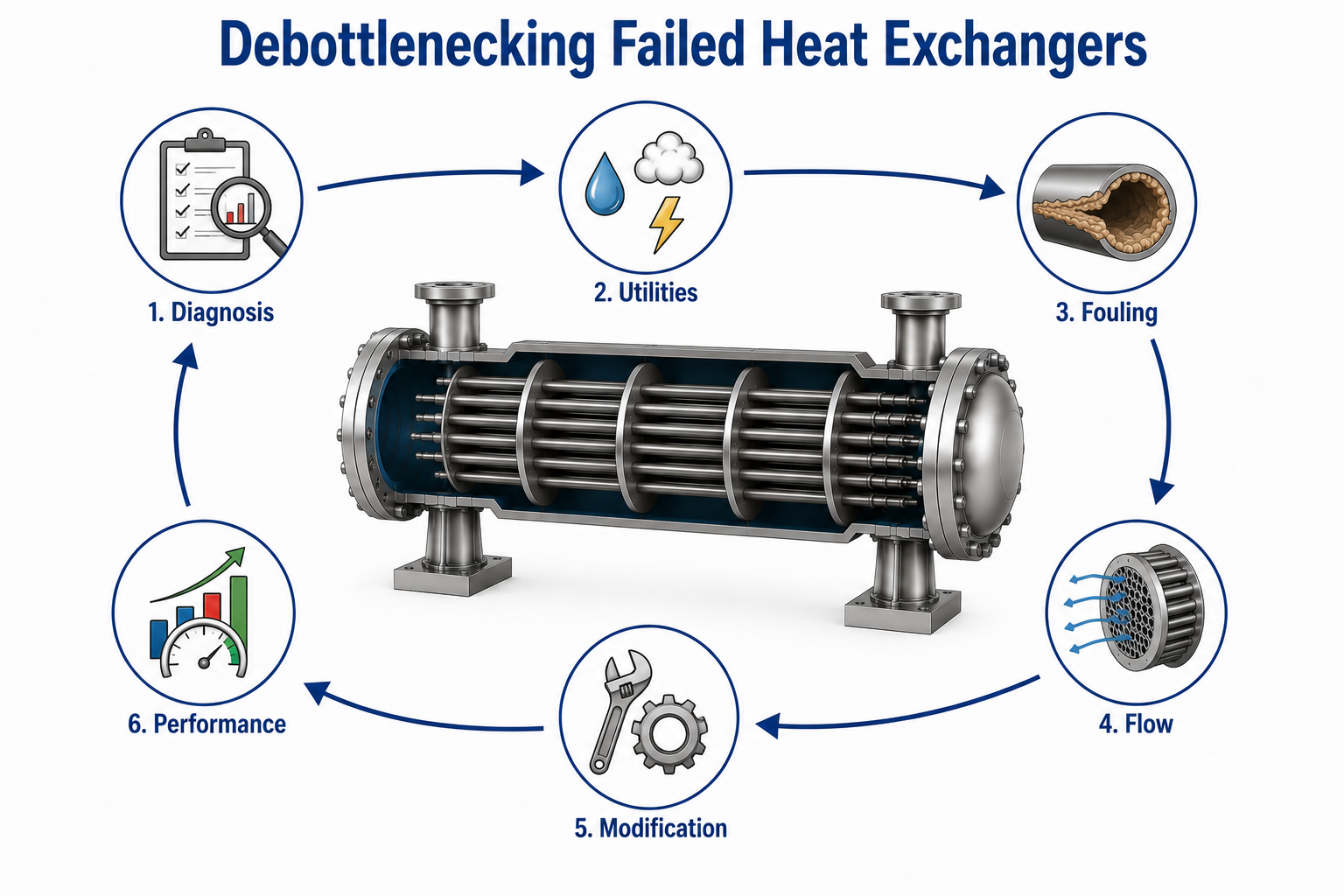
Replacing an underperforming heat exchanger is not always the best solution. In many process plants, exchangers fail to meet production requirements because operating conditions have changed, fouling has increased, utilities have become constrained, or the original design basis is no longer valid. Debottlenecking focuses on identifying the true limiting factor and restoring or improving performance through practical engineering solutions. A systematic debottlenecking approach enables engineers to increase heat duty, reduce energy consumption, and improve plant capacity without unnecessary capital investment.
When a plant struggles to achieve its production targets, heat exchangers are often among the first pieces of equipment to attract attention.
Operators may report:
- “The exchanger cannot cool the product sufficiently.”
- “Steam consumption keeps increasing.”
- “Pressure drop is limiting production.”
- “We cannot increase plant throughput.”
The immediate response is often:
“We need a larger heat exchanger.”
In many cases, however, this conclusion is premature.
An exchanger that appears to have become a bottleneck may simply be responding to conditions that differ from its original design basis.
Successful debottlenecking begins by understanding why the exchanger has become the limiting factor before deciding how to improve its performance.
Experienced engineers recognize that replacing equipment without identifying the real constraint often transfers the bottleneck elsewhere in the process.
Table of Contents
What Does Debottlenecking Mean?
Debottlenecking is the process of removing constraints that limit equipment or plant performance.
For heat exchangers, debottlenecking aims to:
- increase heat duty,
- reduce pressure drop,
- improve thermal efficiency,
- restore production capacity,
- optimize utility consumption,
- extend equipment life.
The objective is not necessarily to redesign the exchanger but to improve overall system performance using the most practical and economical solution.
Step 1: Confirm That the Heat Exchanger Is the Real Bottleneck
Many apparent exchanger problems originate elsewhere in the process.
Before modifying the exchanger, verify:
- process flow rates,
- utility availability,
- pump performance,
- control valve operation,
- instrumentation accuracy,
- upstream equipment,
- downstream restrictions.
For example, insufficient cooling may result from reduced cooling tower performance rather than inadequate exchanger area.
Similarly, high steam demand may originate from process changes instead of exchanger deterioration.
Accurate diagnosis prevents unnecessary modifications.
Step 2: Compare Current Operation with the Original Design Basis
Many bottlenecks develop because the plant has evolved beyond its original design conditions.
Review:
- design flow rates,
- operating temperatures,
- fluid properties,
- utility conditions,
- production capacity,
- fouling assumptions.
Questions to ask include:
- Has production increased?
- Has the feed composition changed?
- Are utilities operating as originally intended?
- Has the exchanger exceeded its design envelope?
Understanding these differences often explains declining performance.
Step 3: Identify the Actual Limiting Mechanism
Not every bottleneck is caused by insufficient heat transfer area.
Typical limiting mechanisms include:
Thermal Limitation
Examples:
- fouling,
- insufficient temperature driving force,
- reduced heat transfer coefficient.
Hydraulic Limitation
Examples:
- excessive pressure drop,
- restricted flow,
- undersized piping,
- tube blockage.
Utility Limitation
Examples:
- inadequate steam pressure,
- insufficient cooling water,
- reduced chilled water capacity.
Operational Limitation
Examples:
- unstable control,
- improper operating procedures,
- incorrect valve positions,
- process variability.
Identifying the true limitation determines the most effective improvement strategy.
Step 4: Evaluate Low-Cost Improvement Opportunities
Many exchanger bottlenecks can be resolved without replacing equipment.
Examples include:
- cleaning fouled surfaces,
- optimizing utility flow,
- balancing process flow,
- recalibrating instrumentation,
- repairing leaking valves,
- improving control strategies,
- removing unnecessary bypasses.
These improvements often restore significant performance at relatively low cost.
Step 5: Investigate Mechanical Modifications
When operational improvements are insufficient, mechanical modifications may provide additional capacity.
Possible modifications include:
- replacing damaged tube bundles,
- increasing heat transfer surface area,
- modifying baffle spacing,
- improving nozzle configuration,
- reducing bypass leakage,
- installing enhanced tubes where appropriate.
Every modification should consider both thermal and hydraulic consequences.
Increasing heat transfer often increases pressure drop, requiring careful engineering evaluation.
Step 6: Optimize Utility Systems
The exchanger can only perform as well as the utilities supporting it.
Review:
- steam pressure,
- condensate removal,
- cooling water temperature,
- cooling water flow,
- chilled water capacity,
- hot oil circulation.
Improving utility performance frequently increases exchanger effectiveness without modifying the exchanger itself.
Step 7: Consider Process Optimization Before Equipment Replacement
Sometimes changing the process is more effective than changing the exchanger.
Examples include:
- reducing unnecessary heat load,
- improving upstream separation,
- optimizing operating temperatures,
- recovering heat elsewhere,
- adjusting production scheduling.
Process improvements may eliminate the apparent bottleneck entirely.
Step 8: Evaluate Whether Replacement Is Truly Necessary
Replacement should be considered only after practical alternatives have been evaluated.
Replacement may become necessary when:
- required duty has permanently increased,
- pressure drop cannot be reduced,
- severe mechanical damage exists,
- corrosion has significantly reduced equipment integrity,
- process requirements have fundamentally changed.
Even then, the replacement exchanger should be designed using updated operating conditions rather than the original project data.
Common Debottlenecking Strategies Used in Industry
Successful plants combine several improvement methods rather than relying on one major modification.
Typical approaches include:
- restoring clean heat transfer surfaces,
- improving flow distribution,
- increasing utility effectiveness,
- eliminating unnecessary restrictions,
- upgrading instrumentation,
- optimizing operating procedures,
- modifying exchanger internals,
- improving preventive maintenance.
The best solution is often the simplest one that removes the limiting constraint.
Why System Thinking Is Essential
Improving one exchanger does not always increase overall plant capacity.
For example:
Increasing exchanger performance may simply shift the bottleneck to:
- reactors,
- pumps,
- compressors,
- distillation columns,
- cooling towers,
- boilers.
Debottlenecking should therefore evaluate the complete process rather than one piece of equipment in isolation.
True capacity improvement occurs only when the overall process constraint is removed.
Common Misunderstandings About Debottlenecking
Many expensive modifications result from incorrect assumptions about the source of the bottleneck.
“A Larger Heat Exchanger Always Solves the Problem”
If the real limitation is insufficient utility capacity or hydraulic restriction, increasing exchanger size may provide little benefit.
“Cleaning Is the Same as Debottlenecking”
Cleaning restores performance lost because of fouling.
Debottlenecking identifies and removes the actual process constraint, which may or may not involve fouling.
“Pressure Drop Is Always a Mechanical Problem”
Pressure drop may result from:
- fouling,
- increased production,
- valve restrictions,
- utility changes,
- operating practices.
Accurate diagnosis is essential before selecting corrective action.
“Debottlenecking Ends After Equipment Modification”
Every modification should be followed by performance verification.
Monitoring confirms whether the intended improvement has actually removed the bottleneck.
Operator Perspective
Operators provide valuable insight into how bottlenecks develop during routine production.
Observations such as:
- increasing steam valve opening,
- declining outlet temperatures,
- rising differential pressure,
- unstable control,
- seasonal performance changes,
often identify developing constraints before engineering calculations reveal them.
Operator experience should always be included during debottlenecking studies.
Owner Perspective
For plant owners, successful debottlenecking maximizes return on existing assets.
Effective improvement projects can:
- increase production capacity,
- reduce utility consumption,
- defer capital investment,
- improve equipment reliability,
- extend asset life,
- lower operating costs.
Many plants achieve significant capacity improvements through systematic optimization rather than major equipment replacement.
Final Perspective
Debottlenecking is not about making a heat exchanger larger—it is about making the entire process perform better.
Successful engineers resist the temptation to treat declining performance as proof that equipment has reached the end of its useful life.
Instead, they investigate operating conditions, utilities, hydraulics, maintenance history, and process changes to identify the true source of the limitation.
Only after understanding the complete system do they decide whether cleaning, optimization, modification, or replacement is the most appropriate solution.
Ultimately, the most successful debottlenecking projects are those that eliminate constraints with the least disruption, the lowest lifecycle cost, and the greatest long-term benefit to the overall process plant.
Explore the complete series in the Heat Exchanger Engineering Hub.

A practicing chemical engineer with 17+ years of experience in process design, project execution, commissioning, and plant operations. Focused on practical engineering judgment beyond textbook explanations.