
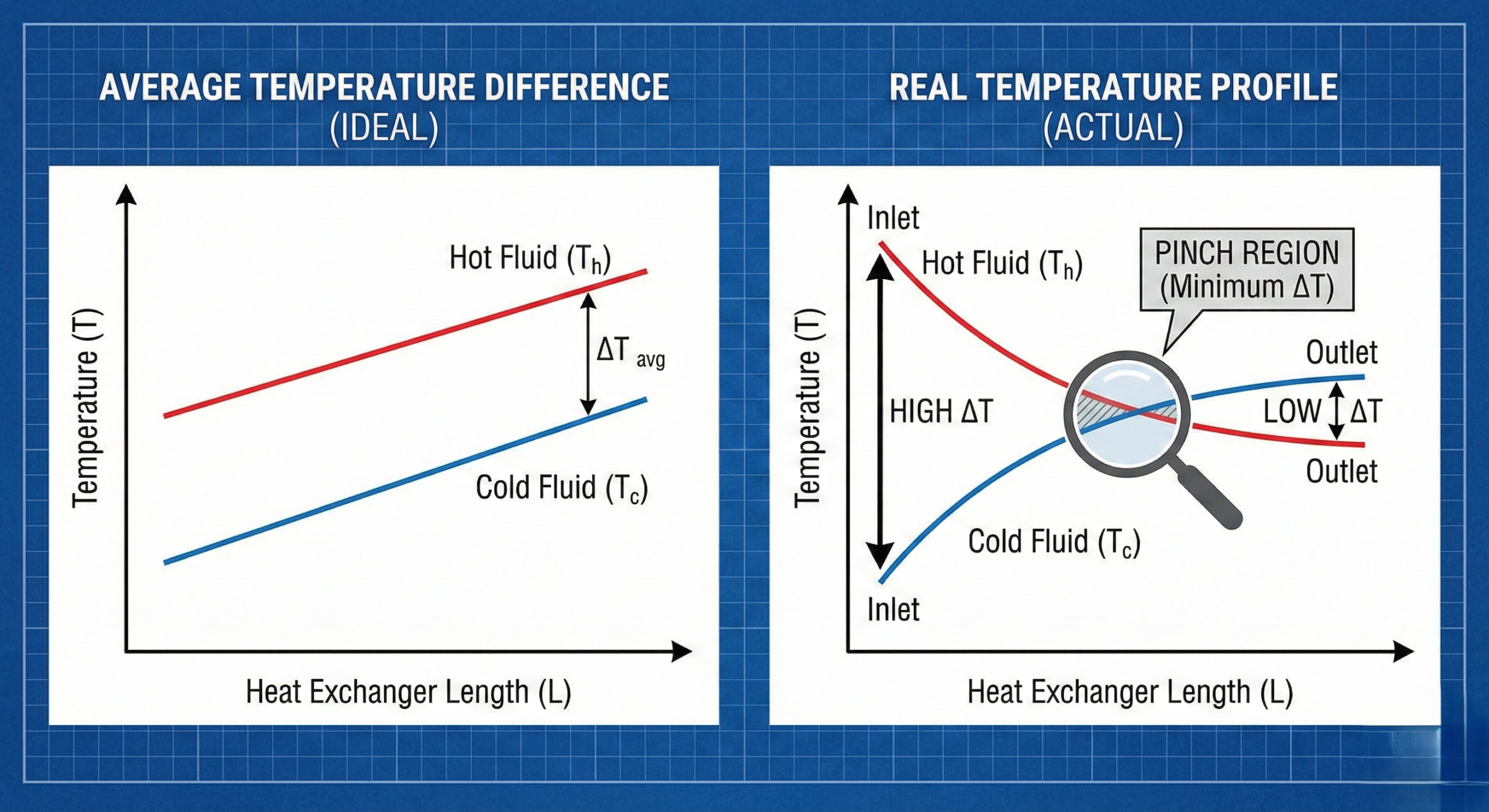
Average temperature difference is one of the most commonly used concepts in heat transfer. It appears in design calculations, simulations, datasheets, and performance discussions.
It is also one of the most frequently misinterpreted quantities in real process plants.
The problem is not that average temperature difference is wrong.
The problem is that it is often treated as reality, rather than what it truly is:
a mathematical simplification of a non-uniform physical process. That non-uniformity becomes visible only when real temperature profiles inside equipment are examined.
This article explains why average temperature difference can be misleading, where it fails to represent real plant behavior, and how experienced engineers use it without being misled by it.
Table of Contents
Heat Transfer Does Not Occur at an Average Condition
Heat transfer happens locally.
At every point in equipment:
- temperatures are different,
- heat flux is different,
- resistance is different.
There is no physical location inside equipment where an “average temperature difference” actually exists.
The average is a calculation convenience, not a physical state.
When this distinction is forgotten, average values start replacing real understanding.
Why Averages Are Used in the First Place
Average temperature difference exists because:
- temperature varies along equipment length,
- solving heat transfer locally everywhere is impractical,
- design decisions need simplified inputs.
Averages allow engineers to:
- size equipment,
- compare alternatives,
- estimate performance quickly.
They are tools, not truths. They simplify the same thermal behavior that heat duty calculations attempt to represent globally.
Problems arise when averages are expected to describe limits, risks, and local behavior.
Local Heat Transfer Is Always Uneven
In real equipment, temperature difference is not constant.
Examples:
- in heat exchangers, temperature difference is highest at one end and lowest at the other,
- in reactors, heat generation may peak locally,
- in furnaces, radiant heat flux varies with position.
Heat transfer rate follows local temperature difference, not the average.
This means:
- some regions transfer much more heat than average,
- some regions transfer much less,
- some regions approach thermal limits even when averages look safe.
Why Equipment Can Meet Duty and Still Fail
A common plant observation is:
“The exchanger meets duty, but something is still wrong.”
This happens because:
- total heat duty matches requirement,
- but local temperature differences are extreme.
Consequences include:
- tube metal overheating,
- localized fouling,
- thermal stress,
- unexpected degradation.
Average temperature difference hides peak conditions that actually govern reliability. This is one reason measured performance may appear inconsistent with calculated duty values.
Average Temperature Difference Masks Minimum Driving Force
In many systems, the minimum temperature difference is what limits performance.
Near pinch points:
- temperature difference becomes very small,
- heat transfer slows dramatically,
- control sensitivity increases.
Average values hide these pinch regions.
This explains why:
- exchangers struggle near outlet,
- small fouling causes large performance loss,
- capacity disappears suddenly rather than gradually.
Plants do not fail at average conditions.
They fail at minimum margins.
Why Control Behavior Conflicts with Average-Based Thinking
Control systems react to local temperature behavior.
When average temperature difference looks acceptable:
- operators expect stable control,
- engineers expect margin.
But if local driving force collapses:
- controllers become aggressive,
- oscillations appear,
- operators intervene repeatedly.
The apparent conflict between “good design” and “poor control” often traces back to reliance on averages.
Average Temperature Difference Ignores Thermal Resistance Distribution
Heat transfer resistance is not uniformly distributed.
Resistance varies with:
- fouling location,
- flow regime,
- surface condition,
- geometry.
Even with the same average temperature difference:
- heat flux may concentrate in certain zones,
- temperature gradients intensify locally.
This explains why:
- fouling starts at specific locations,
- damage clusters rather than spreads evenly,
- inspections find localized issues.
Averages assume uniformity that does not exist.
Transient Conditions Break Average Assumptions
Average temperature difference is usually derived for steady-state conditions.
During:
- startup,
- shutdown,
- load changes,
temperature profiles shift rapidly.
Local differences spike or collapse long before averages settle.
This is why:
- transient damage occurs even when steady-state limits are respected,
- ramp rates are restricted,
- conservative procedures exist.
Averages describe steady behavior poorly during dynamic operation. Instrument timing and temporary imbalance make these periods especially difficult to evaluate accurately.
Why Average Values Encourage False Confidence
Averages feel reassuring.
They:
- smooth variability,
- hide extremes,
- simplify communication.
But this reassurance can be dangerous.
Relying on average temperature difference alone:
- delays recognition of approaching limits,
- masks early warning signs,
- encourages operation closer to failure.
Experienced engineers treat averages as indicators, not guarantees.
How Experienced Engineers Use Average Temperature Difference Correctly
In practice, experienced engineers:
- use averages for preliminary sizing,
- examine profiles for detailed judgment,
- focus on worst-case locations,
- respect minimum driving force,
- apply conservative margins.
They never assume that average values represent:
- peak metal temperature,
- maximum stress,
- safest operating point.
Average temperature difference is a starting point, not a conclusion.
Owner Perspective: Why This Matters Economically
From an ownership standpoint, misuse of averages leads to:
- unexpected failures,
- premature fouling,
- higher maintenance cost,
- unplanned shutdowns.
Equipment rarely fails because average conditions were exceeded.
It fails because local limits were crossed unnoticed.
Understanding this distinction improves:
- reliability,
- energy efficiency,
- asset life.
Final Perspective
Average temperature difference is not wrong.
But it is incomplete.
It simplifies a complex reality into a single number that hides:
- local extremes,
- minimum margins,
- transient behavior.
Plants that rely only on averages often struggle to explain recurring issues.
Plants that understand what averages hide:
- design more robustly,
- operate more safely,
- troubleshoot more effectively.
This understanding is not advanced theory.
It is practical engineering maturity.
Understanding what averages hide is essential for interpreting both heat duty calculations and real plant measurements correctly.
And it is essential for anyone responsible for real heat transfer performance in process plants.
Once thermal calculations are compared against actual plant measurements, engineers often discover that calculated heat duty and measured performance do not perfectly agree.
These differences are common in real operating plants because measurements, assumptions, heat losses, and changing conditions all influence the final thermal balance.
Why Calculated Heat Duty Rarely Matches Measured Values – When Theory and Reality Refuse to Agree
This article explains why calculated and measured heat-transfer values often differ in real plants and why these mismatches are a normal part of practical thermal analysis.
Explore the complete series in the Heat Transfer Engineering Hub.

A practicing chemical engineer with 17+ years of experience in process design, project execution, commissioning, and plant operations. Focused on practical engineering judgment beyond textbook explanations.