
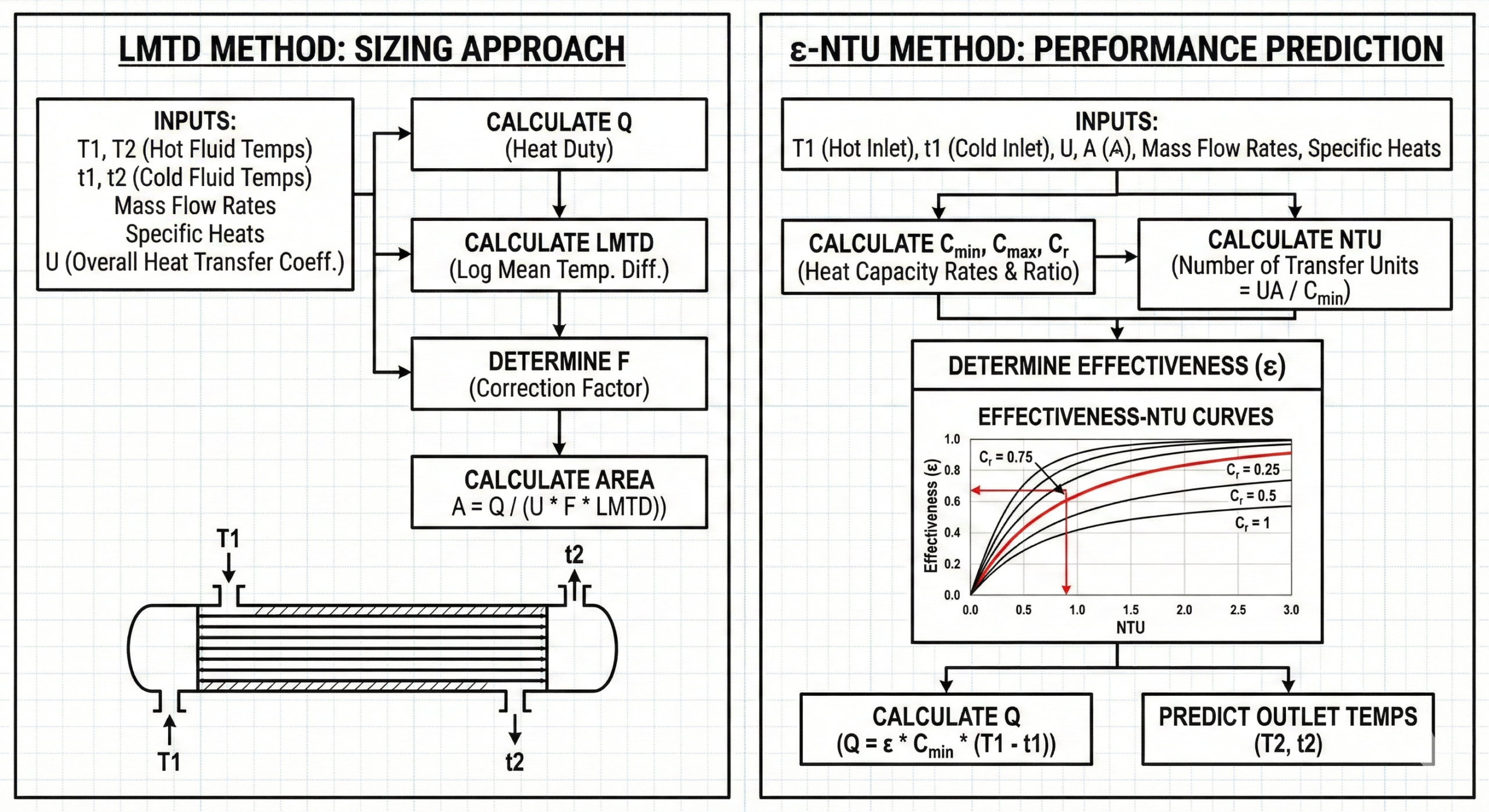
LMTD and ε-NTU are not competing theories.
They are two different ways of describing the same physical reality.
Most problems in heat exchanger design do not come from using the wrong equations. They come from using the right equation in the wrong situation.
This article explains:
- what fundamentally distinguishes LMTD and ε-NTU,
- why LMTD works well in many cases,
- when it becomes fragile or misleading,
- and when designers should deliberately switch to the ε-NTU framework.
Table of Contents
LMTD and ε-NTU Describe Heat Transfer From Opposite Directions
The key difference is what is known and what is being solved for.
LMTD framework:
- assumes inlet and outlet temperatures are known,
- calculates required area or checks performance,
- works backward from temperature targets.
ε-NTU framework:
- assumes exchanger size and configuration are known,
- predicts outlet temperatures,
- works forward from physical capability.
Neither approach is superior in general.
Each is suited to a different class of problems.
Why LMTD Is Preferred in Preliminary Design
LMTD is widely used because it is:
- intuitive,
- simple,
- well suited to steady-state design,
- effective when temperatures are specified.
In early design stages:
- process simulations provide inlet and outlet temperatures,
- duty is defined,
- flow rates are known.
Under these conditions, LMTD allows rapid sizing and comparison of exchanger options.
This is why LMTD dominates basic engineering.
Where LMTD Starts to Struggle
LMTD becomes fragile when:
- outlet temperatures are not known reliably,
- exchanger approaches pinch conditions,
- phase change dominates,
- correction factor becomes low,
- multiple operating cases exist.
In these situations:
- small temperature changes cause large LMTD swings,
- calculations become numerically unstable,
- physical interpretation becomes weak.
This is not a failure of mathematics.
It is a mismatch between problem type and method.
What ε-NTU Does Differently
The ε-NTU method does not start with outlet temperatures.
Instead, it uses:
- heat capacity rates of the fluids,
- exchanger size and configuration,
- number of transfer units (NTU),
- effectiveness (ε).
Effectiveness represents:
The fraction of the maximum possible heat transfer that the exchanger actually achieves.
This reframing avoids the need to assume outlet temperatures upfront.
Why ε-NTU Handles Pinch and Low ΔT Better
Near pinch conditions:
- outlet temperatures become highly sensitive,
- LMTD collapses rapidly,
- small numerical errors cause large design swings.
ε-NTU handles this more gracefully because:
- it works with asymptotic limits,
- it naturally captures diminishing returns,
- it does not require logarithmic temperature differences near zero.
This makes ε-NTU more stable near tight approaches.
Phase Change: A Key Trigger to Switch Methods
When phase change dominates:
- one fluid temperature remains nearly constant,
- outlet temperature may not be meaningful input,
- LMTD interpretation becomes ambiguous.
ε-NTU accommodates phase change more naturally because:
- heat capacity rate on the phase-change side approaches infinity,
- effectiveness formulation remains valid,
- the framework reflects physical limits rather than assumed temperatures.
This is why many condenser and reboiler analyses favor ε-NTU concepts, even if LMTD is used later for final sizing.
Fixed Exchangers, Variable Operation: ε-NTU’s Strength
Once an exchanger is built:
- area is fixed,
- geometry is fixed,
- only operating conditions vary.
ε-NTU is ideal for:
- performance prediction,
- seasonal studies,
- fouling impact analysis,
- debottlenecking evaluation.
It answers the question:
Given this exchanger, how will it actually perform under new conditions?
LMTD answers a different question:
What size exchanger would I need to achieve this temperature?
Why LMTD Is Weak for Rating Existing Equipment
When rating existing exchangers:
- outlet temperatures are unknown,
- approach temperatures may collapse,
- multiple solutions may exist.
Using LMTD in rating mode often requires:
- trial-and-error,
- assumed outlet temperatures,
- iterative guessing.
ε-NTU provides a direct performance prediction without guessing.
This is why experienced engineers often switch frameworks during troubleshooting.
Correction Factor and ε-NTU Are Closely Related
Low correction factor designs signal:
- poor temperature distribution,
- early pinch,
- fragile performance.
These same conditions favor ε-NTU analysis because:
- effectiveness captures utilization limits,
- geometry inefficiency appears naturally,
- diminishing returns are obvious.
When correction factor becomes a dominant concern, it is often time to reconsider the analysis framework.
Common Mistake: Mixing Outputs Without Switching Logic
A frequent error is:
- calculating exchanger area with LMTD,
- evaluating performance mentally using ε-NTU logic,
- drawing conclusions from a hybrid interpretation.
This creates confusion.
The frameworks must be used consciously, not blended casually.
Switching frameworks is not inconsistency.
It is good engineering judgment.
Owner Perspective: Why the Right Method Saves Money
From an ownership standpoint, framework choice affects:
- debottlenecking success,
- revamp accuracy,
- energy optimization,
- capital efficiency.
Using LMTD where ε-NTU is appropriate often leads to:
- oversized revamps,
- underperforming upgrades,
- repeated trial-and-error spending.
Choosing the correct framework early prevents misdirected investment.
Final Perspective
LMTD and ε-NTU are not rivals.
They answer different questions:
- LMTD asks, What size exchanger do I need?
- ε-NTU asks, What will this exchanger actually do?
Good engineers do not defend one method.
They choose deliberately based on the problem at hand.
Knowing when to switch is not advanced theory.
It is practical engineering maturity.
And that maturity is what separates exchangers that work on paper from exchangers that work in real plants.
Explore the complete series in the Heat Transfer Engineering Hub.

A practicing chemical engineer with 17+ years of experience in process design, project execution, commissioning, and plant operations. Focused on practical engineering judgment beyond textbook explanations.