
In heat exchanger design, one mistake appears repeatedly:
U is chosen first.
Designers select a “reasonable” U value from experience or literature, plug it into the heat transfer equation, calculate area, and move on.
On paper, the design closes neatly.
In plants, it often struggles.
This is not because the chosen U value was careless.
It is because U is not something that can be chosen.
U is not a design input.
U is a result of how the final system actually behaves.
This article explains why treating U as a design input is fundamentally flawed, how that habit leads to fragile equipment, and how robust designs reverse the thinking.
Table of Contents
What a Design Input Really Is
A design input is something the designer can reasonably specify or control.
Examples include:
- required heat duty,
- allowable pressure drop,
- design flow rates,
- temperature limits,
- materials of construction,
- exchanger type and geometry.
These inputs define constraints and objectives.
U does not belong in this category.
U is not specified.
U emerges.
Why U Cannot Be Chosen Directly
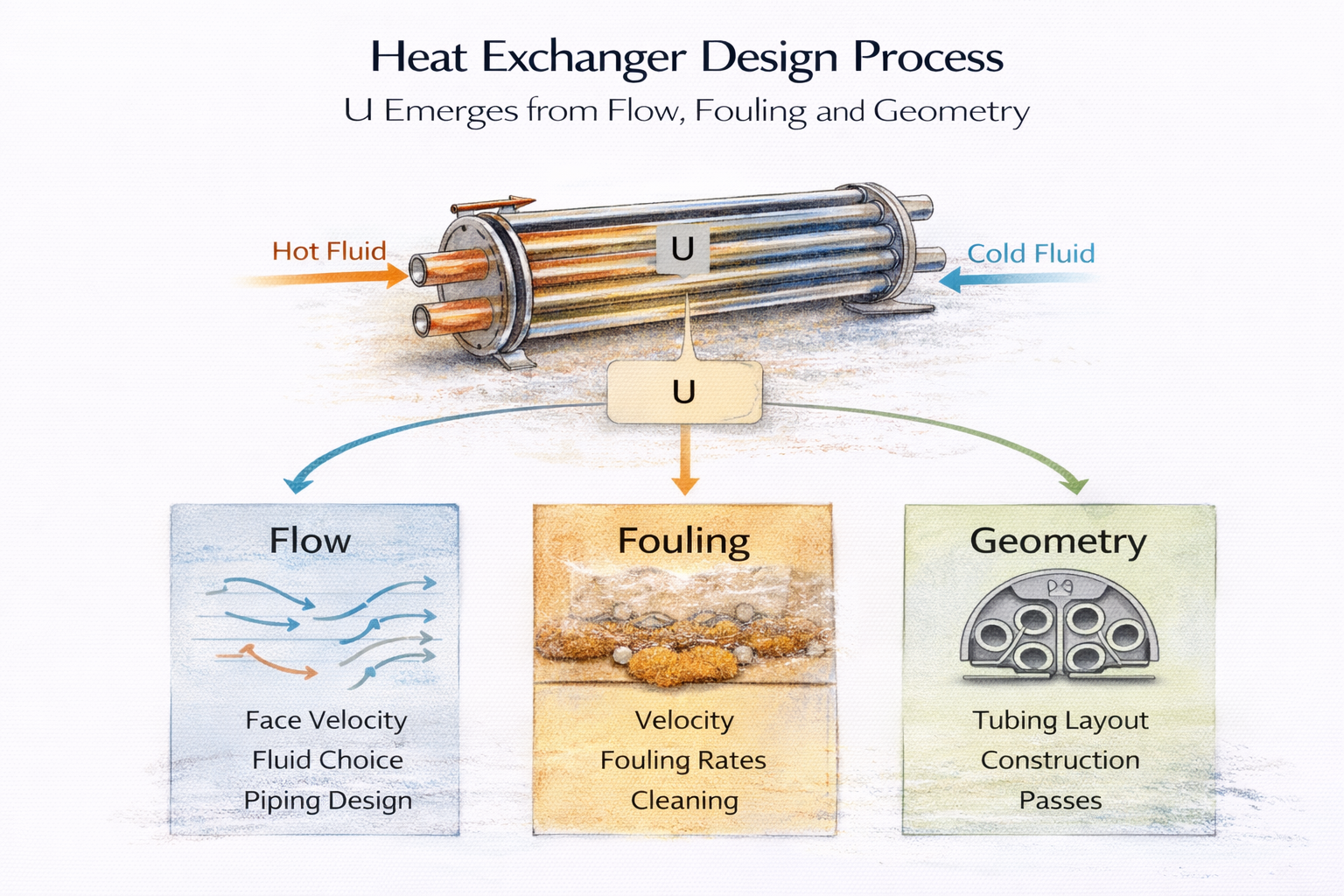
U depends on many interacting factors:
- fluid velocities on both sides,
- fluid properties,
- surface condition,
- fouling behavior,
- geometry effectiveness,
- operating temperature.
Most of these:
- change with operating point,
- evolve over time,
- are only partially predictable.
Because U depends on conditions that do not yet exist at design time, it cannot be fixed in advance.
Any U “chosen” during design is an assumption — not a controllable parameter.
The Illusion Created by the Heat Transfer Equation
The familiar heat transfer equation is often misread:
Heat transfer = U × Area × Driving force
This form creates the illusion that:
- U is independent,
- U can be specified,
- U can be adjusted like area.
In reality:
- U is a consequence of flow, geometry, and fouling,
- area is the only term fully under the designer’s control.
Confusing mathematical form with physical causality leads to wrong design priorities.
What Actually Happens When U Is Treated as an Input
When U is treated as a design input:
- optimistic values are selected,
- area is minimized to reduce capital cost,
- margin is sacrificed silently.
At commissioning:
- clean conditions briefly match assumptions.
Soon after:
- fouling develops,
- operating conditions drift,
- actual U falls.
Because area was minimized, there is no buffer.
The exchanger did not fail.
The assumption did.
Why Designers Are Tempted to Use U as an Input
Using U as an input is tempting because:
- it simplifies calculations,
- it allows quick closure,
- it aligns with textbook examples,
- it reduces apparent capital cost.
In early project stages, this approach often passes reviews because:
- everything “balances,”
- numbers look reasonable,
- no immediate red flags appear.
The consequences only surface in operation.
How Robust Design Thinks Differently
Robust design reverses the logic.
Instead of asking:
“What U should I assume?”
It asks:
“What range of U is realistic over the life of this exchanger?”
And then:
“Will this exchanger still meet duty when U degrades?”
This shifts the focus from:
- chasing optimistic performance,
to: - ensuring long-term operability.
Area Is the True Design Lever
Unlike U, area is real and permanent.
Once installed:
- area does not degrade,
- area does not foul,
- area does not depend on flow regime.
Area provides tolerance against:
- fouling,
- maldistribution,
- seasonal variation,
- operating drift.
Designs that rely on area instead of optimistic U:
- age better,
- require less intervention,
- deliver more stable performance.
This is why experienced engineers favor area over “improved U.”
U as a Diagnostic Output, Not a Target
In operating plants, U is most useful when treated as:
- a trend,
- an indicator,
- a symptom.
A declining U indicates:
- fouling progression,
- flow regime change,
- surface degradation.
A sudden change in U indicates:
- maldistribution,
- operational upset,
- instrumentation error.
Using U diagnostically makes sense.
Using it prescriptively does not.
Why “Improving U” Rarely Solves Root Problems
Many troubleshooting efforts aim to:
- increase velocity,
- raise turbulence,
- push utilities harder,
all in the name of improving U.
Often the result is:
- higher pressure drop,
- erosion or vibration,
- marginal duty improvement,
- accelerated fouling.
Because U reflects resistance balance, forcing one resistance down often shifts the problem elsewhere.
This is why “improving U” is rarely a durable fix.
Clean U vs Life-Cycle Reality
Design calculations often reference clean U.
Plants operate with dirty U.
The difference between them is not an exception.
It is normal behavior.
Designs that depend on clean U:
- lose margin rapidly,
- require frequent cleaning,
- become operationally sensitive.
Designs that expect dirty U:
- remain stable,
- operate predictably,
- cost less over time.
This difference begins with recognizing that U is not an input.
Owner Perspective: Why This Distinction Saves Money
From an ownership standpoint, treating U as a result:
- reduces unexpected bottlenecks,
- lowers maintenance frequency,
- stabilizes energy consumption,
- extends equipment life.
Treating U as an input often leads to:
- repeated debottlenecking,
- aggressive operation,
- capital spent on the wrong fixes.
The financial impact appears gradually — and persistently.
Final Perspective
U is not something designers choose.
It is something plants reveal.
Treating U as a design input creates optimism on paper and disappointment in operation. Treating U as a result forces designers to build margin where it actually works — in area, geometry, and robustness.
This is not conservative design.
It is realistic design.
And understanding why U is a result, not a design input is essential for anyone who wants heat transfer equipment that works reliably not just at startup — but for years afterward.
Explore the complete series in the Heat Transfer Engineering Hub.

A practicing chemical engineer with 17+ years of experience in process design, project execution, commissioning, and plant operations. Focused on practical engineering judgment beyond textbook explanations.