If someone walks through a process plant for the first time, they usually notice:
- tall columns
- large reactors
- rotating pumps and compressors
- storage tanks
- fired heaters
Heat exchangers, in comparison, appear smaller and less dramatic.
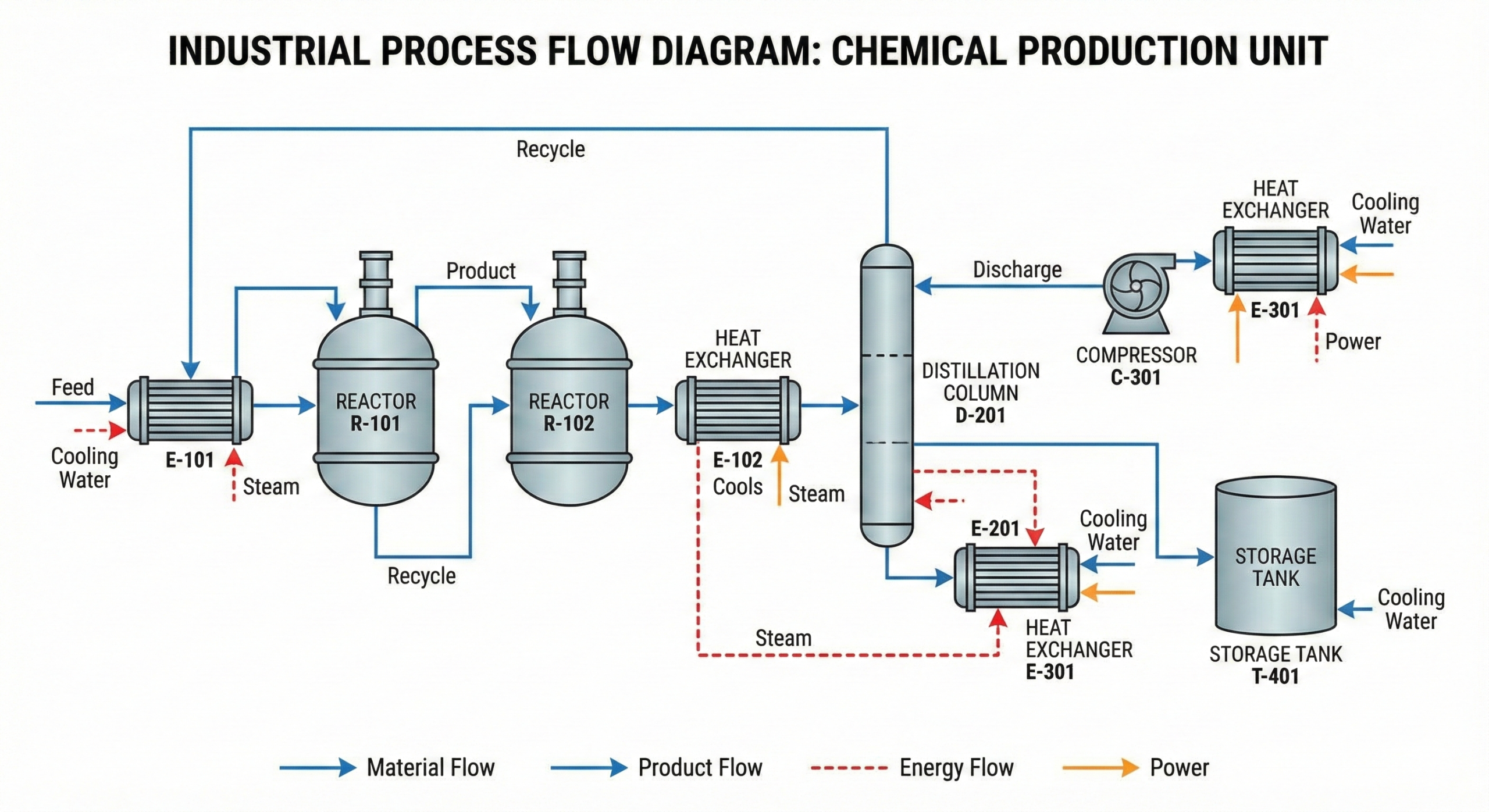
But when you step back and look at the entire plant as a process map — not a physical layout — something becomes clear:
Heat exchangers are placed at almost every critical transition point.
They sit:
- between feed and reactor
- between reactor and separation
- between column and product storage
- between process and utility systems
- between hot and cold process streams
They are not side equipment.
They are connection equipment.
This article explains where heat exchangers actually sit in a real process plant when viewed as a process map — and why their placement reveals their true importance.
Table of Contents
Understanding the Plant as a Flow Map
A process plant is not just equipment arranged on a plot.
It is a sequence of transformations:
- Feed enters
- Feed is conditioned
- Reaction or separation occurs
- Products are stabilized
- Utilities support the system
- Energy is recovered
At almost every stage of this sequence, heat exchangers are present.
To understand their role, we must trace the process flow step by step.
1. At the Feed Entry Section
The very first exchanger often appears before the main unit begins.
Feed streams rarely enter at the ideal process temperature.
They may be:
- too cold
- too hot
- partially vaporized
- too viscous
Heat exchangers at this stage:
- preheat cold feed using steam or hot process streams
- cool down hot feed before entering sensitive equipment
- adjust feed to optimal reaction or separation temperature
Without this conditioning step, the main unit cannot operate properly.
So exchangers sit at the plant entry gate.
2. Before Reactors
Most reactors require feed at a specific temperature window.
If feed enters too cold:
- reaction rate drops
- conversion reduces
If feed enters too hot:
- selectivity changes
- safety margin reduces
Pre-reactor exchangers:
- stabilize inlet temperature
- improve reaction control
- protect catalyst
In exothermic systems, feed preheating may also improve energy integration.
This placement shows exchangers act as reaction enablers.
3. Around Reactors (Cooling & Heat Removal)
Many reactions generate heat.
That heat must be removed to prevent runaway or loss of control.
Heat exchangers appear:
- in reactor jackets
- in external recirculation loops
- downstream as effluent coolers
These exchangers:
- manage reaction temperature
- remove excess heat
- protect downstream equipment
In a process map, they sit directly beside the reactor, acting as temperature regulators.
4. Between Reaction and Separation
After reaction, the effluent is rarely at ideal separation conditions.
It may need:
- cooling before entering a distillation column
- partial condensation
- temperature adjustment for phase separation
Heat exchangers at this transition:
- prepare the stream for separation
- stabilize pressure
- control vapor-liquid balance
Without these exchangers, separation units cannot function effectively.
5. On Distillation Columns
Distillation columns are strongly linked to heat exchangers.
Two critical locations:
Reboiler (bottom of column)
- supplies vapor
- drives mass transfer
- defines separation strength
Condenser (top of column)
- removes heat
- controls overhead pressure
- creates reflux
In the process map, these exchangers are integral parts of the column — not optional accessories.
They define column performance.
6. In Product Cooling Sections
Products leaving separation units are often too hot for:
- storage tanks
- transportation
- downstream processing
Product coolers:
- reduce temperature to safe storage levels
- prevent vapor formation in tanks
- improve safety and material stability
These exchangers sit between final processing and storage.
They protect the plant from thermal problems.
7. In Utility Interfaces
Heat exchangers connect the process side to utilities such as:
- steam
- cooling water
- chilled water
- hot oil
- thermal fluid
These exchangers sit at the boundary between:
- process network
- utility network
They define how much:
- steam is consumed
- cooling water is required
- energy is lost or recovered
So their position on the process map reflects energy economics.
8. In Energy Recovery Networks
Modern plants use heat integration extensively.
Instead of wasting heat:
- hot process streams preheat cold feeds
- energy is internally reused
These exchangers are placed strategically between:
- hot product streams
- cold incoming feeds
They form energy bridges across the plant.
On the process map, they connect distant sections thermally.
9. Before Compression Systems
Compressors are sensitive to temperature.
High inlet temperatures can:
- reduce efficiency
- increase discharge temperature
- stress equipment
Intercoolers and aftercoolers are installed:
- before compression stages
- between stages
They protect rotating equipment and improve compression efficiency.
So exchangers sit in mechanical protection zones as well.
10. In Recycle Loops
Many plants use recycle streams.
Before re-entering the process, these streams often need:
- temperature adjustment
- partial condensation
- cooling
Heat exchangers in recycle loops maintain process stability.
They help keep internal circulation within controlled limits.
Viewing the Plant as a Thermal Network
If we redraw the process plant highlighting only heat exchangers, we see something interesting:
They appear everywhere.
They connect:
- hot to cold
- reaction to separation
- process to utility
- unit to unit
They form a thermal network layered over the material flow network.
This thermal map is often as important as the process flow diagram itself.
Why Placement Reveals Function
The location of a heat exchanger tells us its purpose.
If placed before a reactor:
- it controls reaction temperature.
If placed after a column:
- it stabilizes product.
If placed between two process streams:
- it recovers energy.
If placed between process and utility:
- it manages operating cost.
So understanding placement is key to understanding function.
How Operators Experience These Locations
Operators do not always think in process map terms.
But they observe:
- feed preheater temperature
- reactor inlet temperature
- column top temperature
- product cooler outlet temperature
Each of these readings reflects a heat exchanger’s performance.
If one exchanger underperforms, the impact is felt immediately at its location on the map.
Why Bottlenecks Often Sit at These Points
During capacity increases, exchangers at transition points often limit throughput.
Because they:
- define maximum heating or cooling rate
- restrict temperature control range
- limit phase change rate
So in the process map, bottlenecks often align with exchanger positions.
Owner Perspective: Exchangers Shape the Energy Picture
If we overlay energy flow on the process map:
- steam enters through certain exchangers
- cooling water removes heat through others
- internal heat recovery reduces external utility demand
The efficiency of these exchangers directly determines energy cost.
Their placement defines where money is spent or saved.
Why This Understanding Matters
When troubleshooting a plant problem, it helps to ask:
- Where on the process map is the issue?
- What exchanger sits at that transition?
- Is temperature being prepared correctly for the next step?
Seeing exchangers as transition managers — not just heaters or coolers — improves root cause analysis.
Final Perspective
When viewed as a process map, a plant is a series of transformations connected by heat exchangers.
They sit:
- at entry points
- before reactors
- around separation systems
- at product stabilization
- between process and utilities
- across energy recovery paths
They define how energy flows through the plant.
Understanding where heat exchangers sit in a real process plant changes how we see them.
They are not background hardware.
They are the thermal connectors that allow the entire process to function in a controlled and economical way.
A practicing chemical engineer with 17+ years of experience in process design, project execution, commissioning, and plant operations. Focused on practical engineering judgment beyond textbook explanations.