Heat exchangers may look similar on a P&ID symbol, but in real plants they are very different pieces of equipment.
A shell-and-tube unit behaves differently from a plate exchanger.
An air cooler operates under completely different constraints than a compact printed circuit exchanger.
Yet in many projects, exchanger selection is treated as routine.
“Use shell-and-tube.”
“Use plate type.”
“Use air cooler.”
But selection is not about familiarity.
It is about aligning equipment behavior with:
- fluid characteristics
- operating pressure and temperature
- fouling risk
- maintenance strategy
- space constraints
- utility availability
- lifecycle economics
This article explains the major heat exchanger types used in industry and, more importantly, the selection logic and trade-offs behind each choice.
Table of Contents
Why Exchanger Type Is a Strategic Decision
Two exchangers can perform the same thermal duty but behave very differently in operation.
Equipment type affects:
- hydraulic behavior
- maintenance accessibility
- vibration risk
- expansion handling
- cleaning approach
- long-term reliability
When exchanger type is chosen without considering these aspects, problems appear years later — not during design review.
That is why selection logic matters more than most realize.
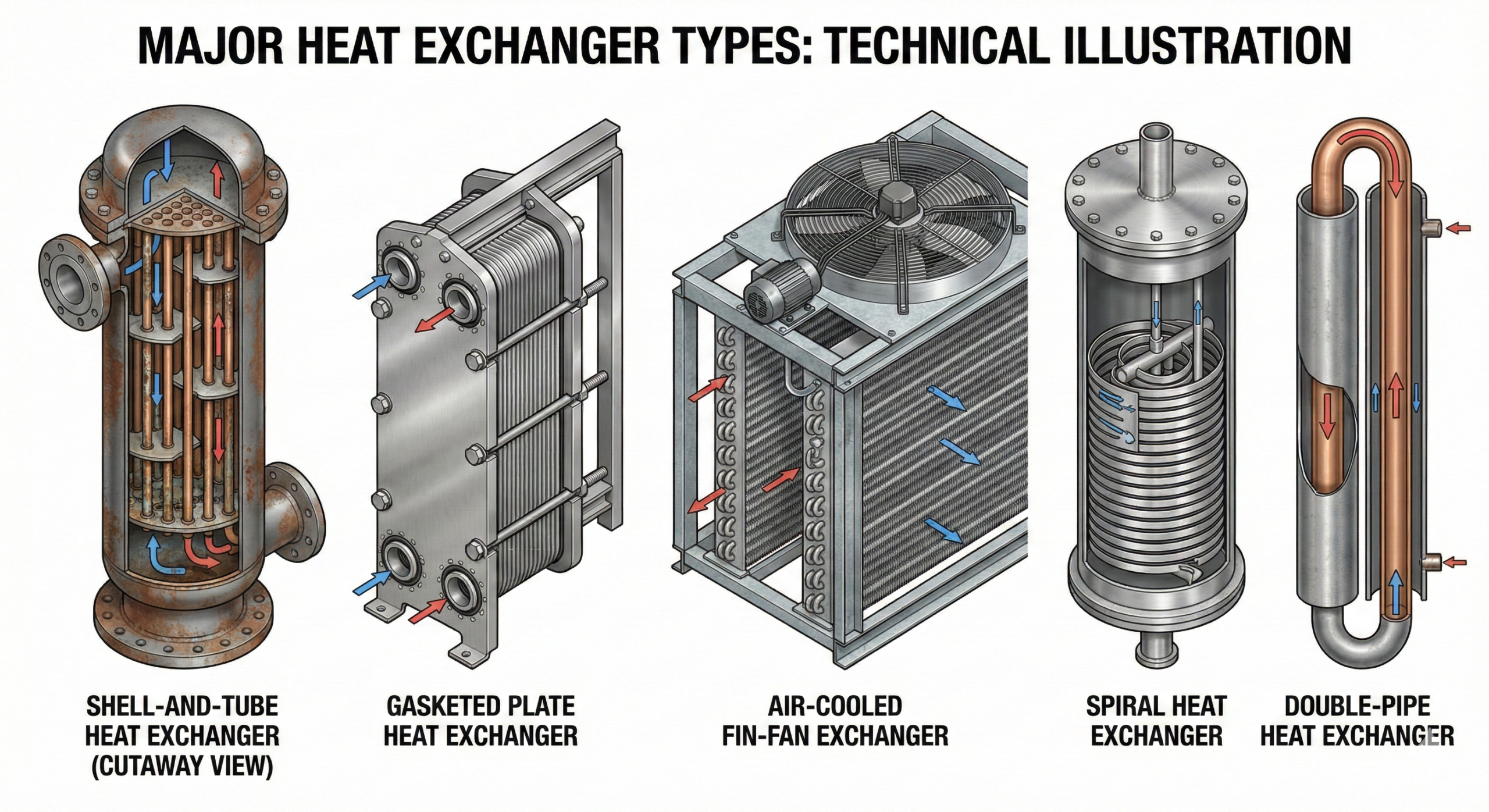
Shell-and-Tube Heat Exchangers
Where They Are Commonly Used
Shell-and-tube exchangers dominate in:
- refineries
- petrochemical complexes
- fertilizer plants
- high-pressure chemical units
- high-temperature services
They are the most established industrial exchanger type.
Why They Are Widely Accepted
They offer:
- strong mechanical integrity
- capability for high pressure and temperature
- flexible material selection
- suitability for phase change services
- familiarity across fabrication and maintenance teams
They are considered the industry workhorse.
Selection Logic
Shell-and-tube exchangers are typically selected when:
- pressure levels are high
- temperature is elevated
- fluids are hazardous
- fouling is expected
- mechanical reliability is critical
- frequent mechanical inspection may be required
They are preferred in demanding services.
Trade-Offs
Advantages:
- robust construction
- suitable for severe conditions
- easier tube-side mechanical cleaning
Limitations:
- larger footprint
- heavier structure
- moderate heat transfer efficiency compared to compact types
They are reliable but not compact.
Plate Heat Exchangers
Where They Are Commonly Used
Plate exchangers are widely used in:
- food and beverage plants
- HVAC systems
- light chemical services
- low-to-moderate pressure applications
They are known for compactness and efficiency.
Why They Perform Well
Their corrugated plates:
- create turbulence
- improve surface contact
- increase heat transfer per unit area
They provide high performance in small space.
Selection Logic
Plate exchangers are selected when:
- footprint is limited
- high efficiency is desired
- fluids are relatively clean
- moderate pressure conditions exist
- quick maintenance turnaround is required
They are ideal for compact installations.
Trade-Offs
Advantages:
- compact design
- high thermal performance
- easy disassembly in gasketed types
Limitations:
- pressure and temperature limits
- gasket aging
- sensitivity to fouling in narrow passages
They deliver efficiency but require cleaner service.
Air-Cooled Heat Exchangers
Where They Are Commonly Used
Air coolers are frequently installed in:
- refineries
- gas processing plants
- remote facilities
- water-scarce regions
They reject heat directly to ambient air.
Why They Are Selected
Air coolers eliminate cooling water dependency.
They are selected when:
- water availability is limited
- environmental discharge must be minimized
- water treatment cost is high
They are utility-independent cooling systems.
Trade-Offs
Advantages:
- no water consumption
- lower corrosion risk from cooling water
- suitable for remote installations
Limitations:
- large plot area
- performance affected by ambient temperature
- seasonal variation
- fan power consumption
They trade water savings for environmental sensitivity and space usage.
Double-Pipe Heat Exchangers
Where They Are Commonly Used
Double-pipe exchangers are found in:
- small-capacity systems
- pilot plants
- high-pressure differential services
- simple heating or cooling tasks
They are structurally simple.
Selection Logic
They are selected when:
- duty is relatively small
- design simplicity is preferred
- high-pressure capability is required
- modular installation is beneficial
They are practical for limited applications.
Trade-Offs
Advantages:
- simple construction
- easy installation
- good for high-pressure service
Limitations:
- inefficient for large duties
- larger footprint for equivalent capacity
They are reliable but not scalable for large throughput.
Spiral Heat Exchangers
Where They Are Commonly Used
Spiral exchangers are suitable for:
- viscous fluids
- slurry handling
- fouling-prone services
Their geometry reduces stagnant zones.
Selection Logic
They are selected when:
- fouling tendency is high
- self-cleaning flow behavior is beneficial
- compact layout is needed for viscous streams
They solve specific process challenges.
Trade-Offs
Advantages:
- improved fouling resistance
- compact for certain duties
- uniform flow path
Limitations:
- limited availability
- specialized fabrication
- less flexible for extreme pressures
They are niche but effective.
Finned Tube Heat Exchangers
Where They Are Commonly Used
Finned tubes are typically used in:
- air coolers
- gas heating systems
- HVAC equipment
They increase effective surface area.
Selection Logic
They are chosen when:
- one side fluid is gas or air
- surface area multiplication is required
- compact gas-side performance is needed
Trade-Offs
Advantages:
- improved gas-side heat transfer
- reduced equipment size for gas services
Limitations:
- fin damage risk
- cleaning difficulty
- corrosion vulnerability
They enhance performance but add maintenance complexity.
Printed Circuit and Compact Heat Exchangers
Where They Are Commonly Used
These exchangers are found in:
- LNG plants
- cryogenic services
- high-pressure gas processing
They offer extremely high compactness.
Selection Logic
They are selected when:
- space is severely limited
- high pressure is involved
- precise temperature control is critical
Trade-Offs
Advantages:
- very compact
- high efficiency
- capable of high pressure
Limitations:
- high capital cost
- difficult cleaning
- limited flexibility for dirty services
They are advanced solutions for specialized applications.
Key Factors That Drive Selection
Fluid Properties
- viscosity
- fouling tendency
- corrosiveness
Operating Conditions
- pressure
- temperature
- phase behavior
Maintenance Philosophy
- cleaning method
- accessibility
- downtime tolerance
Plot and Layout Constraints
- available space
- installation limitations
Utility Availability
- cooling water supply
- steam network capacity
- ambient cooling feasibility
Lifecycle Cost
- capital investment
- energy consumption
- maintenance expense
No exchanger type is universally superior.
Suitability depends entirely on service conditions.
Why Trade-Off Thinking Is Essential
Each exchanger type offers strengths while introducing limitations.
Shell-and-tube provides robustness but occupies space.
Plate exchangers provide efficiency but require cleaner service.
Air coolers save water but depend on ambient conditions.
Compact exchangers reduce footprint but increase cost.
Engineering judgment lies in balancing these trade-offs.
Operator and Owner Perspective
Operators care about:
- stability
- cleaning frequency
- sensitivity to seasonal change
- pressure drop behavior
Owners care about:
- capital cost
- energy efficiency
- maintenance budget
- long-term reliability
Exchanger type directly influences all of these.
Final Perspective
Heat exchanger selection is not about habit or preference.
It is about matching equipment characteristics with:
- process behavior
- operational philosophy
- maintenance capability
- economic objectives
The correct exchanger type is the one that performs reliably under real plant conditions — not just under ideal design assumptions.
Choosing wisely at the beginning prevents performance, reliability, and cost issues later in the plant’s life.

A practicing chemical engineer with 17+ years of experience in process design, project execution, commissioning, and plant operations. Focused on practical engineering judgment beyond textbook explanations.