When people talk about plant energy consumption, they usually think about:
- fired heaters
- boilers
- turbines
- compressors
These are visible energy users.
But if you trace where energy actually moves inside a process plant — where it enters, where it leaves, and where it changes form — you find something consistent:
Heat exchangers dominate the plant energy balance.
Almost every major energy flow passes through a heat exchanger at some stage.
Steam condenses in one.
Cooling water absorbs heat in another.
Hot product transfers energy to cold feed in a third.
Waste heat is recovered in a fourth.
This article explains why heat exchangers are central to plant energy balance, how they control energy distribution, and why their performance directly defines operating cost.
Table of Contents
Understanding Energy Balance at Plant Level
At the plant scale, energy balance answers three questions:
- How much energy enters the plant?
- Where is that energy used?
- Where does that energy leave?
Energy enters mainly as:
- fuel
- steam
- electricity
- hot utilities
Energy leaves as:
- product enthalpy
- flue gas losses
- cooling water heat rejection
- ambient heat loss
Between these two points, heat exchangers handle most of the redistribution.
Steam Consumption Happens Inside Heat Exchangers
Steam is one of the largest energy carriers in many plants.
Where does it actually release its energy?
Inside heat exchangers.
When steam condenses:
- latent heat is transferred to the process
- energy moves from utility to process stream
Without heat exchangers, steam has no controlled path to deliver its energy.
So every unit of steam energy must pass through an exchanger before becoming useful process heat.
Cooling Water Removes Energy Through Heat Exchangers
Cooling water systems are designed to remove excess heat.
But cooling water does not magically cool process streams.
It absorbs heat inside exchangers.
Every degree of temperature rise in cooling water reflects heat removed from the process.
So when analyzing plant energy rejection, most of it occurs through exchanger surfaces.
Fired Heater Energy Also Passes Through Exchangers
Even in units with fired heaters:
- process fluid flows inside tubes
- heat transfers from flame to tube
- energy crosses metal walls
That heat transfer occurs through exchanger surfaces.
So whether heat comes from steam or fuel, it must pass through exchanger geometry before reaching the process.
Process-to-Process Recovery Defines Efficiency
Modern plants use internal heat recovery extensively.
Instead of discarding heat:
- hot streams preheat cold feeds
- intermediate streams exchange energy
These recovery exchangers determine:
- how much steam is saved
- how much cooling load is reduced
Their performance directly influences overall plant efficiency.
If these exchangers foul or underperform:
- steam demand rises
- cooling load increases
- energy cost grows
So internal exchangers shape the energy balance continuously.
Heat Exchangers Set the Temperature Profile of the Plant
Energy balance is not just about total energy.
It is about where temperature changes occur.
Heat exchangers define:
- where streams gain heat
- where streams lose heat
- how sharply temperatures shift
If exchangers underperform:
- target temperatures are not reached
- additional utility must compensate
So exchanger effectiveness defines how efficiently energy is distributed.
They Influence Flue Gas Temperature
In many plants, flue gas temperature is a major energy loss indicator.
Waste heat boilers and air preheaters are exchangers placed in flue gas paths.
Their role:
- recover heat from hot exhaust
- reduce stack temperature
- improve fuel efficiency
If these exchangers foul:
- stack temperature rises
- energy leaves the plant unused
So energy leaving the stack is directly linked to exchanger performance.
They Control Condensation Energy
Condensation systems remove large amounts of latent heat.
In distillation:
- overhead vapors condense in exchangers
- heat moves into cooling water
That rejected energy defines a large part of plant heat removal.
If condensers underperform:
- column pressure rises
- separation suffers
- energy balance shifts
So condensation exchangers are major energy control points.
Throughput and Energy Demand Are Linked by Exchangers
As production increases:
- more material flows
- more heating or cooling is required
The additional energy must pass through exchangers.
If exchangers cannot handle the increased duty:
- temperature targets drift
- energy balance becomes unstable
- throughput becomes limited
So exchangers directly connect production rate with energy flow.
Why Energy Efficiency Programs Focus on Exchangers
When plants aim to reduce fuel or steam consumption, the first technical audits often examine:
- exchanger fouling
- temperature approach margins
- heat recovery efficiency
- surface condition
Because small improvements in exchanger performance can reduce:
- steam demand
- cooling water load
- fuel firing
No other static equipment affects energy consumption so directly.
Fouling Changes the Entire Energy Picture
When exchangers foul:
- heat transfer drops
- temperature approach increases
- additional utility is required
This changes the plant energy balance in two ways:
- More steam or fuel is consumed.
- More heat must be rejected elsewhere.
So fouling shifts energy flows throughout the system.
And because fouling happens gradually, energy consumption often rises slowly without immediate detection.
Utility Systems Depend on Exchanger Performance
Boilers, cooling towers, and thermal fluid systems depend on:
- predictable heat exchange loads
If exchangers:
- lose effectiveness
- operate unevenly
utility systems must work harder.
Cooling towers may run at higher temperature.
Boilers may fire more frequently.
So exchanger behavior affects not only process energy balance but utility system stability.
They Define Energy Transfer Efficiency
Energy efficiency at plant level is not just about fuel input.
It is about how much of that fuel becomes useful process heat.
Heat exchangers determine:
- how effectively steam energy is absorbed
- how much waste heat is recovered
- how much energy escapes unused
So plant energy balance is largely exchanger-dependent.
Operator Perspective: Energy Shows Up as Utility Load
Operators may not calculate full plant energy balance daily.
But they see:
- steam flow rates
- cooling water temperature rise
- fuel consumption trends
When exchangers degrade:
- steam usage increases
- cooling demand rises
- fuel cost grows
These operational signals reflect exchanger-driven energy shifts.
Owner Perspective: Energy Cost Is Exchanger Cost
Energy is often one of the largest operating expenses.
Since most process heat passes through exchangers:
- their condition defines energy cost
- their design defines efficiency
- their maintenance defines long-term savings
Improving exchanger performance often yields faster payback than modifying major equipment.
Why “Dominates” Is Not an Exaggeration
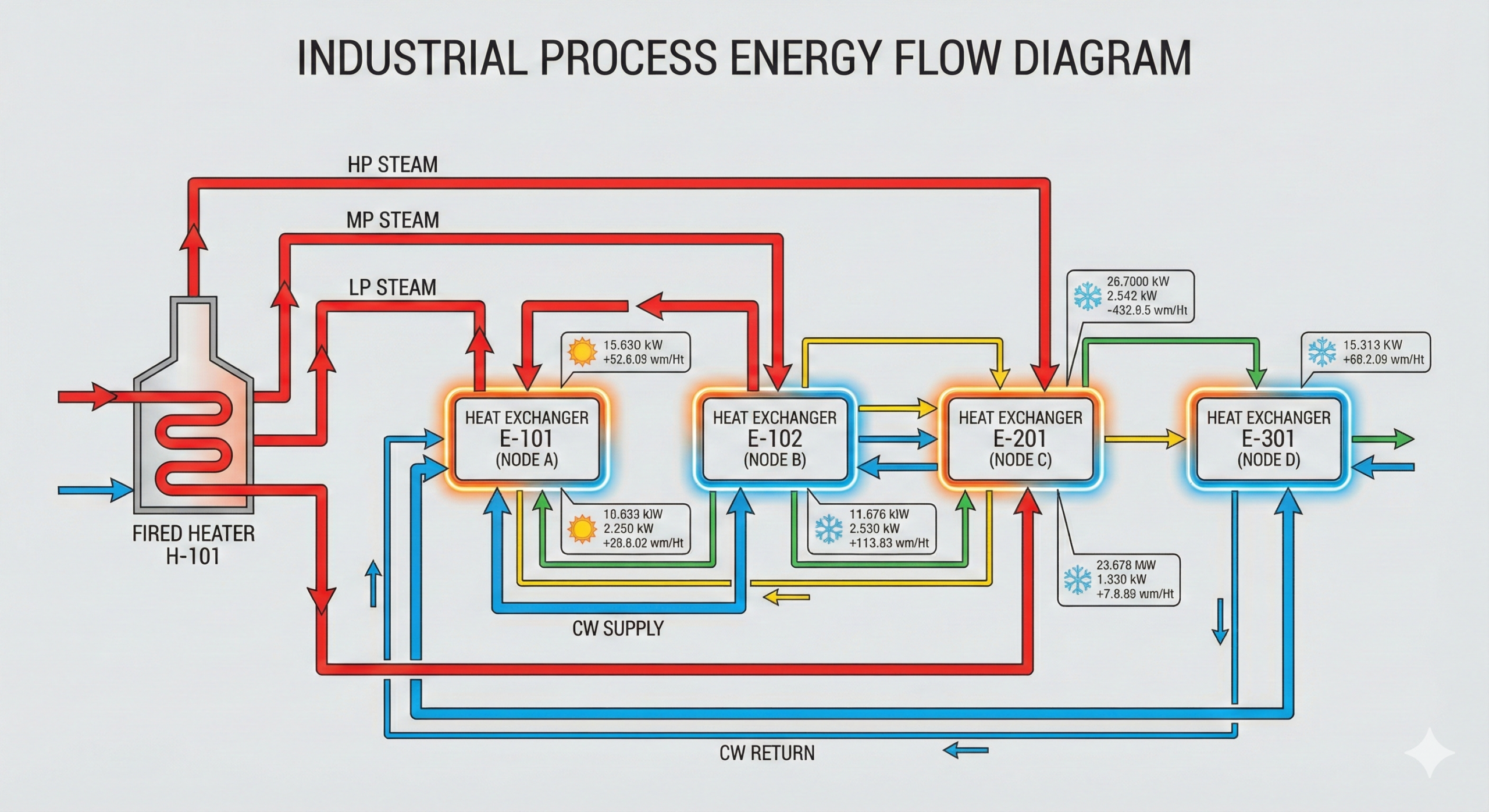
If we redraw plant energy flow and highlight only where energy crosses surfaces, we see:
- steam-to-process transfer
- process-to-process recovery
- process-to-cooling rejection
- flue gas recovery
All are exchanger-based.
Rotating equipment consumes electrical energy.
But thermal energy — which is often larger in magnitude — moves primarily through exchangers.
That is why exchangers dominate the thermal energy balance of process plants.
When Energy Balance Does Not Close
In plant energy studies, when discrepancies appear, investigation often leads back to:
- exchanger fouling
- incorrect temperature measurement around exchangers
- hidden heat losses in exchanger circuits
Because exchangers sit at the heart of energy movement.
Any inaccuracy there magnifies through the entire balance.
Final Perspective
Heat exchangers are where most of the plant’s thermal energy changes direction.
They are:
- entry points for steam energy
- exit points for rejected heat
- bridges for internal recovery
- regulators of temperature distribution
When exchanger performance improves, plant energy balance improves.
When exchanger performance declines, energy cost rises.
Understanding why heat exchangers dominate plant energy balance changes how they are prioritized.
They are not peripheral hardware.
They are the central pathways through which energy flows across the plant.
A practicing chemical engineer with 17+ years of experience in process design, project execution, commissioning, and plant operations. Focused on practical engineering judgment beyond textbook explanations.