
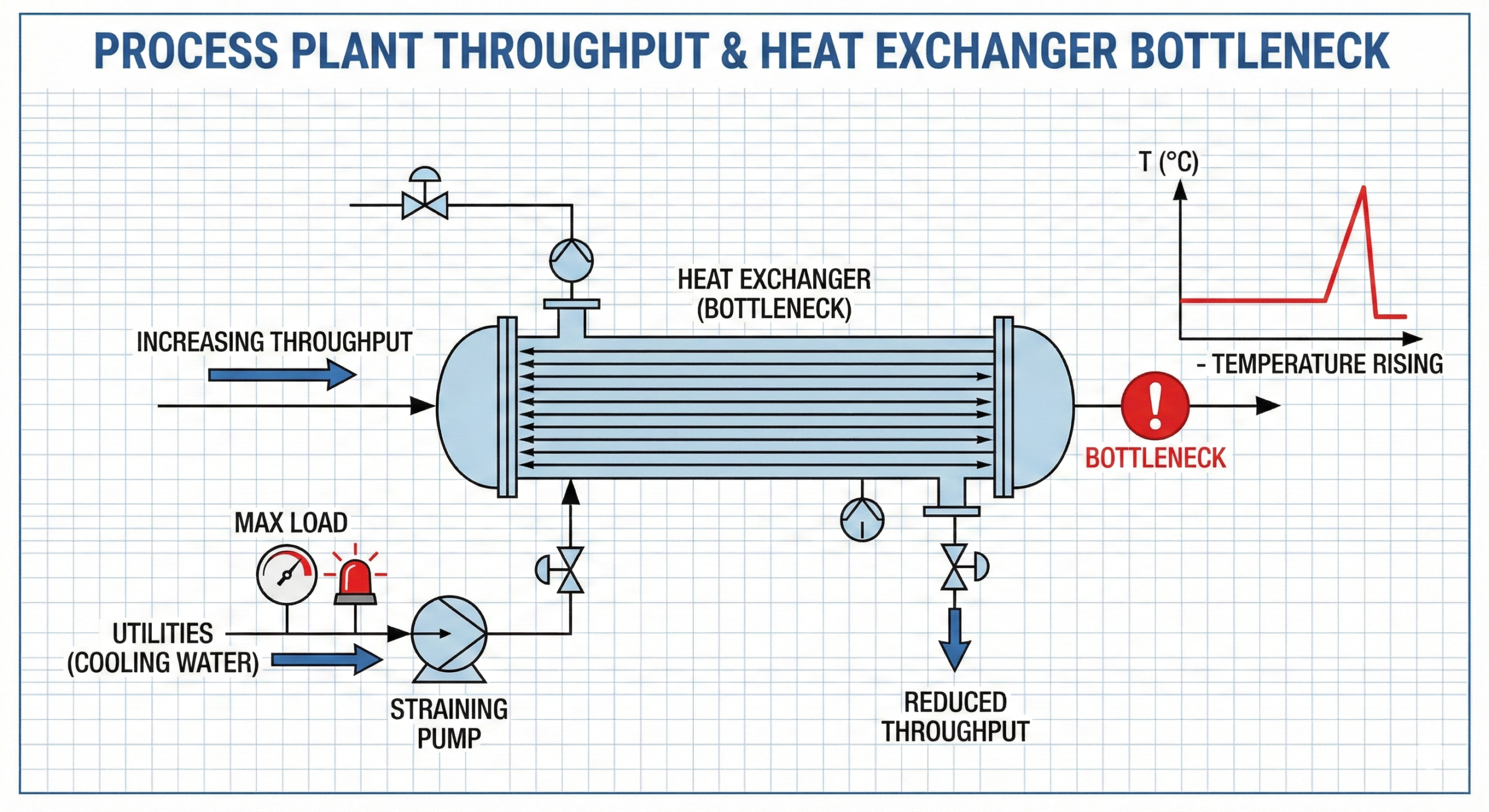
When production targets are not met, the first suspects are usually visible equipment:
- reactors
- compressors
- columns
- pumps
Heat transfer equipment is rarely blamed first.
And yet, in many process plants, the real ceiling on production is not reaction kinetics or mechanical capacity.
It is heat transfer.
Plants often discover this only after pushing harder:
- utilities increase
- temperatures begin drifting
- control becomes unstable
- quality starts fluctuating
Throughput appears to hit an invisible wall.
This article explains how heat transfer quietly limits plant capacity, why this limit is often misunderstood, and how recognizing it early changes the way plants grow.
Table of Contents
Throughput Always Means More Heat to Move
Every increase in production brings one unavoidable consequence:
More material processed means more heat that must be added or removed.
For example:
- More feed to a reactor → more heat of reaction to remove
- Higher column load → more condensation and reboiling needed
- Increased production rate → more cooling required downstream
Heat transfer demand rises directly with throughput.
If exchangers cannot handle the extra duty, the plant cannot safely move forward.
Why Heat Transfer Becomes the First Real Bottleneck
Mechanical equipment often has some overload tolerance.
Pumps can run slightly harder.
Compressors may handle small increases.
Tanks can accept small level fluctuations.
Heat transfer systems are different.
They operate close to thermal limits:
- temperature approaches are fixed
- utilities have finite capacity
- fouling reduces margin
- driving force cannot be forced beyond physics
So as throughput increases, heat transfer is often the first system to say:
“This is as far as we can go.”
Cooling Limitations Are the Most Common Constraint
One of the most frequent real-world bottlenecks is cooling capacity.
As production increases:
- more heat must be rejected
- cooling water absorbs more heat
- outlet temperatures start rising
Eventually:
- process streams stop cooling to required targets
- downstream units receive hotter feed
- separation efficiency drops
Operators then face a choice:
- reduce throughput
- increase utility load
- accept unstable operation
Cooling limits quietly define maximum production.
Heating Limitations Also Cap Throughput
Heating systems can become constraints too.
Examples include:
- reboilers unable to supply enough vapor
- feed preheaters not reaching target temperature
- steam systems reaching pressure limits
When heating duty falls short:
- columns lose separation efficiency
- reactions slow down
- product quality drifts
Throughput must then be reduced to maintain process stability.
Temperature Driving Force Shrinks as Load Increases
One of the most misunderstood reasons heat transfer limits throughput is this:
As flow increases, effective temperature driving force often decreases.
Why?
- fluids pass faster through exchangers
- residence time drops
- outlet temperatures move closer to inlet values
- pinch conditions become tighter
Even if exchanger area stays the same, performance weakens at higher loads.
So capacity is not only about area.
It is about driving force availability.
Fouling Turns Small Limits into Hard Limits
At moderate loads, fouling may not seem serious.
But at higher throughput:
- heat flux increases
- deposits form faster
- resistance grows
- U drops
Fouling consumes margin over time — one of the most persistent thermal problems in process plants
An exchanger that handled 100% load when clean may struggle at 110% load after fouling develops.
Throughput limits then appear earlier than expected.
Utilities Are Part of the Heat Transfer System
Plants often assume utilities are always available.
In reality:
- cooling water temperature rises in summer
- steam pressure drops during peak demand
- shared utility networks affect multiple units
At higher production rates:
- utility systems reach their limits
- heat rejection becomes harder
- exchanger performance drops
So even if process exchangers are sized well, utility limits can stop production growth.
Why Plants Can Run at Full Load Only After Cleaning
A common pattern seen in operating plants:
- After shutdown and cleaning → plant runs at high throughput
- After months of operation → capacity slowly reduces
This happens because:
- clean surfaces provide higher U
- fouling consumes margin over time
- heat transfer resistance increases
So throughput limits appear not as a sudden failure, but as a slow squeeze.
Cleaning temporarily removes the limit.
But the underlying thermal balance remains unchanged.
The Control System Hides the Limit — Until It Cannot
At first, control systems compensate:
- steam valves open more
- cooling water flow increases
- temperatures stay within limits
Because control systems respond to temperature signals rather than actual heat flow — a distinction clarified in heat versus temperature in process plants — the thermal constraint often remains hidden.
This gives the impression that the plant can handle higher load.
But as margins shrink:
- valves reach maximum opening
- utilities cannot increase further
- temperature control becomes unstable
At this point, the thermal limit becomes visible.
And it often feels sudden.
Why Throughput Limits Often Appear in Summer
Many plants observe:
- production targets are easier in winter
- performance drops in summer
This is not coincidence.
Higher ambient temperatures mean:
- cooling water enters warmer
- heat rejection becomes less effective
- temperature driving force reduces
So heat transfer limits appear seasonally, even when equipment has not changed.
Why Adding Equipment Does Not Always Remove the Limit
When plants hit throughput limits, the first reaction is often:
- add another exchanger
- increase utility supply
- push higher velocity
Sometimes this helps.
But often the real issue is:
- pinch points elsewhere in the system
- maldistribution
- fouling drivers
- utility network constraints
Without reviewing the full thermal balance, added equipment may shift the bottleneck instead of removing it.
Owner Perspective: Heat Transfer Defines Production Potential
From a business standpoint, heat transfer limits affect:
- maximum achievable throughput
- seasonal production stability
- energy consumption — directly affected by declining thermal performance as explained in heat transfer vs energy efficiency
- long-term expansion planning
Ignoring thermal limits leads to:
- missed production targets
- emergency capital spending
- repeated debottlenecking projects
Understanding heat transfer capacity early makes expansion predictable and stable.
A Simple Way to See the Limit
In many plants, heat transfer limits reveal themselves through small signals:
- utilities always at high load
- outlet temperatures slowly drifting
- operators manually adjusting valves frequently
- performance better immediately after cleaning
These are early signs that throughput is already pressing against thermal boundaries.
Why Heat Transfer Limits Are Often Underestimated
Heat transfer does not fail loudly.
It does not trip immediately.
It does not break suddenly.
Instead, it gradually tightens margins.
So the limit feels like:
- control instability
- quality fluctuation
- seasonal sensitivity
But the root cause is often simple:
The plant is trying to move more heat than the exchangers can handle.
Final Perspective
Every process plant has a thermal capacity limit.
That limit may not be written anywhere.
It may not appear on datasheets.
It may not be obvious at startup.
But it exists.
As throughput increases, heat transfer becomes the quiet gatekeeper.
This constraint ultimately reflects the same physical law that governs all heat movement, as explained in why heat transfer always occurs.
Plants that understand this:
- plan expansions better
- size exchangers with margin
- manage fouling more strategically
- avoid sudden production ceilings
Plants that ignore it often discover the limit only when growth stops.
Understanding how heat transfer limits plant throughput turns an invisible constraint into a manageable design reality.
If heat transfer defines how much a plant can produce, it also defines how efficiently it operates. When thermal performance drops, energy demand rises quietly across the system.
Read next: Heat Transfer vs Energy Efficiency – What Plants Actually Lose
Explore the complete series in the Heat Transfer Engineering Hub.

A practicing chemical engineer with 17+ years of experience in process design, project execution, commissioning, and plant operations. Focused on practical engineering judgment beyond textbook explanations.