In everyday plant language, these words are often used interchangeably:
- Heat exchanger
- Heater
- Cooler
Someone may say:
- “Start the exchanger.”
- “Increase heater duty.”
- “Check the cooler.”
Technically, all three involve temperature change.
But at the equipment level, they are not the same.
Their construction, energy source, operational behavior, and role in the plant energy network are fundamentally different.
This article clarifies the distinction — not from textbook heat transfer theory, but from how these pieces of equipment behave in real process plants.
Understanding this difference helps in:
- design selection
- troubleshooting
- energy optimization
- maintenance planning
Table of Contents
The Core Difference in One Line
Before going deeper, here is the simplest distinction:
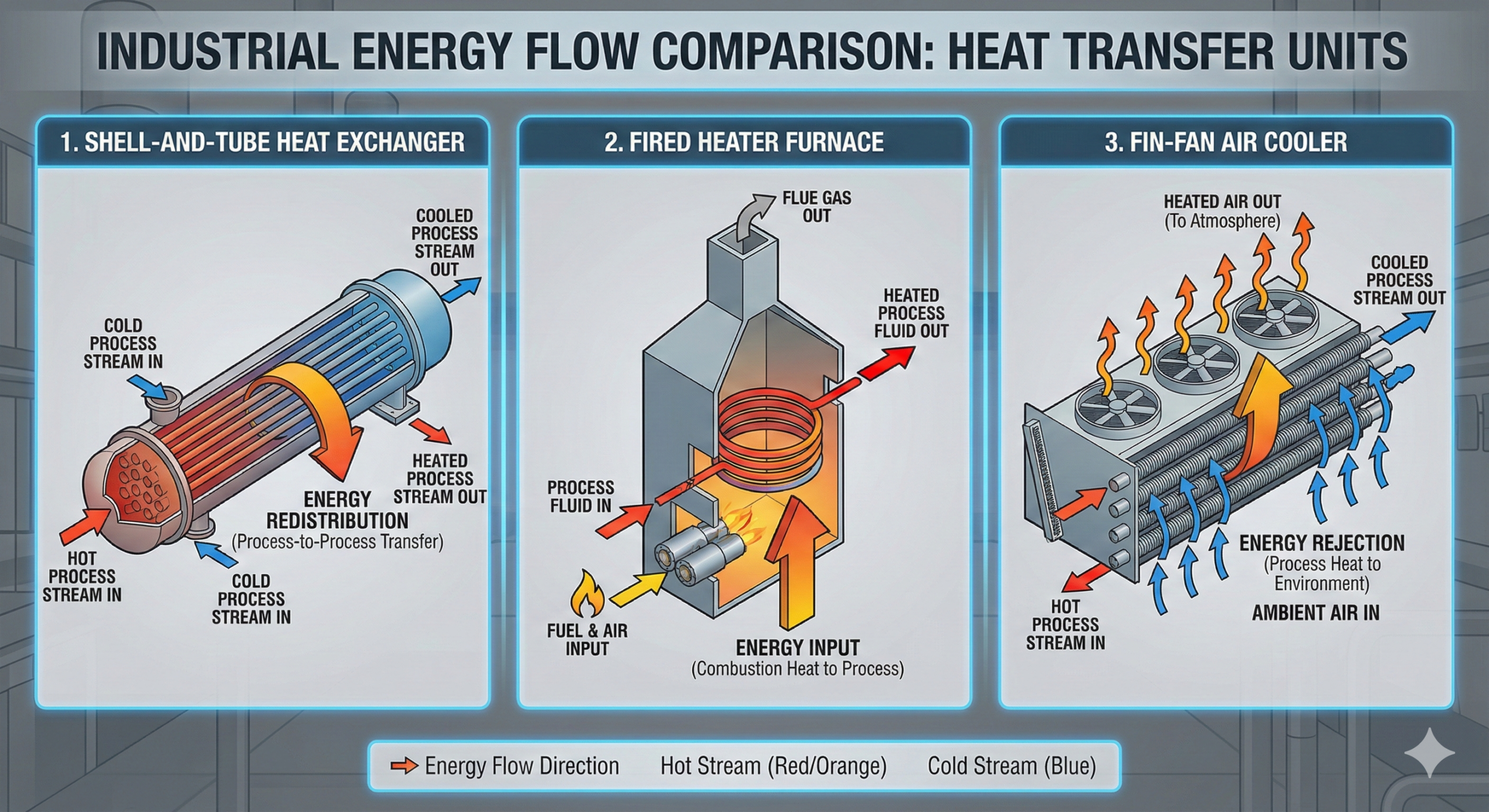
- A heat exchanger transfers heat between two process or utility streams.
- A heater adds energy from an external source (usually combustion or electricity).
- A cooler removes energy from the process, usually rejecting it to a utility or environment.
All three change temperature.
But how they do it — and what that means for plant behavior — is very different.
Heat Exchanger – Energy Redistribution Equipment
A heat exchanger does not create or destroy energy.
It moves energy from one stream to another.
Typical examples:
- process-to-process exchangers
- feed-effluent exchangers
- steam condensers
- cooling water exchangers
The key feature:
Two fluids exchange energy across a barrier.
No combustion.
No electrical heating element.
No direct energy generation.
Heat exchangers redistribute energy within the plant or between process and utility systems.
Equipment-Level Characteristics
Heat exchangers typically:
- have two fluid circuits
- separate fluids by metal walls
- operate continuously
- depend on temperature difference
They are passive equipment in the sense that they do not generate energy.
They rely on existing thermal differences.
Operational Behavior
Their performance depends on:
- surface condition
- flow distribution
- fouling
- temperature driving force
If fouling builds:
- performance drops gradually.
They rarely create sudden thermal spikes.
They tend to degrade slowly over time.
Heater – Energy Input Equipment
A heater adds energy from an external source.
Common examples:
- fired heaters
- electric heaters
- steam heaters (when steam is the energy source)
Unlike a simple exchanger, a heater:
Introduces new energy into the system.
It increases the total enthalpy of the process network.
Fired Heater Case
In a fired heater:
- fuel is burned
- chemical energy converts to thermal energy
- heat enters process tubes
This is not redistribution.
This is energy generation within the unit.
Equipment-Level Characteristics
Heaters:
- involve combustion or electrical power
- have control over energy input rate
- directly affect plant energy consumption
They are often large energy cost drivers.
Operational Behavior
Heaters are dynamic.
Changing firing rate:
- immediately changes heat input
- shifts temperature profile
- affects downstream units
They can respond quickly to control actions.
But they also introduce:
- combustion risk
- flame management
- fuel supply dependency
They are active energy sources.
Cooler – Energy Rejection Equipment
A cooler removes heat from the process.
Typical examples:
- air coolers
- cooling water exchangers
- chilled water exchangers
A cooler does not generate energy.
It removes energy and rejects it to:
- air
- water
- atmosphere
In the plant energy balance, coolers are exit points.
Equipment-Level Characteristics
Coolers:
- connect process to cooling utility
- reduce temperature
- often operate near ambient conditions
They are essential for:
- stabilizing product
- protecting equipment
- condensing vapors
Operational Behavior
Coolers are strongly influenced by:
- ambient temperature
- cooling water supply
- air flow (in air coolers)
In summer, performance often drops.
So coolers are sensitive to environmental conditions.
Why the Distinction Matters in Real Plants
At first glance, the difference seems semantic.
But at equipment level, it influences:
- design philosophy
- cost structure
- control strategy
- maintenance approach
Energy Impact
Heater:
- increases plant energy input.
Heat exchanger:
- redistributes internal energy.
Cooler:
- increases plant energy rejection.
If steam consumption rises:
- investigate heaters and exchangers.
If cooling tower load rises:
- investigate coolers and condensers.
Understanding which equipment type is involved helps target energy audits.
Control Strategy Differences
Heaters:
- controlled by adjusting firing rate or power input.
Heat exchangers:
- controlled by flow or temperature difference.
Coolers:
- influenced by utility temperature and flow.
These differences affect control loop design and response speed.
Maintenance Differences
Heaters require:
- burner inspection
- refractory checks
- fuel system maintenance
Heat exchangers require:
- cleaning
- tube inspection
- gasket replacement
Coolers require:
- fin cleaning
- air fan maintenance
- water side descaling
Different equipment types demand different maintenance strategies.
Risk Profile Differences
Heaters carry combustion risks.
Heat exchangers carry:
- leakage risk
- cross-contamination risk
Coolers carry:
- environmental dependency risk
- seasonal performance variation
So operational risk differs across equipment types.
Where Confusion Usually Happens
The confusion often arises when:
- steam is used in an exchanger
Is it a heater or exchanger?
From energy standpoint:
- if steam condenses and transfers heat to process → it is a heat exchanger connecting process to steam utility.
From plant energy standpoint:
- steam was generated in a boiler → so total energy originated elsewhere.
So classification depends on perspective.
Equipment-level classification focuses on construction and role.
Why Equipment-Level Thinking Matters
If someone says:
“The exchanger is not giving enough heat.”
The response depends on equipment type:
If it is a heater:
- increase firing rate.
If it is a process exchanger:
- check fouling.
If it is a cooler:
- check cooling water temperature.
Same temperature problem.
Different equipment solution.
Owner Perspective
From a cost standpoint:
Heaters:
- drive fuel cost.
Heat exchangers:
- influence energy efficiency.
Coolers:
- influence cooling utility cost and environmental load.
Misidentifying equipment type can lead to wrong cost-saving strategies.
Process Map Perspective
If we look at plant layout:
Heaters sit at energy input points.
Heat exchangers sit at transition and recovery points.
Coolers sit at energy rejection points.
They define energy direction across the plant.
Why This Distinction Becomes Critical in Revamps
During debottlenecking or expansion:
- increasing heater firing increases total energy input.
- improving exchanger performance improves efficiency.
- upgrading coolers improves rejection capacity.
Each decision has different economic and operational implications.
Treating them as identical thermal devices can lead to poor design choices.
Final Perspective
Heat exchangers, heaters, and coolers all change temperature.
But at equipment level, they serve different roles:
- Heat exchangers move energy within the plant.
- Heaters introduce new energy into the plant.
- Coolers remove energy from the plant.
Understanding this distinction improves:
- troubleshooting accuracy
- energy analysis clarity
- maintenance planning
- revamp decision-making
They may look similar on P&IDs.
But in real process plants, their behavior, impact, and economic influence are fundamentally different.

A practicing chemical engineer with 17+ years of experience in process design, project execution, commissioning, and plant operations. Focused on practical engineering judgment beyond textbook explanations.