
When engineers discuss industrial heat exchangers, the conversation usually revolves around:
- shell-and-tube exchangers
- plate heat exchangers
- air coolers
- compact exchangers
Double pipe heat exchangers rarely receive the same attention.
They are often viewed as:
- old-fashioned
- small-capacity equipment
- suitable only for minor duties
As a result, many young engineers assume double pipe exchangers have become obsolete.
The reality is very different.
While they no longer dominate large industrial installations, double pipe heat exchangers continue to solve specific engineering problems exceptionally well.
In the right service, they can be:
- simpler
- cheaper
- easier to maintain
- more flexible
than larger and more complex exchanger designs.
This article explores where double pipe heat exchangers still make engineering sense and why they remain part of the modern heat exchanger toolkit.
What Is a Double Pipe Heat Exchanger?
The Basic Configuration
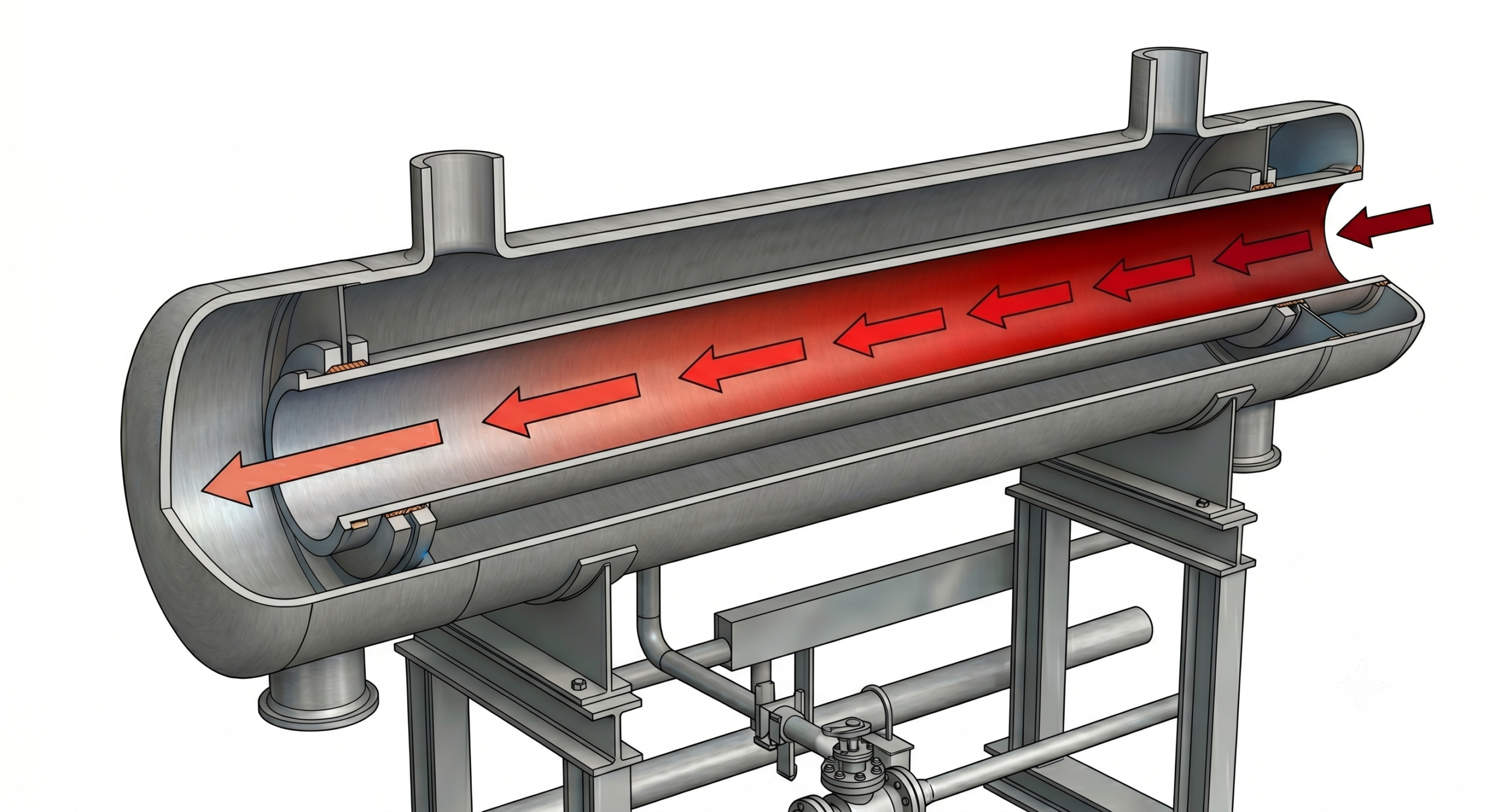
A double pipe heat exchanger consists of:
- one pipe inside another pipe
One fluid flows through the inner pipe.
The second fluid flows through the annular space between the two pipes.
Heat transfers through the wall of the inner pipe.
The concept is extremely simple.
Unlike shell-and-tube exchangers, there are:
- no tube bundles
- no tube sheets
- no baffles
- no channel heads
The exchanger is essentially a pipe-within-a-pipe arrangement.
Why Double Pipe Exchangers Were Popular Historically
Simplicity Was Their Biggest Strength
Before modern fabrication techniques became widespread, double pipe exchangers offered a straightforward solution for:
- small process duties
- pilot plants
- utility services
They required:
- simple fabrication
- minimal maintenance
- relatively low capital cost
Many of those advantages remain relevant today.
Understanding Their Real Limitation
Surface Area Becomes the Constraint
Heat exchanger capacity depends heavily on available surface area.
In a double pipe exchanger:
- surface area increases only with pipe length
For small duties, this is acceptable.
For large duties, the required length becomes excessive.
This is the primary reason why shell-and-tube exchangers replaced double pipe units in many industrial applications.
The limitation is not performance.
The limitation is scalability.
Where Double Pipe Exchangers Still Excel
Small-Duty Process Services
Many industrial systems require modest heating or cooling.
Examples include:
- sample systems
- chemical injection systems
- analyzer loops
- utility side services
In these applications:
- heat duty is limited
- simplicity is valuable
- compact installation is possible
A double pipe exchanger often provides the most practical solution.
High Pressure Differential Applications
Pressure Can Be More Important Than Duty
Certain services involve large pressure differences between streams.
Examples include:
- gas heating systems
- hydraulic fluid cooling
- specialized process loops
The simple geometry of double pipe exchangers allows them to tolerate significant pressure differentials.
The inner pipe acts as a strong pressure boundary.
This makes them attractive in services where pressure containment is critical.
Pilot Plants and Research Facilities
Flexibility Matters More Than Capacity
Pilot plants frequently operate under changing conditions.
Engineers may need to:
- modify flow rates
- test different fluids
- alter operating temperatures
Double pipe exchangers are well suited to these environments because they are:
- simple to install
- easy to modify
- relatively inexpensive to replace
Their flexibility often outweighs thermal efficiency considerations.
Batch Processing Systems
Not Every Process Runs Continuously
Many specialty chemical and pharmaceutical operations use batch processing.
These systems often require:
- moderate heat duties
- intermittent operation
- simple maintenance
Double pipe exchangers fit naturally into such applications.
Their straightforward construction simplifies operation and troubleshooting.
Viscous Fluid Services
Large Flow Passages Can Be Beneficial
Highly viscous fluids create challenges in many exchanger designs.
Narrow passages may cause:
- excessive pressure drop
- cleaning difficulty
- flow maldistribution
Double pipe exchangers can be designed with relatively large flow areas.
This helps accommodate viscous fluids more effectively in some applications.
Corrosive Services
Material Selection Can Be Simplified
When handling corrosive fluids:
- material cost becomes important
Constructing a large shell-and-tube exchanger from exotic alloys can be expensive.
For small duties, a double pipe exchanger made from corrosion-resistant material may provide a more economical solution.
The simplicity of the design reduces fabrication complexity.
Remote and Modular Installations
Simplicity Supports Reliability
Remote facilities often prioritize:
- reliability
- ease of maintenance
- minimal spare parts
Examples include:
- gas gathering stations
- remote utility systems
- skid-mounted packages
Double pipe exchangers fit these requirements well.
Their simplicity reduces maintenance demands and simplifies field repairs.
Why They Remain Popular in Packaged Equipment
Packaged Systems Favor Simplicity
Many equipment manufacturers incorporate double pipe exchangers into:
- packaged compressor systems
- lubrication skids
- hydraulic units
- specialty process packages
These systems often prioritize:
- compact assembly
- predictable performance
- ease of replacement
Double pipe exchangers align well with those objectives.
Maintenance Advantages
Easy Inspection and Repair
Maintenance personnel appreciate equipment that is easy to understand.
Double pipe exchangers offer:
- straightforward construction
- simple inspection procedures
- relatively easy replacement
There are fewer internal components compared to shell-and-tube exchangers.
This simplicity reduces maintenance complexity.
Why They Are Rarely Used for Large Duties
Length Becomes Impractical
As heat duty increases:
- more surface area is required
For double pipe exchangers, this means:
- longer pipe runs
- larger installation footprints
- increased support requirements
Eventually, the design becomes impractical.
At that point:
- shell-and-tube exchangers
- plate exchangers
become more economical.
This is why double pipe exchangers are rarely seen in major process units.
Pressure Drop Can Become Significant
Long Flow Paths Create Resistance
To increase heat transfer area, exchanger length increases.
Longer flow paths create:
- higher friction losses
- increased pumping requirements
- larger pressure drops
This becomes another limiting factor for larger applications.
The exchanger may meet thermal requirements but fail hydraulic requirements.
Limited Compactness
Surface Area Density Is Low
Compared to modern compact exchangers:
- double pipe designs require more physical length
- area utilization is lower
In space-constrained facilities, this can be a significant disadvantage.
Compactness is not their strength.
Simplicity is.
Why Engineers Sometimes Overlook Them
Bigger Equipment Often Gets More Attention
Engineering discussions often focus on:
- large exchangers
- complex systems
- advanced technologies
As a result, simple solutions may be ignored.
Yet many successful designs come from choosing the simplest equipment capable of performing the required duty.
Double pipe exchangers often fall into that category.
Selection Logic: When They Make Sense
Strong Candidates
Double pipe exchangers are often good choices when:
- heat duty is small
- pressure differential is high
- simplicity is important
- maintenance access is limited
- modular construction is preferred
- pilot-scale flexibility is needed
These conditions align with their strengths.
Selection Logic: When They Do Not
Better Alternatives Usually Exist When
- heat duty is large
- footprint must be minimized
- energy recovery requirements are significant
- pressure drop is tightly restricted
- future expansion is expected
In these situations, other exchanger types generally provide better economics.
Operator Perspective
Operators often appreciate double pipe exchangers because:
- performance is predictable
- operation is straightforward
- troubleshooting is simple
There are fewer internal components that can create unexpected problems.
This simplicity translates into operational confidence.
Owner Perspective
From a business standpoint, double pipe exchangers offer:
- low capital cost for small duties
- simple maintenance
- reliable operation
- straightforward replacement
For appropriately sized applications, they often provide excellent lifecycle value.
Why They Continue to Survive in Modern Plants
Many exchanger technologies have evolved dramatically.
Yet double pipe exchangers continue to appear in new projects.
The reason is simple:
Some engineering problems do not require sophisticated solutions.
For certain services, the simplest design remains the most practical.
And few exchanger types are simpler than a double pipe exchanger.
Final Perspective
Double pipe heat exchangers no longer dominate industrial heat transfer applications.
Large process duties are usually handled by:
- shell-and-tube exchangers
- plate exchangers
- air coolers
- compact exchanger technologies
However, for:
- small duties
- high-pressure differential services
- pilot plants
- packaged equipment
- modular systems
double pipe exchangers remain highly relevant.
Their continued use is a reminder of an important engineering principle:
The best equipment is not always the most advanced.
It is the equipment that solves the problem effectively, reliably, and economically.
And in the right service, the humble double pipe heat exchanger still does exactly that.

A practicing chemical engineer with 17+ years of experience in process design, project execution, commissioning, and plant operations. Focused on practical engineering judgment beyond textbook explanations.