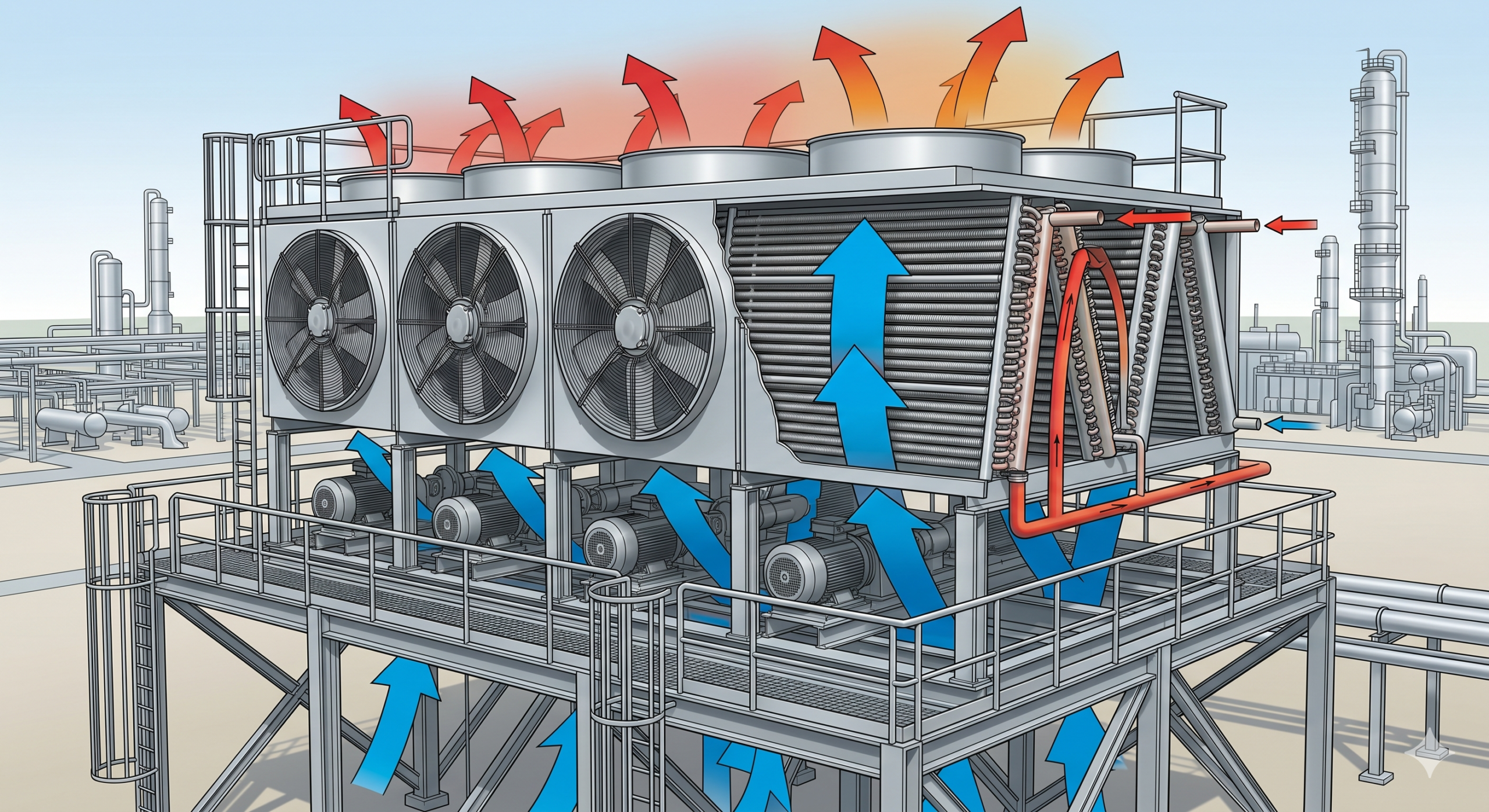
Air-cooled heat exchangers are among the most recognizable pieces of equipment in industrial plants.
Mounted high on structural frames with large fans underneath, they are often viewed as a simple alternative to water-cooled systems.
The selection logic appears straightforward:
- no cooling water required
- lower water treatment costs
- reduced environmental discharge
- independence from cooling towers
Because of these advantages, air-cooled heat exchangers have become standard equipment in:
- refineries
- petrochemical complexes
- gas processing plants
- LNG facilities
- remote industrial sites
However, air cooling is not a free solution.
Every advantage comes with a trade-off.
While air coolers eliminate dependence on cooling water, they introduce limitations related to:
- ambient temperature
- weather conditions
- plot space
- fan power consumption
- seasonal performance variation
This article explores the practical limits and real-world constraints of air-cooled heat exchangers and explains why their selection requires much more than a simple utility comparison.
Table of Contents
Why Air-Cooled Heat Exchangers Exist
The Basic Purpose
Every process plant must reject excess heat.
Traditionally, this heat is removed using:
- cooling water systems
- cooling towers
- once-through water systems
But water is not always available.
Some facilities operate in:
- deserts
- offshore platforms
- remote gas fields
- regions with water restrictions
In these situations, air becomes the only practical cooling medium.
Air-cooled heat exchangers transfer heat directly from process fluids to atmospheric air without requiring an intermediate water system.
How Air-Cooled Heat Exchangers Work
The Equipment Arrangement
In most air coolers:
- process fluid flows inside tubes
- ambient air flows across finned tube surfaces
Large fans force air through the tube bundle.
The fins increase external surface area because air has much lower heat transfer capability than water.
Without fins, the exchanger would become excessively large.
The entire design is built around overcoming the limitations of air as a cooling medium.
Air Is a Weak Cooling Medium
The Fundamental Constraint
The biggest limitation of air coolers is simple:
Air removes heat far less effectively than water.
Compared with cooling water, air has:
- lower density
- lower heat capacity
- poorer heat transfer characteristics
As a result:
- larger surface areas are required
- larger equipment is needed
- more airflow must be generated
This reality influences every aspect of air cooler design.
Ambient Temperature Controls Everything
Cooling Performance Cannot Beat the Weather
Cooling water systems can often provide relatively stable temperatures.
Air coolers cannot.
Their performance depends directly on ambient air temperature.
When ambient temperature rises:
- cooling capacity decreases
- process outlet temperatures increase
- operating margins shrink
Unlike cooling water systems, air coolers have no independent temperature source.
They are completely dependent on local climate.
Summer Is the Real Design Challenge
Plants Must Survive the Hottest Day
Air coolers are usually sized based on peak summer conditions.
This means engineers often design for:
- maximum ambient temperature
- worst-case solar load
- minimum cooling margin
During winter:
- performance may appear excellent
During summer:
- the same equipment may struggle to achieve target temperatures
This seasonal variation is one of the most important practical realities of air cooling.
Temperature Approach Is Limited
Air Cooling Has Natural Boundaries
In any cooling system, the process outlet temperature approaches the cooling medium temperature.
With air coolers:
- process temperature can only approach ambient air temperature
It cannot realistically cool below ambient conditions without additional refrigeration.
This limitation becomes important when:
- low outlet temperatures are required
- climate is hot
- process specifications are tight
The closer the target temperature is to ambient air, the larger and more expensive the exchanger becomes.
Plot Space Requirements Are Significant
Air Cooling Requires Area
Because air is a weak cooling medium:
- large bundles are required
- multiple fan bays may be needed
- elevated structures become necessary
Compared to water-cooled exchangers, air coolers often occupy substantially more space.
In greenfield facilities this may be manageable.
In brownfield projects, available plot space can become a major constraint.
Fan Power Is Not Free
Water Savings Come With Electrical Cost
Air coolers eliminate cooling water consumption.
However, they require:
- large electric motors
- continuous fan operation
- electrical infrastructure
As airflow requirements increase:
- fan power increases
- operating cost rises
The plant essentially exchanges water consumption for electrical consumption.
The economic balance depends on local utility costs.
Air Distribution Is Critical
Not All Air Reaches Every Tube Equally
Uniform airflow is essential.
If air distribution becomes uneven:
- some tube sections receive adequate cooling
- other sections become thermally overloaded
Causes include:
- damaged fans
- poor plenum design
- recirculation effects
- structural obstructions
Even a well-designed exchanger can underperform if airflow distribution is poor.
Air Recirculation Creates Hidden Problems
Hot Air Can Return to the Inlet
One of the most common air cooler problems is recirculation.
This occurs when hot discharge air returns to the fan inlet.
Instead of drawing fresh ambient air:
- the fan pulls partially heated air
The result:
- higher inlet temperature
- reduced cooling capacity
- unexpected performance loss
Recirculation becomes more severe when:
- equipment spacing is poor
- wind conditions are unfavorable
- structures interfere with airflow
Wind Can Help or Hurt Performance
Nature Influences Equipment Operation
Unlike water-cooled systems, air coolers interact directly with the environment.
Strong winds may:
- improve airflow
- disrupt airflow
- increase recirculation
- create uneven cooling
Performance can vary significantly depending on plant layout and local weather patterns.
This is a constraint unique to air-cooled systems.
Fouling Still Exists
Air Cooling Does Not Eliminate Maintenance
A common misconception is that air coolers are maintenance-free.
In reality, fins can accumulate:
- dust
- sand
- pollen
- hydrocarbons
- industrial contaminants
As deposits accumulate:
- airflow decreases
- thermal performance drops
- fan loading changes
Regular cleaning remains necessary.
The fouling mechanism differs from water systems, but it still exists.
Fin Damage Reduces Performance
Surface Area Is Everything
The effectiveness of an air cooler depends heavily on fin integrity.
Damaged fins reduce:
- available area
- airflow characteristics
- thermal performance
Common causes include:
- cleaning damage
- corrosion
- mechanical impact
Since fins provide most of the external area, even moderate damage can affect performance noticeably.
Noise Can Become a Design Issue
Large Fans Create Operational Challenges
Air coolers often generate significant noise.
Sources include:
- fan blades
- airflow turbulence
- motor operation
In facilities near:
- residential areas
- offices
- environmentally sensitive zones
noise restrictions may influence equipment design.
Additional mitigation measures can increase project cost.
Air Coolers Are Sensitive to Capacity Increases
Debottlenecking Is Not Always Easy
When plant throughput increases:
- more heat must be rejected
- cooling demand rises
For water-cooled exchangers, increasing cooling water flow may help.
For air coolers:
- airflow may already be near practical limits
- fan upgrades may be insufficient
- additional bays may be required
Capacity expansion can become expensive.
Why Air Coolers Dominate Certain Industries
The Water Availability Question
Despite their limitations, air coolers remain extremely popular because water often creates bigger problems.
Cooling water systems require:
- water supply
- treatment facilities
- cooling towers
- chemical control
- environmental management
Air cooling avoids all of these.
In many locations, that advantage outweighs the performance penalties.
Operator Perspective
Operators often observe air cooler limitations through:
- higher summer outlet temperatures
- changing performance with weather
- fan maintenance requirements
- seasonal operating adjustments
Unlike many exchangers, air coolers constantly interact with environmental conditions.
Operating experience is therefore closely tied to climate.
Owner Perspective
From a business perspective, air coolers offer:
- reduced water dependency
- lower environmental discharge
- simplified utility systems
However, they also require:
- larger capital investment
- significant structural support
- electrical power for fans
- larger plot space
Selection becomes an economic trade-off rather than a purely thermal decision.
When Air Cooling Makes the Most Sense
Strong Candidates
Air-cooled heat exchangers are often the preferred choice when:
- water is scarce
- environmental regulations are strict
- remote operation is required
- utility simplicity is valuable
Less Suitable Situations
They become less attractive when:
- very low outlet temperatures are required
- plot space is limited
- ambient temperatures are extremely high
- seasonal performance variation is unacceptable
Understanding these boundaries is essential during selection.
Final Perspective
Air-cooled heat exchangers solve one of industry’s biggest utility challenges: dependence on cooling water.
But eliminating water does not eliminate constraints.
Instead, the plant becomes dependent on:
- ambient temperature
- airflow quality
- weather conditions
- fan performance
- available space
This is why successful air cooler selection requires more than comparing heat duties.
It requires understanding the realities of climate, layout, operations, and long-term plant behavior.
Air-cooled heat exchangers are not simply water coolers without water.
They are a completely different cooling philosophy—with their own strengths, limitations, and trade-offs.

A practicing chemical engineer with 17+ years of experience in process design, project execution, commissioning, and plant operations. Focused on practical engineering judgment beyond textbook explanations.