Plate heat exchangers have earned a strong reputation in modern industry.
They are:
- compact
- efficient
- lightweight
- easy to expand
- capable of achieving very close temperature approaches
Because of these advantages, engineers sometimes view them as a superior alternative to traditional shell-and-tube exchangers.
But in real process plants, exchanger selection is rarely that simple.
A plate heat exchanger can be the perfect solution in one service and a costly mistake in another.
The key is understanding where its strengths align with process requirements—and where its limitations become operational problems.
This article explores when plate heat exchangers make sense, when they do not, and how engineers evaluate the trade-offs before selecting them.
Table of Contents
Understanding What Makes Plate Exchangers Different
The Core Design Philosophy
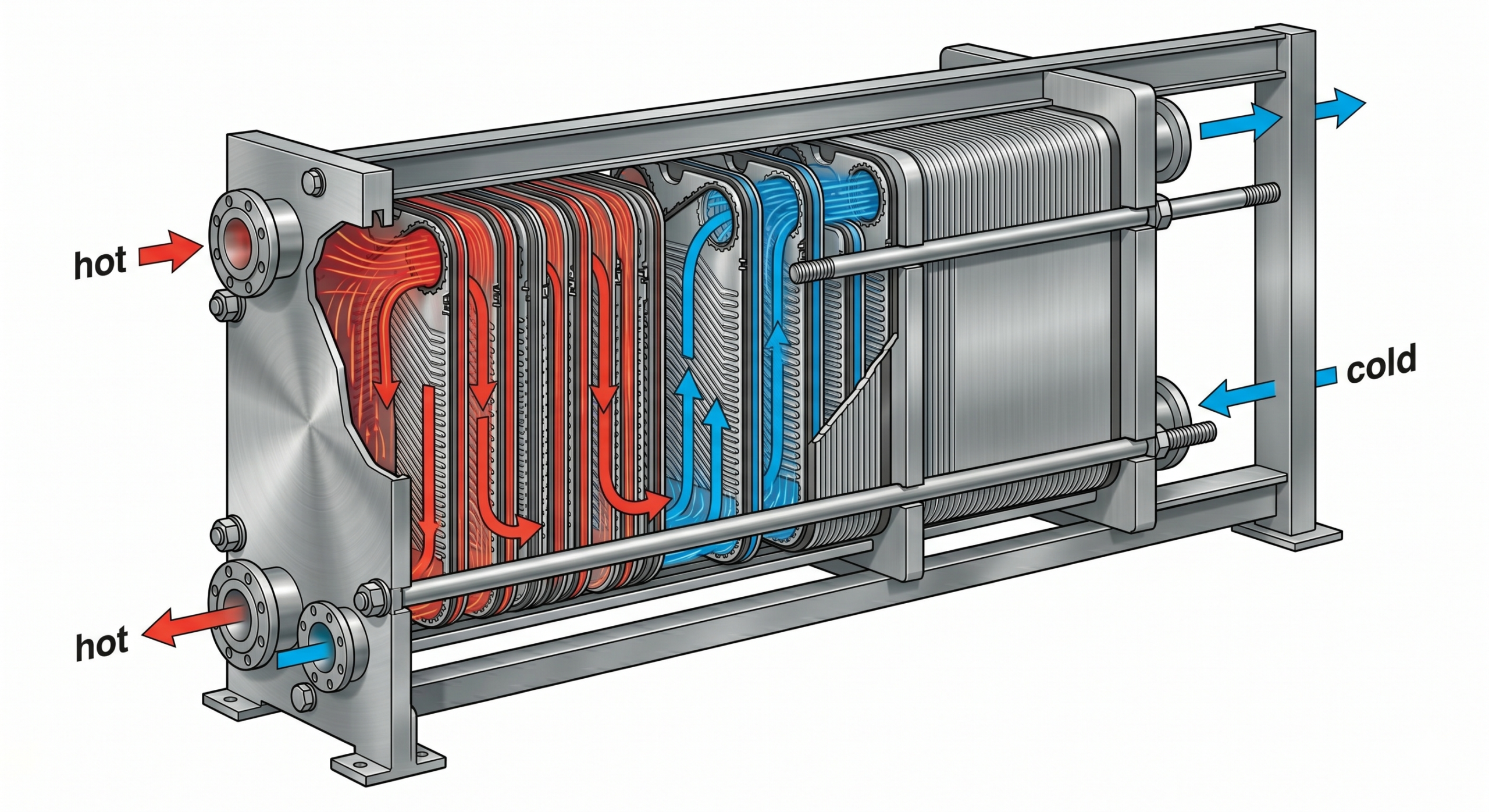
Unlike shell-and-tube exchangers that use bundles of tubes, plate heat exchangers use a series of thin metal plates stacked together.
The plates create alternating channels.
- One fluid flows through one channel.
- The second fluid flows through the adjacent channel.
Heat passes through the thin plate separating the fluids.
The result is a very large heat transfer surface packed into a relatively small volume.
This compactness is the foundation of most plate exchanger advantages.
Why Plate Exchangers Became Popular
Higher Thermal Efficiency in Smaller Space
One of the biggest attractions of plate exchangers is their ability to achieve high heat transfer rates.
The plate corrugations create:
- strong turbulence
- continuous fluid mixing
- improved surface utilization
As a result, they often require much less surface area than a comparable shell-and-tube exchanger.
For plant designers dealing with limited space, this can be extremely valuable.
When Plate Heat Exchangers Make Sense
Clean Liquid-to-Liquid Services
The Ideal Application
Plate exchangers perform exceptionally well when both fluids are:
- relatively clean
- low in solids
- low in fouling tendency
- moderate in viscosity
Examples include:
- cooling water systems
- clean chemical streams
- food processing fluids
- pharmaceutical applications
- HVAC systems
In these services, narrow channels remain open and thermal performance stays high.
This is where plate exchangers often outperform larger alternatives.
When Space Is Limited
Compactness Can Be a Major Advantage
Plant expansions frequently face space constraints.
A shell-and-tube exchanger may require:
- additional structural steel
- larger foundations
- more plot area
A plate exchanger may fit into existing space.
For brownfield projects, this can significantly reduce project cost and installation complexity.
In some cases, compactness alone justifies the selection.
When Energy Recovery Is Important
Plate Exchangers Excel at Close Temperature Approaches
Many heat recovery applications require:
- hot streams to transfer as much heat as possible
- cold streams to reach temperatures very close to the hot stream outlet
Plate exchangers can often achieve tighter temperature approaches than shell-and-tube units.
This improves:
- energy recovery
- steam savings
- cooling water reduction
For energy integration projects, this capability is often extremely attractive.
When Future Expansion Is Possible
Capacity Can Often Be Increased Easily
One advantage of gasketed plate exchangers is flexibility.
If additional duty is needed:
- plates can often be added
- surface area can be increased
- expansion may not require a complete replacement
This flexibility can support future plant growth more easily than some traditional exchanger designs.
When Fast Maintenance Is Required
Maintenance Can Be Simple
Many gasketed plate exchangers can be opened quickly.
Maintenance teams can:
- inspect plates
- clean deposits
- replace damaged gaskets
without removing large tube bundles.
In facilities where downtime is expensive, this accessibility is valuable.
When Plate Heat Exchangers Do Not Make Sense
Dirty or Fouling Services
Narrow Channels Become a Problem
The same narrow channels that improve efficiency can create operational challenges.
If fluids contain:
- suspended solids
- fibers
- scale-forming materials
- catalyst fines
- sludge
channel blockage becomes more likely.
As deposits accumulate:
- pressure drop rises
- flow distribution deteriorates
- performance declines rapidly
In these services, shell-and-tube exchangers are often the safer choice.
High-Fouling Hydrocarbon Services
Industrial Reality Matters
Many refinery and petrochemical streams experience:
- coke formation
- polymerization
- scaling
- particulate contamination
These conditions can quickly reduce plate exchanger effectiveness.
Repeated cleaning may eliminate the thermal efficiency advantage.
The exchanger becomes difficult to operate economically.
Very High Pressure Applications
Mechanical Limits Matter
Modern plate exchangers can handle significant pressures.
However, extremely high-pressure services often favor shell-and-tube construction.
Examples include:
- hydrogen systems
- synthesis gas services
- high-pressure reactor circuits
These applications place heavy demands on mechanical integrity.
Shell-and-tube units generally offer greater design flexibility under severe pressure conditions.
Very High Temperature Services
Gaskets Become a Limitation
Many plate exchangers rely on elastomer gaskets.
These gaskets have temperature limits.
As temperature increases:
- gasket aging accelerates
- sealing reliability decreases
- maintenance frequency increases
For severe temperature conditions, welded or shell-and-tube designs are often preferred.
Services Requiring Frequent Mechanical Cleaning
Accessibility Depends on Fouling Type
Plate exchangers are easy to open.
But some fouling mechanisms require aggressive mechanical cleaning.
Examples include:
- hard scale deposits
- coke layers
- abrasive solids
Repeated cleaning can damage plates.
In such services, tube bundles may tolerate maintenance better.
Large Process Duties
Bigger Is Not Always Better
As duty increases dramatically:
- plate count increases
- frame size grows
- maintenance becomes more complex
At very large capacities, shell-and-tube exchangers may become more practical.
The selection depends on the overall process economics.
Why Plate Exchangers Sometimes Disappoint
Wrong Selection Is the Real Problem
Most plate exchanger failures are not caused by poor equipment.
They are caused by poor application selection.
A plate exchanger chosen for a service it was never meant to handle may experience:
- excessive fouling
- gasket failures
- hydraulic instability
- high maintenance cost
The equipment is blamed when the real issue is improper selection logic.
Comparing Selection Priorities
Choose a Plate Exchanger When
- fluids are relatively clean
- space is limited
- thermal efficiency is critical
- energy recovery is important
- maintenance access is valuable
- pressure and temperature are moderate
Be Cautious When
- solids are present
- fouling is severe
- pressure is extremely high
- temperatures are very high
- mechanical cleaning is frequent
These factors often determine success or failure.
Operator Perspective
Operators typically appreciate plate exchangers because they:
- respond quickly
- occupy little space
- achieve excellent temperature control
However, when fouling begins, performance can decline quickly.
The operating experience depends heavily on fluid cleanliness.
Owner Perspective
From a business standpoint, plate exchangers offer:
- lower footprint requirements
- excellent energy efficiency
- expansion flexibility
- reduced utility consumption
But these benefits only materialize when the service matches the equipment’s strengths.
Selecting a plate exchanger for the wrong application can increase maintenance costs and reduce reliability.
Why “More Efficient” Is Not the Same as “Better”
One of the biggest misconceptions in exchanger selection is equating thermal efficiency with overall suitability.
A plate exchanger may transfer heat more effectively.
But exchanger selection also involves:
- reliability
- maintainability
- fouling resistance
- mechanical durability
- lifecycle cost
The best exchanger is not necessarily the most efficient.
It is the one that performs reliably under actual operating conditions.
Final Perspective
Plate heat exchangers are among the most effective heat transfer devices available in industry.
They provide:
- exceptional thermal performance
- compact design
- strong energy recovery capability
- operational flexibility
But they are not universal solutions.
Their strengths become weaknesses when exposed to:
- severe fouling
- extreme pressure
- high temperature
- dirty process streams
Understanding when plate heat exchangers make sense—and when they don’t—is what separates equipment selection from equipment specification.
The best engineers do not choose exchangers based on popularity.
They choose them based on how the plant will actually operate for the next twenty years.

A practicing chemical engineer with 17+ years of experience in process design, project execution, commissioning, and plant operations. Focused on practical engineering judgment beyond textbook explanations.