
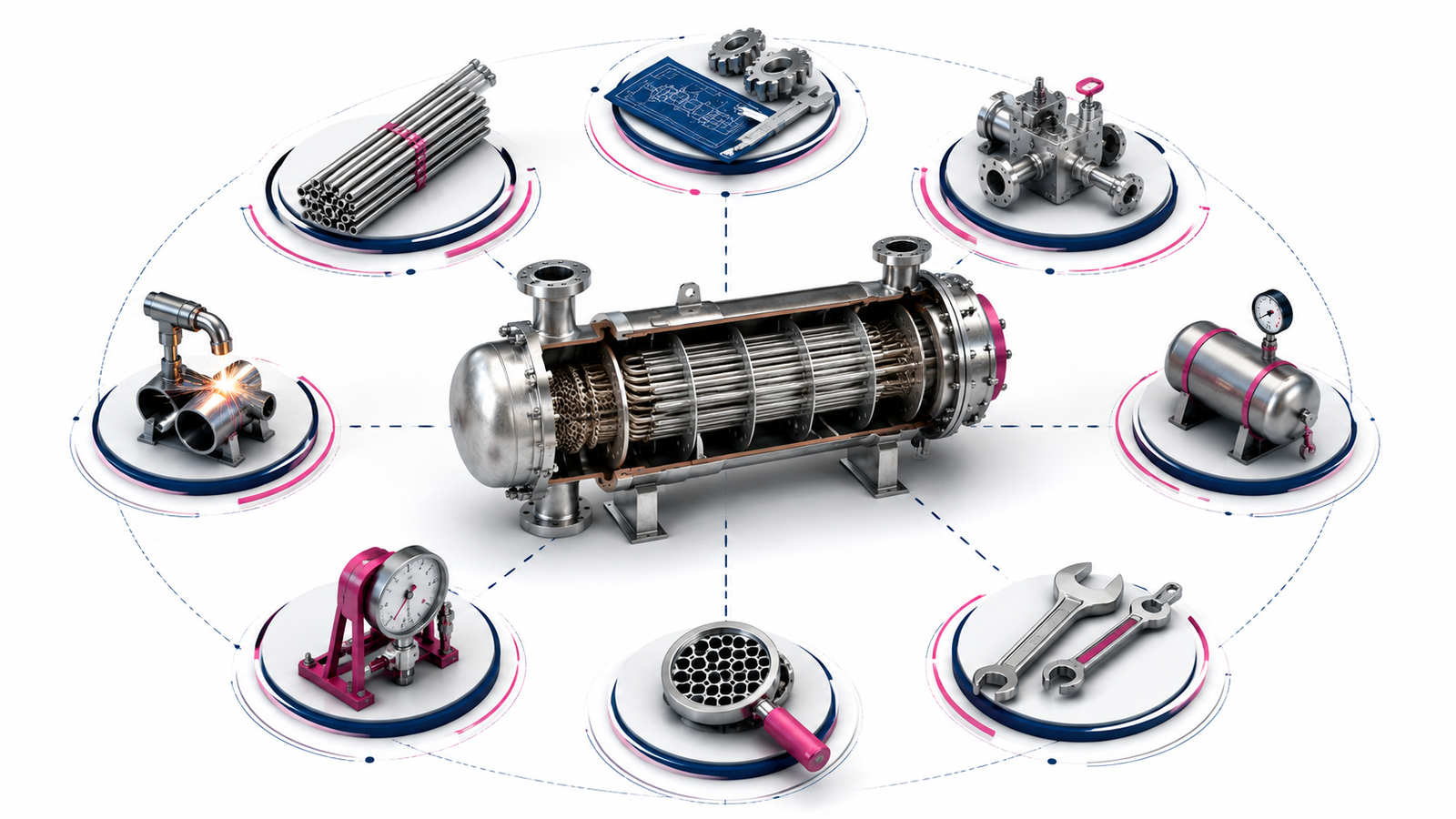
More Than a Design Standard—It Defines How Shell & Tube Heat Exchangers Are Built, Inspected, and Maintained. When engineers first encounter a shell-and-tube heat exchanger datasheet, one of the first specifications they notice is the TEMA type, such as:
- BEM
- AES
- BEU
- AET
Many assume TEMA is simply a naming convention for exchanger configurations.
In reality, TEMA is much more than that.
It is a comprehensive engineering standard that establishes how shell-and-tube heat exchangers should be:
- designed
- fabricated
- assembled
- inspected
- tested
- maintained
It provides a common engineering language that allows process engineers, mechanical engineers, equipment manufacturers, inspectors, and plant owners to work from the same set of expectations.
This article explains what TEMA actually controls, why the standard was developed, and how it influences the entire lifecycle of a shell-and-tube heat exchanger.
Table of Contents
What Is TEMA?
A Standard Developed Specifically for Shell-and-Tube Heat Exchangers
TEMA stands for the Tubular Exchanger Manufacturers Association.
It is an industry organization that publishes standards specifically for shell-and-tube heat exchangers.
Unlike broader engineering codes that cover many types of pressure equipment, TEMA focuses only on tubular heat exchangers.
Its recommendations are based on decades of operating experience across industries such as:
- oil and gas
- petrochemicals
- fertilizers
- power generation
- pharmaceuticals
- food processing
- specialty chemicals
The objective is simple:
Provide standardized construction practices that improve reliability, safety, maintainability, and interchangeability.
Why Was TEMA Developed?
Standardization Reduces Engineering Uncertainty
Before standardized practices became common, exchanger construction varied significantly between manufacturers.
Different companies used:
- different dimensions
- different terminology
- different maintenance arrangements
- different fabrication methods
This created problems during:
- equipment procurement
- plant maintenance
- spare part replacement
- engineering communication
TEMA introduced a common standard so that engineers could specify exchanger construction without depending entirely on manufacturer-specific practices.
Today, a TEMA designation immediately communicates important mechanical information regardless of who manufactures the exchanger.
TEMA Does Not Perform Thermal Design
One of the Most Common Misunderstandings
Many young engineers believe TEMA calculates heat transfer or sizes exchangers.
It does not.
Thermal design determines:
- required heat duty
- heat transfer area
- outlet temperatures
- pressure drop
- fluid velocities
These calculations are performed using thermal design methods and specialized software.
TEMA begins after the thermal requirements are known.
Its primary concern is how the exchanger will be mechanically built to achieve those thermal requirements safely and reliably.
TEMA Controls Mechanical Configuration
The Three-Letter Classification System
One of the most visible parts of the TEMA standard is its classification system.
Each exchanger receives a three-letter designation representing:
- front head
- shell
- rear head
For example:
- BEM
- AES
- BEU
These letters define the exchanger’s mechanical arrangement—not its thermal performance.
The classification allows engineers to understand construction without reviewing detailed fabrication drawings.
TEMA Defines Standard Components
Consistency Across Manufacturers
TEMA standardizes the major components of shell-and-tube exchangers.
These include:
- channel heads
- shell geometry
- tube sheets
- rear heads
- nozzles
- support arrangements
- baffles
- pass partitions
This consistency simplifies:
- fabrication
- procurement
- maintenance
- inspection
It also allows engineers to compare equipment from different manufacturers more effectively.
TEMA Establishes Mechanical Design Requirements
Structural Integrity Is a Primary Objective
Shell-and-tube exchangers operate under:
- internal pressure
- temperature gradients
- thermal expansion
- vibration
- cyclic loading
TEMA provides guidance for designing components capable of handling these operating conditions.
The standard addresses issues such as:
- component dimensions
- minimum thickness requirements
- construction details
- allowable clearances
- support arrangements
These recommendations improve long-term mechanical reliability.
TEMA Influences Tube Bundle Design
More Than Just Tube Layout
Tube bundles are central to exchanger performance.
TEMA provides recommendations related to:
- tube pitch
- tube layout
- tube support
- tube expansion methods
- tube sheet attachment
These details affect both:
- mechanical integrity
- maintenance accessibility
Proper tube bundle construction reduces vibration and improves equipment durability.
TEMA Defines Baffle Practices
Flow Control and Mechanical Support
Baffles serve two major purposes:
- directing shell-side flow
- supporting tubes
Poor baffle design can lead to:
- excessive vibration
- uneven flow
- tube damage
- reduced performance
TEMA provides guidance on:
- baffle spacing
- support arrangements
- construction practices
The objective is to achieve reliable operation while maintaining acceptable pressure drop.
TEMA Addresses Thermal Expansion
Heat Exchangers Expand During Operation
One of the biggest mechanical challenges in shell-and-tube exchangers is thermal expansion.
The shell and tube bundle often operate at different temperatures.
Without proper accommodation:
- thermal stress develops
- joints become overloaded
- equipment life decreases
TEMA provides recognized construction options for handling thermal expansion, including:
- fixed tube sheet arrangements
- floating head designs
- U-tube configurations
Selecting the appropriate arrangement depends on service conditions.
TEMA Improves Maintainability
Maintenance Is Considered During Design
Unlike many equipment standards, TEMA places considerable emphasis on future maintenance.
It recognizes that heat exchangers eventually require:
- cleaning
- inspection
- tube replacement
- bundle removal
Different TEMA configurations provide different levels of maintenance access.
For example, some arrangements allow complete tube bundle removal, while others are intended for cleaner services where such access is less important.
Maintenance is therefore incorporated into the design philosophy—not treated as an afterthought.
TEMA Supports Inspection Requirements
Easier Inspection Improves Reliability
Industrial plants routinely inspect heat exchangers during shutdowns.
Inspection may involve:
- visual examination
- tube inspection
- thickness measurement
- hydrostatic testing
- leak detection
TEMA configurations influence how easily these activities can be performed.
A well-selected exchanger reduces inspection time and simplifies turnaround planning.
TEMA Promotes Interchangeability
Standardization Simplifies Replacement
When equipment eventually reaches the end of its service life, replacement becomes easier if standardized dimensions and construction practices have been followed.
This provides benefits such as:
- easier procurement
- reduced engineering effort
- better compatibility with existing plant layouts
Although complete interchangeability cannot always be guaranteed, TEMA significantly improves consistency across manufacturers.
TEMA Works Alongside Other Engineering Codes
TEMA Is Not a Pressure Vessel Code
Another common misunderstanding is assuming TEMA replaces pressure vessel regulations.
It does not.
A shell-and-tube exchanger must often satisfy multiple standards simultaneously.
For example:
- pressure vessel codes govern pressure integrity
- material specifications govern metallurgy
- project specifications define client requirements
- TEMA governs exchanger-specific construction practices
These standards complement one another rather than compete.
TEMA Also Defines Equipment Classes
Different Industries Require Different Levels of Robustness
Not every heat exchanger operates under the same conditions.
TEMA recognizes this by defining different equipment classes suited to different applications.
These classes consider factors such as:
- service severity
- expected reliability
- construction robustness
- inspection requirements
The detailed differences between TEMA classes will be discussed in a later support article.
Who Uses TEMA Standards?
More Than Equipment Manufacturers
TEMA is used by a wide range of professionals.
Process Engineers
To specify appropriate exchanger configurations.
Mechanical Engineers
To develop detailed equipment designs.
Equipment Manufacturers
To fabricate exchangers according to recognized standards.
Inspection Engineers
To verify construction quality and compliance.
Maintenance Engineers
To understand equipment configuration before shutdown activities.
Plant Owners
To ensure purchased equipment meets expected reliability and maintainability standards.
TEMA provides a common reference for every stage of an exchanger’s lifecycle.
Why TEMA Remains Relevant Today
New Technologies Have Not Replaced It
Modern industry now uses:
- compact exchangers
- plate heat exchangers
- printed circuit exchangers
- spiral exchangers
Yet shell-and-tube exchangers remain the dominant choice for many heavy industrial services.
As long as shell-and-tube exchangers continue to be widely used, TEMA will remain one of the most important standards governing their design and construction.
Its relevance extends beyond fabrication.
It influences how exchangers are selected, maintained, inspected, and operated throughout decades of service.
Common Misconceptions About TEMA
“TEMA Calculates Heat Transfer”
No.
Thermal calculations are performed separately.
TEMA focuses on mechanical construction.
“TEMA Only Defines the Three-Letter Code”
The three-letter designation is only one part of the standard.
TEMA also covers:
- construction practices
- dimensions
- maintenance considerations
- inspection provisions
- component design
“Every Shell-and-Tube Exchanger Must Be TEMA”
Many industrial exchangers are designed using TEMA principles.
However, project specifications, regional codes, and client requirements may also influence final construction.
TEMA remains a widely accepted reference rather than the only engineering requirement.
Final Perspective
TEMA is far more than a classification system.
It provides the engineering framework that defines how shell-and-tube heat exchangers are:
- constructed
- assembled
- inspected
- maintained
- repaired
It does not calculate heat transfer or determine process duty.
Instead, it ensures that once the thermal design is complete, the exchanger can be built in a way that is safe, reliable, maintainable, and practical for decades of industrial service.
For engineers working with shell-and-tube heat exchangers, understanding TEMA is not optional.
It is the foundation for making informed mechanical design and equipment selection decisions.
Explore the complete series in the Heat Exchanger Engineering Hub.

A practicing chemical engineer with 17+ years of experience in process design, project execution, commissioning, and plant operations. Focused on practical engineering judgment beyond textbook explanations.