
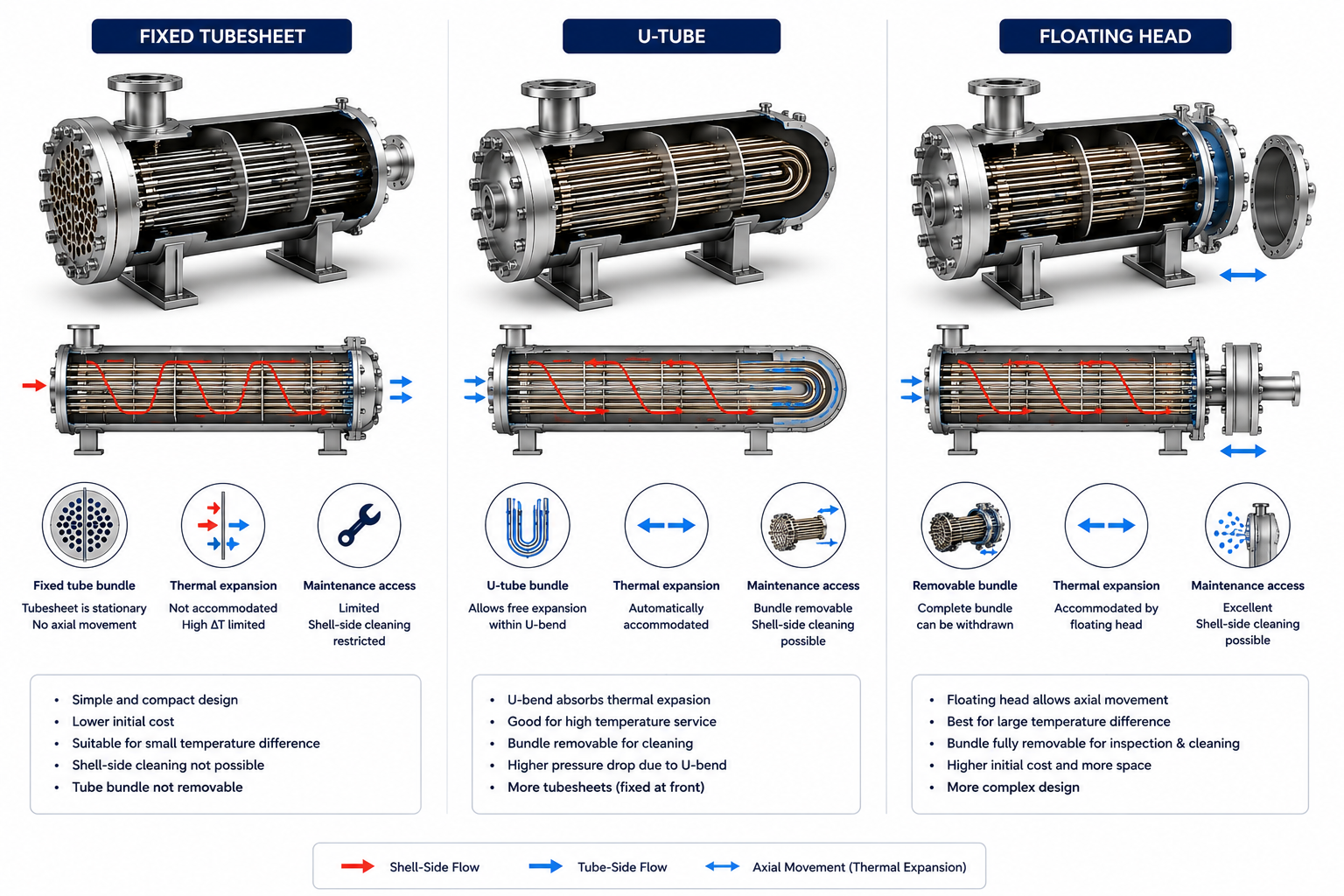
The Rear Head Design Determines Maintenance, Thermal Expansion, and Lifecycle Cost
After learning TEMA classifications, many engineers ask a simple question:
Which is better—Fixed Tubesheet, Floating Head, or U-Tube?
The answer is:
None of them is universally better.
Each rear head design solves a different engineering problem.
A Fixed Tubesheet exchanger may be the perfect solution in one service and a costly mistake in another.
Likewise, selecting a Floating Head exchanger simply because it is “more advanced” can unnecessarily increase project cost.
The choice depends on:
- thermal expansion
- fouling tendency
- maintenance philosophy
- cleaning requirements
- lifecycle economics
Understanding these three designs is one of the most important skills in shell-and-tube heat exchanger selection.
This article compares Fixed Tubesheet, Floating Head, and U-Tube exchangers from a practical engineering perspective rather than simply describing their construction.
Table of Contents
Why the Rear Head Matters More Than Many Engineers Realize
The Rear Head Influences the Entire Life of the Exchanger
The rear head is not merely the component that closes the shell.
It determines:
- how thermal expansion is accommodated
- whether the tube bundle can be removed
- how the exchanger is cleaned
- how shutdown maintenance is performed
- how much the exchanger costs over its lifetime
Although all three exchanger types may deliver exactly the same heat duty, they behave very differently after years of plant operation.
That is why experienced engineers spend considerable time selecting the rear head arrangement.
Fixed Tubesheet Exchangers
How the Design Works
In a Fixed Tubesheet exchanger:
- both tubesheets are permanently welded or attached to the shell
- the tube bundle cannot be removed
- shell and tubes become one rigid assembly
The construction is mechanically simple.
It is also the least expensive of the three designs.
Where Fixed Tubesheet Exchangers Work Best
They are ideal when:
- shell-side fluid is clean
- shell-side fouling is minimal
- temperature difference between shell and tubes is relatively small
- maintenance requirements are low
Typical applications include:
- cooling water services
- clean utility exchangers
- lube oil coolers
- treated water systems
Advantages
- Lowest fabrication cost
- Simple construction
- Strong mechanical integrity
- Fewer gasket joints
- Lower maintenance of sealing surfaces
Limitations
The biggest disadvantage is maintenance.
Because the tube bundle cannot be removed:
- shell-side inspection becomes difficult
- shell-side mechanical cleaning is almost impossible
- severe fouling significantly increases maintenance effort
Thermal expansion is another limitation.
Large temperature differences may create excessive mechanical stress.
U-Tube Exchangers
How the Design Works
In a U-Tube exchanger, every tube is bent into a U-shape.
Instead of moving a tubesheet, thermal expansion is absorbed by the flexibility of the tubes themselves.
The bundle remains removable.
This design eliminates the need for a floating head assembly.
Where U-Tube Exchangers Work Best
They are commonly selected when:
- temperature difference is large
- shell-side cleaning is required
- tube-side fouling is relatively light
- lower cost than floating head construction is desired
Typical services include:
- steam heaters
- condensers
- refinery exchangers
- high-temperature utilities
Advantages
- Excellent thermal expansion capability
- Lower cost than floating head designs
- Removable tube bundle
- Fewer gasket joints than floating head construction
Limitations
The curved tubes create maintenance challenges.
Mechanical cleaning near the U-bend is difficult.
In addition:
- individual tube replacement is more complicated
- tube layout flexibility is reduced
For severe tube-side fouling, U-Tube exchangers may not be the best choice.
Floating Head Exchangers
How the Design Works
Floating Head exchangers allow one end of the tube bundle to move independently inside the shell.
As temperature changes:
- shell expands
- tubes expand
The floating head absorbs the differential movement.
This minimizes thermal stress.
The complete tube bundle can also be removed for maintenance.
Where Floating Head Exchangers Work Best
Floating Head exchangers are preferred when:
- thermal expansion is severe
- both shell-side and tube-side cleaning are required
- maintenance accessibility is critical
- operating conditions are demanding
Typical applications include:
- crude oil preheat trains
- refinery process exchangers
- petrochemical plants
- heavy hydrocarbon services
Advantages
- Excellent thermal expansion accommodation
- Complete bundle removal
- Easy shell-side cleaning
- Easy tube-side cleaning
- Suitable for severe fouling
- Long service life under difficult conditions
Limitations
These benefits come at a price.
Floating Head exchangers involve:
- higher fabrication cost
- more complex construction
- additional gasket joints
- larger maintenance inventory
They should be selected only when the process genuinely requires their flexibility.
Comparing Thermal Expansion Capability
This Is Often the First Selection Criterion
Large temperature differences create differential expansion between the shell and tubes.
Each design handles this differently.
| Design | Expansion Method |
|---|---|
| Fixed Tubesheet | Very limited expansion accommodation |
| U-Tube | Tube bending absorbs expansion |
| Floating Head | Floating tubesheet absorbs expansion |
When temperature differences are small, Fixed Tubesheet construction is usually sufficient.
As thermal expansion increases, U-Tube or Floating Head designs become more attractive.
Comparing Maintenance Accessibility
Cleaning Philosophy Changes Everything
Maintenance is one of the biggest differentiators.
| Feature | Fixed | U-Tube | Floating Head |
|---|---|---|---|
| Tube Bundle Removal | No | Yes | Yes |
| Shell-Side Cleaning | Poor | Excellent | Excellent |
| Tube-Side Cleaning | Good | Moderate | Excellent |
| Bundle Inspection | Limited | Good | Excellent |
Plants expecting frequent maintenance usually avoid Fixed Tubesheet exchangers.
Comparing Fouling Tolerance
Fouling Often Determines Lifecycle Cost
If both fluids remain clean:
all three designs can perform well.
When fouling increases:
selection changes dramatically.
Fixed Tubesheet
Suitable for:
- clean services
- low fouling
U-Tube
Suitable for:
- shell-side fouling
- moderate tube-side fouling
Floating Head
Suitable for:
- severe fouling
- repeated cleaning
- difficult process streams
The dirtier the service, the greater the advantage of Floating Head construction.
Comparing Fabrication Cost
Simplicity Usually Costs Less
Construction complexity increases from Fixed Tubesheet to Floating Head.
The general cost trend is:
- Fixed Tubesheet (Lowest)
- U-Tube
- Floating Head (Highest)
However, purchase price should never be evaluated without considering maintenance cost.
Comparing Lifecycle Economics
Lowest Purchase Price Is Not Always Cheapest
A Fixed Tubesheet exchanger may cost less initially.
But if shell-side fouling requires difficult maintenance every shutdown, the lifetime operating cost may become much higher.
Conversely, a Floating Head exchanger may cost more to purchase but reduce:
- cleaning time
- shutdown duration
- maintenance labor
- production losses
Experienced engineers therefore evaluate lifecycle cost rather than equipment price alone.
Typical Industrial Selection
Where Each Design Is Most Common
Fixed Tubesheet
Usually selected for:
- utility cooling
- clean process fluids
- low-maintenance services
U-Tube
Common in:
- refinery heaters
- condensers
- high-temperature services
- moderate fouling applications
Floating Head
Preferred in:
- crude oil preheat trains
- petrochemical plants
- heavy fouling services
- exchangers requiring frequent inspection
Common Selection Mistakes
Choosing Floating Head for Every Service
Some engineers assume Floating Head exchangers are always superior.
This unnecessarily increases:
- equipment cost
- fabrication complexity
- spare parts inventory
If thermal expansion and fouling are minimal, a simpler design often performs equally well.
Choosing Fixed Tubesheet Only to Reduce Cost
The opposite mistake is selecting Fixed Tubesheet construction for a service that experiences:
- severe fouling
- high thermal stress
- frequent maintenance
The initial savings may disappear during the first few shutdowns.
A Simple Selection Guideline
Ask These Questions
Before selecting the rear head, consider:
Is thermal expansion significant?
If Yes, consider:
- U-Tube
- Floating Head
Is shell-side mechanical cleaning required?
If Yes, avoid Fixed Tubesheet.
Is severe tube-side fouling expected?
If Yes, Floating Head generally provides the best maintenance access.
Is capital cost the primary concern?
If Yes, Fixed Tubesheet may be appropriate—provided the service conditions allow it.
Operator Perspective
Operators rarely notice the rear head during normal operation.
However, they quickly appreciate its importance during plant shutdowns.
The ease of:
- cleaning
- inspection
- restarting the unit
often depends on the rear head selected years earlier during the design stage.
Owner Perspective
For plant owners, the rear head affects:
- purchase cost
- maintenance cost
- turnaround duration
- equipment reliability
- lifecycle economics
The correct choice minimizes the total cost of ownership rather than simply reducing the purchase price.
Final Perspective
There is no universally “best” rear head design.
Each exists because industrial processes place different demands on heat exchangers.
- Fixed Tubesheet emphasizes simplicity and low capital cost.
- U-Tube offers economical thermal expansion flexibility.
- Floating Head delivers the highest maintenance accessibility and operational flexibility.
The best selection is the one that balances:
- process conditions
- thermal expansion
- fouling behavior
- maintenance philosophy
- lifecycle economics
The most successful exchanger is not the one with the most sophisticated construction.
It is the one that continues to perform reliably, economically, and safely throughout its entire operating life.
Explore the complete series in the Heat Exchanger Engineering Hub.

A practicing chemical engineer with 17+ years of experience in process design, project execution, commissioning, and plant operations. Focused on practical engineering judgment beyond textbook explanations.