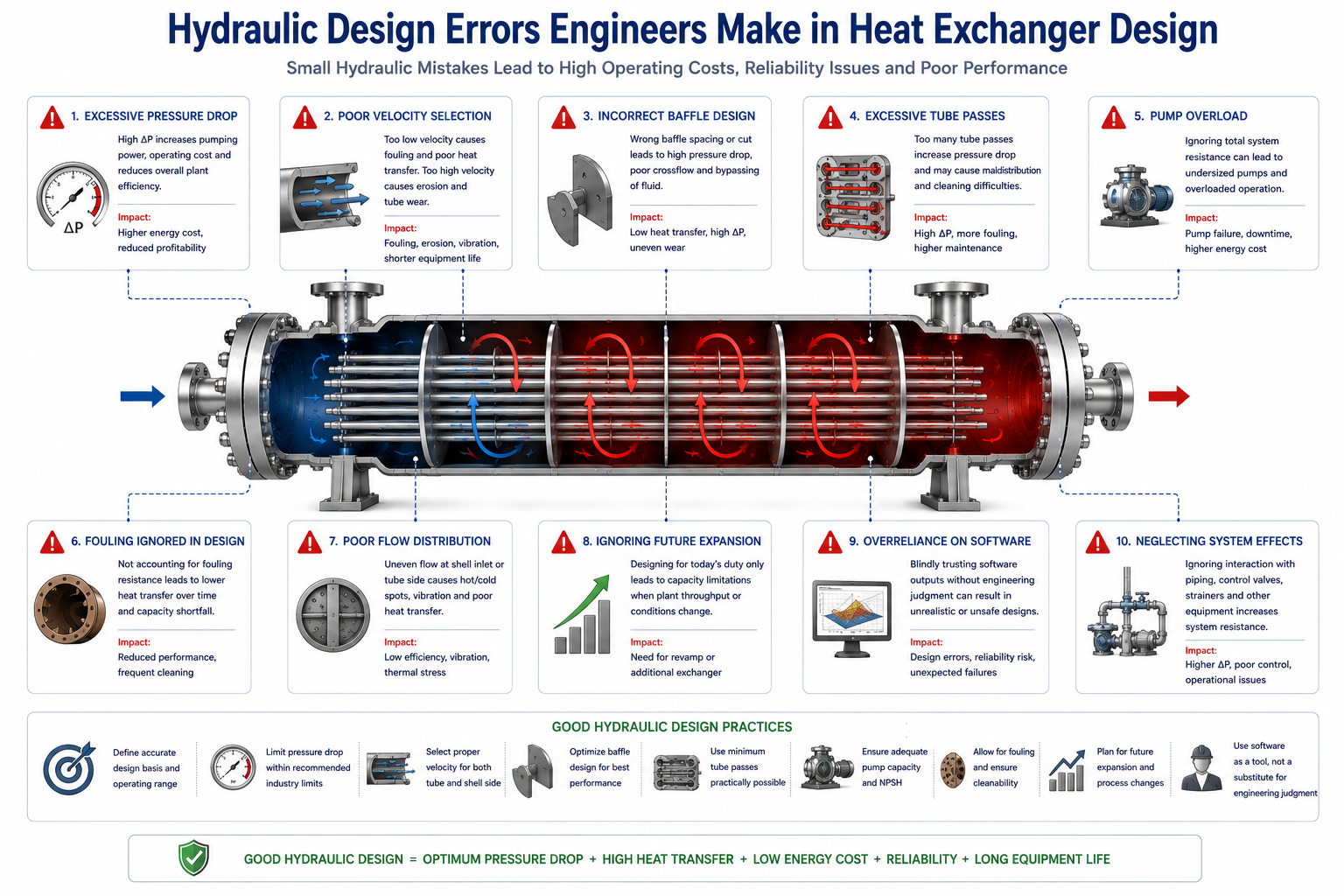
Most hydraulic problems in heat exchangers are not caused by complex calculations—they are caused by incorrect engineering decisions made during design. An exchanger may satisfy every thermal requirement on paper but still become a bottleneck because hydraulic performance was not evaluated with the same level of attention.
Thermal design and hydraulic design should always progress together.
In practice, however, young engineers often focus primarily on achieving the required heat duty. Once the exchanger satisfies the thermal calculations, pressure drop is sometimes treated as a final verification rather than a design constraint.
Experienced engineers know that this approach can lead to expensive mistakes.
An exchanger with excessive pressure drop may:
- overload pumps,
- increase compressor power,
- reduce plant throughput,
- accelerate fouling,
- increase maintenance frequency,
- shorten equipment life.
Many of these problems are not caused by calculation errors. Instead, they result from assumptions that seemed reasonable during design but proved unrealistic in plant operation.
Understanding these common hydraulic design errors helps engineers avoid costly modifications after commissioning and produce exchangers that remain reliable throughout their operating life.
Table of Contents
Designing Only for Heat Duty
A heat exchanger is successful only when both thermal and hydraulic requirements are satisfied.
One of the most common mistakes is concentrating entirely on heat transfer.
The designer successfully achieves:
- required outlet temperatures,
- specified heat duty,
- acceptable LMTD,
- desired overall heat transfer coefficient.
Only after completing the thermal design is the pressure drop reviewed.
Sometimes it is already too late.
Reducing pressure drop at this stage may require changing:
- shell diameter,
- tube diameter,
- tube passes,
- baffle arrangement,
- exchanger size.
Experienced engineers evaluate heat transfer and pressure drop simultaneously throughout the design process.
Assuming Lower Pressure Drop Is Always Better
Reducing hydraulic resistance without considering thermal performance often creates a different problem.
Some engineers attempt to minimize pressure drop wherever possible.
This may involve:
- increasing tube diameter,
- reducing tube passes,
- increasing baffle spacing,
- lowering fluid velocity.
Although these changes reduce pumping requirements, they may also:
- reduce turbulence,
- lower heat transfer,
- increase fouling,
- require larger exchangers.
Hydraulic optimization should never occur independently of thermal optimization.
Selecting Unrealistic Fluid Velocity
Velocity should match the service rather than follow a standard value.
Choosing velocity without considering the process fluid is another common mistake.
For example:
Very high velocity may cause:
- erosion,
- tube vibration,
- excessive pressure drop.
Very low velocity may result in:
- particle settling,
- poor heat transfer,
- rapid fouling.
Every service has its own practical operating range.
Fluid properties, solids content, material selection, and operating conditions all influence the appropriate design velocity.
Ignoring Fouling During Hydraulic Design
Pressure drop increases throughout the exchanger’s operating life.
Many preliminary designs consider only clean operating conditions.
Initially, pressure drop appears acceptable.
As fouling develops:
- flow passages become smaller,
- hydraulic resistance increases,
- pumping requirements rise.
If no allowance has been made for this gradual increase, the exchanger may exceed the allowable pressure drop long before scheduled maintenance.
Hydraulic design should always consider the exchanger’s operating condition between cleaning intervals rather than only immediately after commissioning.
Using Too Many Tube Passes
Increasing tube passes improves velocity but also increases hydraulic resistance.
Adding more tube passes is a common method of increasing tube-side velocity.
Higher velocity often improves heat transfer.
However, every additional pass also introduces:
- extra return losses,
- greater friction,
- higher pressure drop.
Beyond a certain point, the hydraulic penalty becomes larger than the thermal benefit.
Engineers should increase tube passes only when the overall thermal-hydraulic balance justifies the change.
Poor Baffle Selection
Baffles influence shell-side hydraulics more than many engineers initially realize.
Baffle spacing and baffle cut determine how shell-side fluid moves through the exchanger.
Incorrect selection may produce:
- excessive shell-side pressure drop,
- bypass flow,
- dead zones,
- uneven velocity distribution.
Closer spacing generally improves heat transfer but also increases hydraulic resistance.
Wider spacing reduces pressure drop but may reduce thermal effectiveness.
Good baffle design balances both requirements.
Ignoring Pump and Compressor Limitations
The exchanger is part of a complete hydraulic system—not an isolated piece of equipment.
Some designs satisfy exchanger pressure drop requirements without considering the equipment supplying the flow.
In practice, pumps and compressors have finite operating limits.
Excessive exchanger pressure drop may cause:
- reduced flow,
- higher motor loading,
- operation away from the Best Efficiency Point,
- reduced compressor capacity.
Hydraulic design should therefore consider the complete process system.
Assuming Pressure Drop Remains Constant
Hydraulic performance changes continuously during plant operation.
Pressure drop depends on:
- production rate,
- fouling,
- fluid properties,
- operating temperature,
- maintenance condition.
Designing as though pressure drop remains fixed throughout the exchanger’s life is unrealistic.
Engineers should evaluate hydraulic performance across the expected operating range rather than at a single operating point.
Neglecting Future Plant Expansion
Today’s acceptable pressure drop may become tomorrow’s production bottleneck.
Many plants eventually increase production through:
- debottlenecking,
- process optimization,
- capacity expansion.
Higher flow rates naturally increase pressure drop.
If the exchanger has no hydraulic flexibility, production increases may become impossible without equipment modification.
When future expansion is reasonably expected, designers should evaluate whether the exchanger can accommodate higher flow without exceeding allowable pressure limits.
Overlooking Flow Distribution
Uniform flow is assumed during design but not always achieved in practice.
Hydraulic calculations generally assume that fluid distributes evenly through the exchanger.
In reality:
- some tubes may carry more flow,
- bypass streams may develop,
- shell-side leakage may occur.
Poor flow distribution creates:
- local high velocity,
- stagnant regions,
- uneven heat transfer,
- localized erosion.
Mechanical design details therefore play an important role in hydraulic performance.
Depending Entirely on Software
Software calculates pressure drop but cannot replace engineering judgment.
Modern thermal design software evaluates:
- tube-side pressure drop,
- shell-side pressure drop,
- velocities,
- heat transfer,
- exchanger geometry.
However, software cannot determine whether:
- the process data are realistic,
- fouling assumptions are appropriate,
- future production will increase,
- maintenance practices are adequate.
Engineering experience remains essential when interpreting software results.
Ignoring Lifecycle Cost
The exchanger with the lowest purchase price may become the most expensive to operate.
Reducing exchanger size often reduces capital cost.
However, if this is achieved by accepting very high pressure drop, the plant may experience:
- higher electricity consumption,
- increased maintenance,
- shorter equipment life.
These operating costs continue for many years.
Successful hydraulic design therefore considers both:
- initial investment,
- long-term operating cost.
Treating Thermal and Hydraulic Design as Separate Activities
Every thermal decision influences hydraulics, and every hydraulic decision influences heat transfer.
Increasing velocity improves heat transfer.
It also increases pressure drop.
Increasing baffle spacing reduces pressure drop.
It may also reduce heat transfer.
Changing tube diameter influences both parameters simultaneously.
This close relationship means thermal and hydraulic design should always be performed together rather than as independent calculations.
Common Signs That Hydraulic Errors Were Made During Design
Many hydraulic design mistakes become visible only after commissioning.
Typical symptoms include:
- pump operating continuously near maximum capacity,
- excessive differential pressure,
- frequent exchanger cleaning,
- inability to increase production,
- unstable process flow,
- higher-than-expected utility consumption,
- repeated tube failures caused by erosion.
These symptoms often indicate that hydraulic behaviour was underestimated during the original design.
Operator Perspective
Operators are usually the first to recognize hydraulic problems in day-to-day operation.
Common observations include:
- increasing pump current,
- declining process flow,
- unstable control valves,
- rising differential pressure,
- reduced exchanger performance.
Monitoring these trends helps identify hydraulic deterioration before it significantly affects production.
Owner Perspective
Avoiding hydraulic design errors reduces operating cost throughout the exchanger’s service life.
For plant owners, sound hydraulic design provides:
- lower pumping energy,
- greater production flexibility,
- fewer maintenance shutdowns,
- improved equipment reliability,
- lower lifecycle cost.
Although correcting hydraulic problems after installation is possible, it is usually much more expensive than preventing them during design.
Final Perspective
Most hydraulic design errors do not occur because engineers misunderstand pressure drop calculations.
They occur because hydraulic performance is not considered as an integral part of exchanger design.
Successful heat exchanger design requires balancing:
- heat transfer,
- pressure drop,
- fluid velocity,
- fouling,
- maintenance,
- operating flexibility,
- lifecycle cost.
Engineers who consistently produce reliable exchangers are those who recognize that hydraulic performance deserves the same level of attention as thermal performance from the very beginning of the design process.
Explore the complete series in the Heat Exchanger Engineering Hub.

A practicing chemical engineer with 17+ years of experience in process design, project execution, commissioning, and plant operations. Focused on practical engineering judgment beyond textbook explanations.