
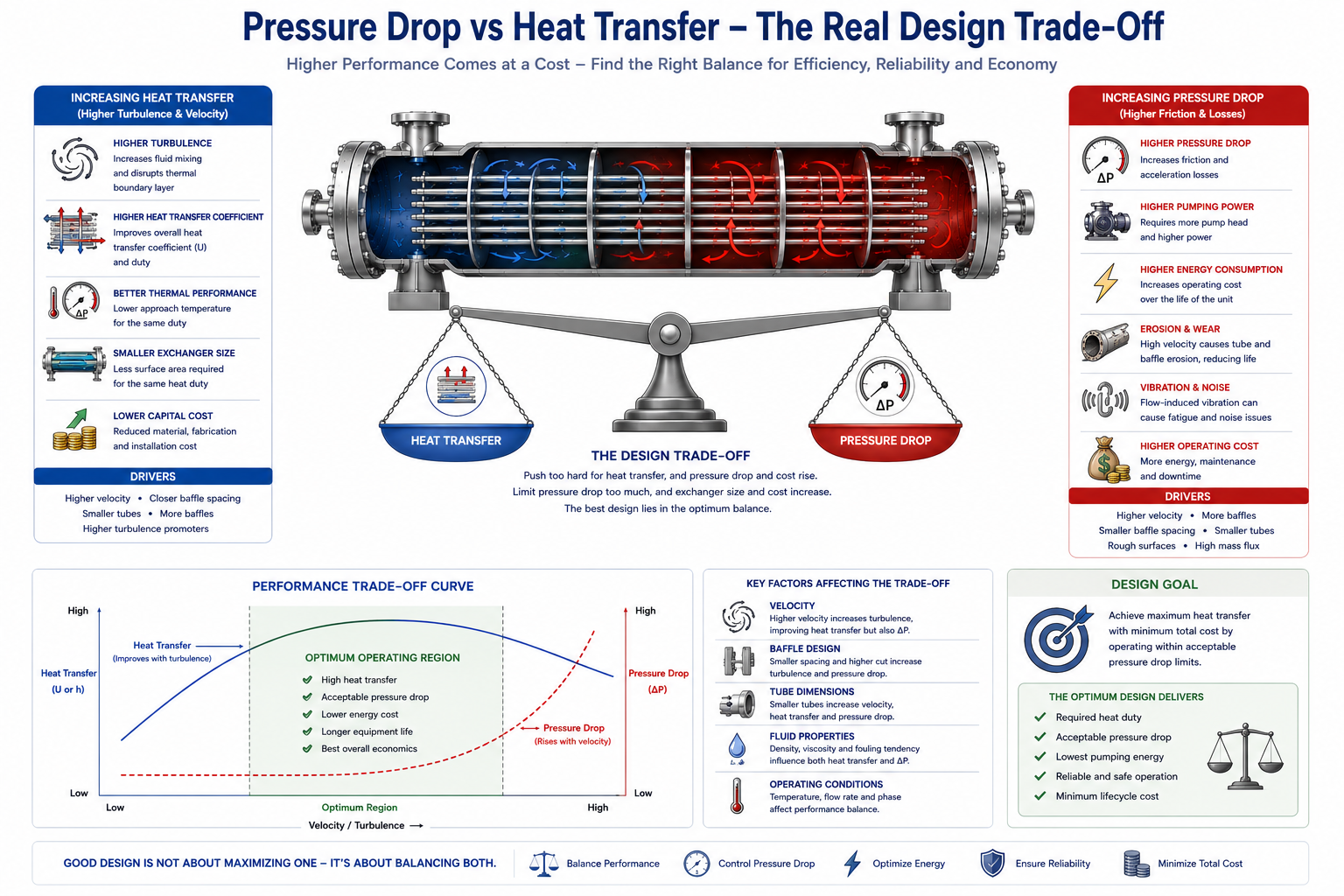
Every heat exchanger designer faces the same engineering challenge: improving heat transfer almost always increases pressure drop, while reducing pressure drop usually weakens heat transfer. The objective is not to maximize either parameter but to find the optimum balance that delivers reliable, economical, and long-term plant performance.
One of the biggest misconceptions in heat exchanger design is that improving heat transfer automatically creates a better exchanger.
At first glance, that assumption seems reasonable.
Higher heat transfer means:
- faster heating,
- better cooling,
- improved energy recovery,
- smaller exchanger size.
However, achieving better heat transfer usually requires increasing fluid velocity or forcing the fluid through more restrictive flow paths.
Both approaches increase hydraulic resistance.
As pressure drop rises:
- pumps consume more power,
- compressors work harder,
- operating costs increase,
- erosion and vibration risks become higher.
Conversely, reducing pressure drop by lowering velocity or simplifying the flow path decreases operating costs but also reduces turbulence, weakens heat transfer, and often increases fouling.
This constant interaction between thermal and hydraulic performance is the reason experienced engineers never optimize one parameter independently.
Instead, they evaluate the exchanger as a complete system where heat transfer, pressure drop, reliability, maintenance, and lifecycle cost are all interconnected.
This article explores why this trade-off exists and how engineers balance these competing requirements during practical heat exchanger design.
Table of Contents
Why Heat Transfer and Pressure Drop Are Connected
Both parameters are controlled by the same fluid behaviour inside the exchanger.
Heat transfer depends largely on how effectively fluid moves across the heat transfer surface.
When velocity increases:
- turbulence increases,
- boundary layers become thinner,
- heat moves more easily through the fluid.
These improvements increase the overall heat transfer coefficient.
At the same time, the faster-moving fluid creates greater friction against:
- tube walls,
- shell surfaces,
- baffles,
- flow passages.
The result is increased pressure drop.
This is why heat transfer and pressure drop cannot be treated as independent design parameters.
Increasing Velocity Improves Heat Transfer
Higher turbulence improves thermal performance by reducing resistance to heat flow.
One of the simplest ways to increase exchanger performance is to increase fluid velocity.
Greater velocity:
- improves mixing,
- continually replaces the fluid adjacent to the heat transfer surface,
- reduces thermal resistance.
As a result:
- higher heat duty can be achieved,
- required heat transfer area may decrease,
- exchanger size may become smaller.
These are valuable advantages.
However, they are only part of the engineering picture.
Higher Velocity Also Increases Pressure Drop
Hydraulic resistance grows as fluid moves faster through the exchanger.
As velocity increases, friction losses increase throughout the flow path.
This affects both:
- the tube side,
- the shell side.
Higher pressure drop means:
- larger pump head,
- greater compressor duty,
- increased electricity consumption,
- higher operating expenses.
For continuously operating plants, these energy costs continue throughout the life of the exchanger.
The Relationship Is Not Linear
The thermal benefit eventually becomes smaller while the hydraulic penalty continues increasing.
At relatively low velocities, increasing flow often produces a noticeable improvement in heat transfer.
Beyond a certain point, however:
- each additional increase in velocity produces only a modest improvement in heat transfer,
- pressure drop continues rising rapidly.
Eventually, the exchanger reaches a point where additional pumping energy produces very little additional thermal benefit.
This region is generally avoided during practical design.
Lower Pressure Drop Has Its Own Consequences
Reducing hydraulic resistance too much can create thermal problems.
Suppose an engineer attempts to minimize pressure drop by reducing fluid velocity.
Initially, pumping power decreases.
However:
- turbulence declines,
- heat transfer coefficient decreases,
- larger heat transfer area becomes necessary.
Low velocity also encourages:
- fouling,
- particle settling,
- stagnant regions.
The exchanger may become hydraulically efficient but thermally inefficient.
This illustrates why minimizing pressure drop alone is not a good design strategy.
Heat Transfer Area Can Help Balance the Trade-Off
Sometimes increasing surface area is a better solution than increasing velocity.
Suppose the required heat duty cannot be achieved.
One option is increasing velocity.
Another option is increasing heat transfer area.
Adding area may allow the exchanger to:
- maintain lower velocity,
- reduce pressure drop,
- avoid erosion,
- improve operating reliability.
Although the exchanger becomes physically larger, the reduction in operating cost may justify the additional capital investment.
This is one reason experienced engineers evaluate multiple design alternatives before selecting the final exchanger.
Fluid Properties Influence the Trade-Off
The optimum balance depends heavily on the process fluid.
Different fluids respond differently to changes in velocity.
For example:
A clean cooling water service often tolerates relatively high velocity because:
- fouling is limited,
- erosion risk is low,
- pumping systems are readily available.
A viscous oil behaves differently.
Higher velocity may create excessive pressure drop without producing the same improvement in heat transfer.
Similarly:
- gases,
- slurries,
- condensing fluids,
- boiling fluids
all require different optimization strategies.
There is no universal solution.
Pressure Drop Is an Operating Cost
Heat transfer influences capital cost, while pressure drop influences operating cost.
Improving heat transfer often reduces exchanger size.
A smaller exchanger generally costs less to manufacture.
However, if the design achieves this by significantly increasing pressure drop, the plant pays for that decision every day through:
- higher electricity consumption,
- larger pump loading,
- increased compressor duty.
Engineers therefore evaluate both:
- capital expenditure,
- lifecycle operating cost.
The lowest purchase price does not always produce the lowest total cost.
Reliability Is Part of the Trade-Off
Operating at the highest thermal efficiency may reduce equipment life.
High velocity increases:
- erosion,
- tube vibration,
- mechanical wear,
- maintenance frequency.
Low velocity increases:
- fouling,
- cleaning frequency,
- thermal degradation.
Neither extreme provides reliable long-term operation.
The preferred operating region lies between these two limits.
Design Optimization Involves Many Variables
Velocity is only one of several design tools available to engineers.
When optimizing an exchanger, engineers may modify:
- tube diameter,
- shell diameter,
- tube length,
- number of tube passes,
- baffle spacing,
- baffle cut,
- tube layout,
- heat transfer area.
Each modification changes both:
- heat transfer,
- pressure drop.
Successful design comes from evaluating these variables together rather than changing only one parameter.
Thermal Software Helps Find the Balance
Modern software evaluates thermal and hydraulic performance simultaneously.
Thermal design programs calculate:
- heat duty,
- overall heat transfer coefficient,
- pressure drop,
- velocity,
- outlet temperatures,
- exchanger geometry.
Engineers review these results together.
If pressure drop exceeds the allowable limit, they revise the design.
If heat transfer becomes inadequate, they modify the geometry again.
This iterative process continues until both requirements are satisfied.
Practical Design Is About Optimization, Not Maximization
Experienced engineers rarely ask how to maximize heat transfer—they ask how to optimize the exchanger.
A successful exchanger should provide:
- required heat duty,
- acceptable pressure drop,
- manageable fouling,
- reasonable pumping power,
- reliable operation,
- practical maintenance.
Optimizing only one objective usually creates problems elsewhere in the system.
Common Misunderstandings About the Trade-Off
Many design errors occur because thermal and hydraulic performance are considered separately.
“Maximum Heat Transfer Produces the Best Exchanger”
Not necessarily.
Maximum heat transfer may require unacceptable pressure drop and excessive operating cost.
“Lowest Pressure Drop Is Always the Best Design”
Very low pressure drop often results in:
- reduced turbulence,
- lower heat transfer,
- increased fouling,
- larger equipment.
The best exchanger is not the one with the lowest pressure drop.
It is the one with the most appropriate pressure drop.
“Increasing Velocity Solves Every Thermal Problem”
Increasing velocity improves heat transfer only to a practical limit.
Beyond that point, erosion, vibration, and operating costs increase much faster than thermal performance.
“Thermal Design and Hydraulic Design Are Separate Activities”
In reality, every thermal design decision influences hydraulic performance.
Similarly, every hydraulic modification influences heat transfer.
They must always be evaluated together.
Operator Perspective
Operators experience the balance between heat transfer and pressure drop every day, even if they never see the thermal calculations.
When the balance is poor, operators may observe:
- increasing pump current,
- higher utility consumption,
- declining outlet temperatures,
- unstable process control,
- frequent exchanger cleaning.
These symptoms often indicate that the exchanger is operating outside its optimum thermal-hydraulic balance.
Owner Perspective
The most economical heat exchanger is usually the one with the best balance—not the highest thermal efficiency.
For plant owners, a well-optimized exchanger provides:
- lower energy consumption,
- stable production,
- reduced maintenance,
- improved equipment life,
- lower lifecycle cost.
These long-term benefits often outweigh modest differences in initial purchase cost.
Final Perspective
Pressure drop and heat transfer are not competing objectives.
They are complementary aspects of the same engineering problem.
Increasing turbulence improves heat transfer but increases hydraulic resistance.
Reducing resistance lowers energy consumption but may weaken heat transfer and accelerate fouling.
The role of the heat exchanger designer is not to maximize either parameter.
It is to achieve the optimum balance where thermal performance, hydraulic efficiency, operating cost, reliability, and maintenance requirements work together to deliver consistent plant performance over many years of operation.
Explore the complete series in the Heat Exchanger Engineering Hub.
A practicing chemical engineer with 17+ years of experience in process design, project execution, commissioning, and plant operations. Focused on practical engineering judgment beyond textbook explanations.