
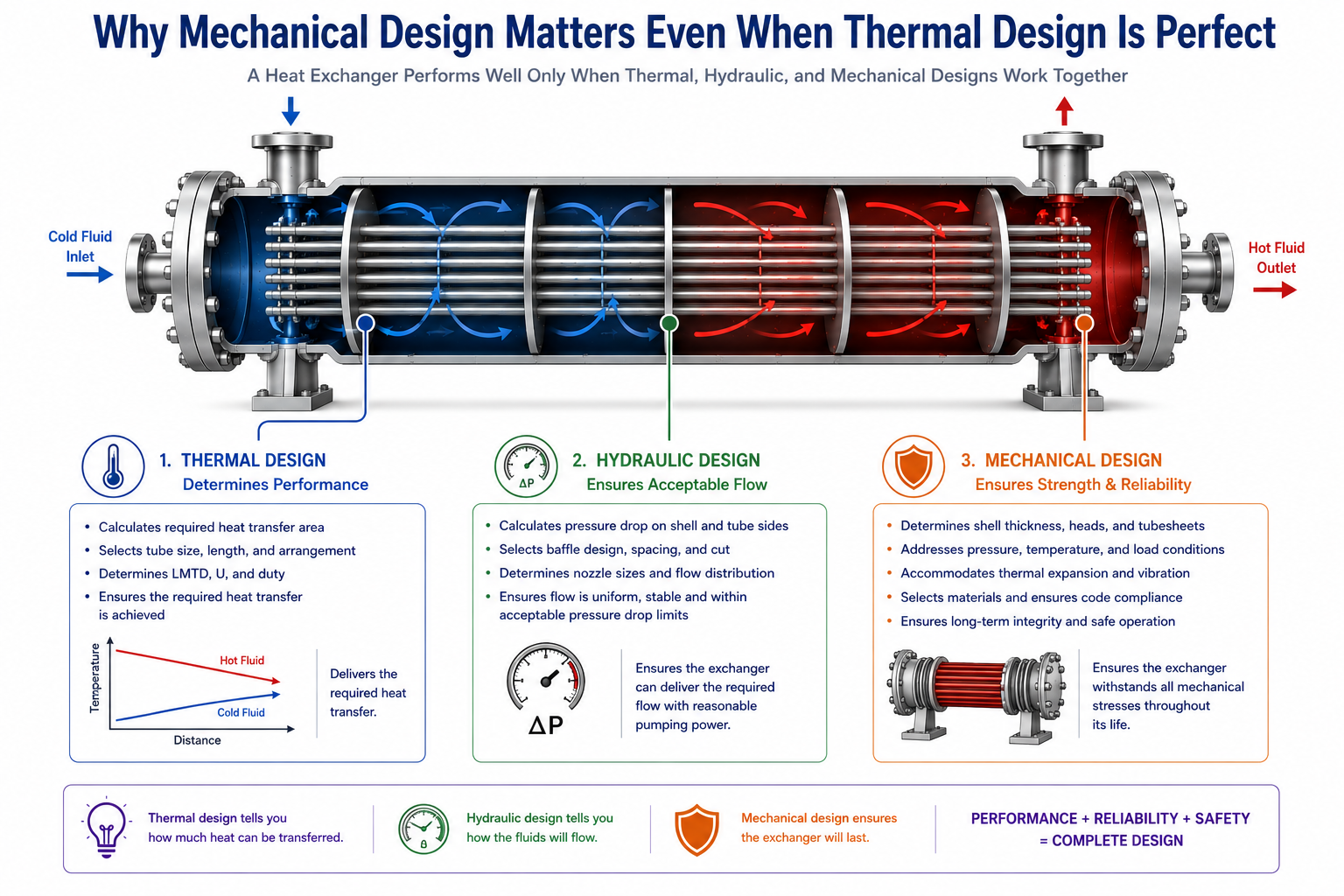
A heat exchanger may satisfy every thermal calculation and still fail in service because thermal performance alone does not guarantee mechanical reliability. The true success of a shell-and-tube heat exchanger depends on its ability to withstand pressure, thermal expansion, vibration, fatigue, corrosion, maintenance, and years of continuous plant operation.
When a shell-and-tube heat exchanger is designed, the first questions process engineers usually ask are:
- Can it achieve the required heat duty?
- Will the outlet temperatures meet the process requirement?
- Is the pressure drop within the allowable limit?
If the answer to all these questions is yes, it is easy to assume that the exchanger has been successfully designed.
Unfortunately, industrial plants tell a different story.
Many heat exchangers that perform perfectly during thermal calculations develop problems after commissioning. Tube failures, leaking tubesheets, excessive vibration, thermal stresses, difficult maintenance, and premature shutdowns are often traced back to mechanical design rather than thermal design.
The exchanger did exactly what it was thermally designed to do—but it was not mechanically prepared for the realities of long-term operation.
This is why experienced engineers never evaluate a heat exchanger using thermal performance alone. They understand that heat transfer calculations define what the exchanger should achieve, while mechanical design determines whether it can continue achieving that performance safely and reliably throughout its operating life.
Understanding this relationship helps process engineers make better design decisions, review vendor proposals more effectively, and appreciate why successful heat exchanger design extends far beyond thermal calculations.
Table of Contents
Thermal Performance Is Only One Measure of Success
A heat exchanger must satisfy thermal, hydraulic, and mechanical requirements simultaneously.
Thermal design answers important process questions such as:
- How much heat must be transferred?
- What should be the outlet temperatures?
- How much heat transfer area is required?
- What overall heat transfer coefficient should be achieved?
These calculations are essential.
However, they represent only one part of exchanger design.
A heat exchanger must also withstand:
- internal pressure,
- temperature changes,
- thermal expansion,
- vibration,
- corrosion,
- repeated operating cycles,
- maintenance activities.
Ignoring these mechanical requirements may result in an exchanger that performs well during commissioning but becomes unreliable after months or years of operation.
A Thermally Perfect Exchanger Can Still Fail
Many operating failures originate from mechanical limitations rather than incorrect thermal calculations.
Consider two shell-and-tube heat exchangers designed for identical process conditions.
Both satisfy:
- required heat duty,
- outlet temperatures,
- allowable pressure drop,
- utility requirements.
From a thermal perspective, both designs appear equally successful.
After several years of operation, however, one exchanger continues operating reliably while the other experiences:
- tube leakage,
- vibration damage,
- gasket failures,
- frequent shutdowns,
- expensive repairs.
The thermal calculations were not wrong.
The difference lies in how the exchangers were mechanically designed to handle real operating conditions.
This is one of the most important lessons in heat exchanger engineering.
Heat Exchangers Are Pressure Vessels, Not Just Heat Transfer Equipment
Every shell-and-tube heat exchanger must safely withstand mechanical loads throughout its operating life.
A shell-and-tube heat exchanger is fundamentally a pressure vessel.
In addition to transferring heat, it must safely resist:
- internal pressure,
- external loads,
- nozzle loads from connected piping,
- weight of the tube bundle,
- thermal stresses,
- cyclic loading,
- transportation loads.
These mechanical forces exist whether the exchanger transfers heat efficiently or not.
Mechanical design ensures the equipment remains structurally sound under all expected operating conditions.
Mechanical Design Protects Against Thermal Expansion
Temperature changes create mechanical movement that must be accommodated safely.
When a heat exchanger starts up, the shell and tubes begin heating at different rates.
Since different materials and components expand differently:
- tubes become longer,
- shells expand,
- tubesheets experience stress,
- supports carry additional loads.
If these movements are restrained, excessive thermal stress develops.
Potential consequences include:
- tube buckling,
- tubesheet distortion,
- gasket leakage,
- shell deformation,
- fatigue cracking.
Mechanical design prevents these problems through features such as:
- floating heads,
- U-tubes,
- expansion joints,
- flexible supports.
Without these provisions, even an excellent thermal design may fail mechanically.
Mechanical Design Controls Equipment Reliability
Reliability depends on far more than achieving the required heat duty.
Industrial plants expect heat exchangers to operate continuously for many years.
During that time, the exchanger experiences:
- thousands of temperature cycles,
- continuous pressure loading,
- flow-induced vibration,
- fouling,
- cleaning operations,
- maintenance shutdowns.
Mechanical design considers all these conditions.
Components such as:
- tubesheets,
- baffles,
- tie rods,
- support plates,
- channel covers,
are selected not simply to assemble the exchanger but to ensure reliable long-term operation.
Good Thermal Design Can Create Mechanical Challenges
Improving thermal performance often introduces new mechanical problems.
Many thermal improvements have mechanical consequences.
For example:
Increasing tube length may:
- increase heat transfer area,
but also:
- increase vibration risk,
- increase tube deflection,
- complicate bundle removal.
Reducing baffle spacing may:
- improve shell-side heat transfer,
but also:
- increase pressure drop,
- increase vibration forces,
- increase fabrication complexity.
Similarly, increasing fluid velocity may:
- improve the heat transfer coefficient,
while simultaneously increasing:
- erosion,
- vibration,
- tube wear.
Every thermal improvement should therefore be evaluated from a mechanical perspective.
Mechanical Design Determines Maintainability
An exchanger that cannot be inspected or cleaned efficiently becomes a long-term operating liability.
Maintenance is rarely considered during early thermal calculations.
However, experienced engineers know that every exchanger will eventually require:
- inspection,
- tube cleaning,
- gasket replacement,
- tube plugging,
- retubing.
Mechanical design influences whether these activities are straightforward or extremely difficult.
Design decisions affecting maintenance include:
- tube bundle removal space,
- nozzle orientation,
- channel accessibility,
- lifting arrangements,
- exchanger location.
A thermally efficient exchanger that requires excessive downtime for maintenance often becomes one of the most expensive pieces of equipment in the plant.
Material Selection Is a Mechanical Decision Too
Materials are chosen for mechanical performance as well as corrosion resistance.
Many engineers immediately think about corrosion when selecting materials.
While corrosion resistance is important, engineers must also evaluate:
- strength,
- design pressure,
- operating temperature,
- thermal expansion,
- weldability,
- fatigue resistance,
- fabrication requirements.
A material that performs well chemically may not always provide the required mechanical performance.
Material selection therefore involves balancing several engineering considerations.
Flow-Induced Vibration Cannot Be Solved by Thermal Calculations
Mechanical failures often develop even when thermal calculations remain correct.
High shell-side velocity creates turbulence that improves heat transfer.
Unfortunately, it may also generate:
- flow-induced vibration,
- tube fretting,
- fatigue damage,
- support wear.
These failures usually develop gradually.
The exchanger may continue meeting its thermal duty while mechanical damage accumulates internally.
Preventing vibration requires mechanical design decisions involving:
- tube support,
- baffle spacing,
- unsupported tube length,
- flow distribution.
Mechanical Design Influences Lifecycle Cost
The cheapest exchanger is rarely the most economical over its operating life.
Reducing the initial purchase cost may involve:
- simpler construction,
- fewer supports,
- fixed tubesheets,
- less expensive materials.
These decisions may lower capital expenditure.
However, they can also increase:
- maintenance cost,
- cleaning frequency,
- downtime,
- repair cost,
- replacement frequency.
A mechanically robust exchanger often provides significantly lower lifecycle cost despite a slightly higher initial investment.
Process Engineers Should Understand Mechanical Design
Understanding mechanical principles improves engineering decisions even when detailed calculations are performed by specialists.
Process engineers are not expected to perform:
- stress analysis,
- pressure vessel calculations,
- finite element analysis.
However, understanding mechanical design helps them:
- prepare better datasheets,
- evaluate vendor proposals,
- participate in design reviews,
- understand client comments,
- communicate effectively with mechanical engineers,
- troubleshoot operating problems.
This knowledge improves collaboration across engineering disciplines.
Common Misunderstandings About Mechanical Design
Many engineers underestimate the importance of mechanical design because thermal performance is easier to measure.
“If Heat Duty Is Achieved, the Design Is Successful”
Achieving the required heat duty is only one requirement.
The exchanger must also remain mechanically reliable throughout its service life.
“Mechanical Design Is Only the Mechanical Engineer’s Responsibility”
Mechanical calculations may belong to the mechanical discipline.
Understanding mechanical limitations is the responsibility of every engineer involved in exchanger selection and design.
“Mechanical Design Starts After Thermal Design”
Mechanical considerations influence many thermal decisions from the beginning of the project.
Both disciplines should develop together rather than sequentially.
“Mechanical Design Only Increases Equipment Cost”
Better mechanical design often reduces:
- maintenance,
- downtime,
- repairs,
- lifecycle cost.
The initial investment frequently pays for itself during plant operation.
Operator Perspective
Operators experience the consequences of mechanical design every day, even if they never see the engineering calculations.
Poor mechanical design often appears as:
- recurring tube leaks,
- gasket failures,
- vibration,
- difficult maintenance,
- frequent shutdowns,
- unstable operation.
Well-designed exchangers generally require fewer interventions and provide more consistent plant performance.
Owner Perspective
Mechanical reliability has a direct impact on production, maintenance costs, and plant profitability.
For plant owners, sound mechanical design provides:
- longer equipment life,
- lower maintenance cost,
- fewer unplanned shutdowns,
- improved production reliability,
- safer operation,
- lower lifecycle cost.
The financial benefits often continue throughout the entire operating life of the exchanger.
Final Perspective
A shell-and-tube heat exchanger is much more than a device that transfers heat.
It is a mechanically engineered system expected to operate safely under pressure, temperature fluctuations, vibration, and continuous industrial service for many years.
Thermal design defines what the exchanger must accomplish.
Hydraulic design determines how fluids move through it.
Mechanical design ensures the exchanger can continue accomplishing those objectives throughout its entire operating life.
The most successful heat exchangers are not those with the highest heat transfer coefficient or the largest surface area.
They are the ones whose thermal, hydraulic, and mechanical designs work together to deliver safe, reliable, and economical performance year after year.
Explore the complete series in the Heat Exchanger Engineering Hub.

A practicing chemical engineer with 17+ years of experience in process design, project execution, commissioning, and plant operations. Focused on practical engineering judgment beyond textbook explanations.