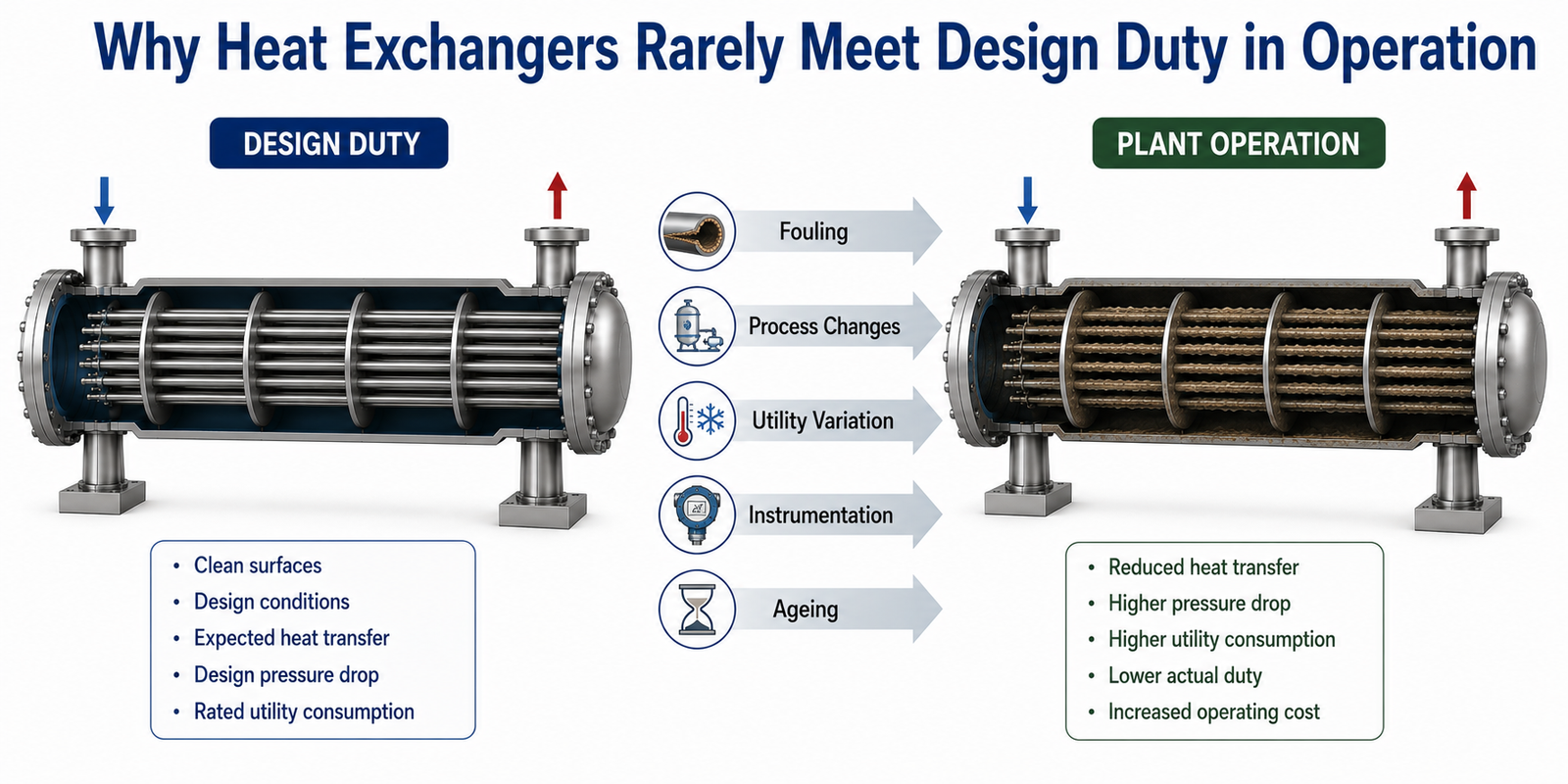
A heat exchanger may be carefully designed, accurately rated, professionally manufactured, and successfully commissioned, yet still fail to achieve its expected heat duty during routine plant operation. This apparent mismatch is not necessarily a sign of poor engineering or defective equipment. Instead, it reflects the difference between ideal design assumptions and the dynamic conditions encountered in real process plants. Understanding why this gap exists enables engineers to diagnose performance problems correctly, optimize operation, and make better design decisions for future projects.
One of the most common questions asked in operating plants is:
“The exchanger was designed for this duty, so why isn’t it achieving it?”
The assumption behind this question is understandable.
If thermal calculations predict a certain outlet temperature or heat duty, many people expect the exchanger to deliver exactly that performance throughout its service life.
In reality, heat exchanger design calculations represent performance under a specific set of assumed conditions.
These assumptions include:
- process flow rates,
- fluid properties,
- inlet temperatures,
- utility conditions,
- clean heat transfer surfaces,
- specified fouling resistance.
During commissioning, these assumptions are often reasonably close to actual operating conditions.
As the plant continues to operate, however, conditions gradually change.
Feedstocks vary.
Utilities fluctuate.
Equipment ages.
Fouling develops.
Operating practices evolve.
Production requirements change.
The exchanger therefore moves further away from its original design point.
Understanding this difference between design performance and operating performance is essential for realistic troubleshooting and effective plant optimization.
Table of Contents
Design Duty Represents a Design Point, Not Every Operating Condition
Heat exchanger design is based on a defined operating case rather than every possible plant condition.
During thermal design, engineers establish a process basis that includes:
- expected process flow,
- inlet temperatures,
- outlet temperature targets,
- physical properties,
- utility availability,
- allowable pressure drop.
The exchanger is then sized to satisfy these design conditions.
Real plants rarely operate continuously at this exact point.
Production rates may increase or decrease.
Raw materials may change.
Utility systems may experience seasonal variations.
Consequently, the exchanger performs differently because the operating conditions have changed—not necessarily because the equipment has failed.
Process Conditions Change Long After Design Is Completed
Many operating plants differ significantly from the assumptions used during project execution.
Common changes include:
- increased production capacity,
- modified product grades,
- different raw material suppliers,
- process optimization,
- equipment revamps,
- utility system changes.
Each modification influences heat transfer performance.
Although individual changes may appear small, their combined effect can substantially reduce exchanger effectiveness.
Fouling Gradually Reduces Heat Transfer
Even well-maintained exchangers experience some degree of fouling during operation.
Deposits create additional thermal resistance between the process fluid and the heat transfer surface.
As fouling increases:
- overall heat transfer coefficient decreases,
- heat duty declines,
- utility consumption increases,
- outlet temperatures drift away from design values.
Fouling develops gradually, making performance deterioration difficult to recognize without trend monitoring.
Utility Systems Do Not Always Deliver Design Conditions
The exchanger can only perform as well as the utility supplied to it.
Examples include:
- lower steam pressure,
- reduced cooling water flow,
- warmer cooling water during summer,
- chilled water temperature fluctuations,
- unstable hot oil temperatures.
Even a perfectly clean exchanger cannot achieve its design duty if the available temperature driving force is lower than assumed during design.
Fluid Properties May Differ from Design Data
Heat transfer calculations depend heavily on accurate physical properties.
Changes in:
- viscosity,
- density,
- specific heat,
- thermal conductivity,
- composition,
can alter:
- heat transfer coefficients,
- Reynolds number,
- flow regime,
- required heat transfer area.
Unexpected changes in feed composition frequently explain differences between predicted and actual performance.
Flow Distribution Is Rarely Perfect
Real equipment rarely achieves the ideal flow patterns assumed during thermal design.
Flow maldistribution may result from:
- nozzle configuration,
- uneven shell-side flow,
- bypass streams,
- tube plugging,
- damaged baffles,
- partial blockages.
These conditions reduce effective heat transfer area even when the exchanger appears mechanically sound.
Instrumentation Can Create the Illusion of Poor Performance
Incorrect measurements often lead engineers to diagnose problems that do not actually exist.
Examples include:
- inaccurate temperature transmitters,
- drifting flowmeters,
- pressure transmitter errors,
- incorrect control valve position feedback.
Before concluding that heat duty has declined, engineers should always verify measurement accuracy.
Reliable data is the foundation of successful performance evaluation.
Operation Outside the Original Design Window
Plants often operate exchangers under conditions never considered during design.
Examples include:
- reduced flow during partial-load operation,
- higher production campaigns,
- frequent startup and shutdown,
- utility sharing between multiple units,
- emergency operating conditions.
Performance naturally changes when the exchanger operates outside its intended design envelope.
Mechanical Ageing Affects Long-Term Performance
Equipment condition gradually changes throughout its service life.
Long-term deterioration may include:
- tube surface roughening,
- corrosion,
- erosion,
- gasket ageing,
- baffle wear,
- tube vibration damage.
Although these effects develop slowly, they gradually reduce thermal and hydraulic performance.
Design Safety Margins Are Not Unlimited
Engineers include reasonable design margins, but no exchanger can compensate indefinitely for changing operating conditions.
Margins help accommodate:
- expected fouling,
- normal operating variation,
- manufacturing tolerances.
They cannot fully compensate for:
- major production increases,
- severe fouling,
- large utility deficiencies,
- significant process modifications.
Eventually, plant conditions exceed the design envelope.
Why Performance Monitoring Is More Valuable Than One-Time Testing
Continuous monitoring reveals trends that individual inspections cannot detect.
Useful performance indicators include:
- inlet temperatures,
- outlet temperatures,
- differential pressure,
- utility consumption,
- process flow,
- calculated heat duty,
- exchanger effectiveness.
Trend analysis often identifies performance deterioration months before operators notice production problems.
Monitoring enables predictive maintenance rather than reactive troubleshooting.
When an Exchanger Truly Cannot Meet Design Duty
Not every performance problem is caused by changing operating conditions.
Occasionally, investigations reveal genuine design or implementation issues such as:
- incorrect thermal calculations,
- fabrication deviations,
- installation errors,
- unsuitable exchanger selection,
- significant process data errors.
These situations occur far less frequently than commonly believed.
A systematic engineering investigation should distinguish between design deficiencies and operational changes before major corrective action is taken.
Common Misunderstandings About Design Duty
Misinterpreting design duty often leads to unnecessary troubleshooting and equipment replacement.
“Design Duty Should Be Achieved Forever”
Design duty reflects a defined operating condition.
Long-term plant operation inevitably introduces changes that influence exchanger performance.
“If Heat Duty Falls, the Exchanger Has Failed”
Reduced duty may result from:
- fouling,
- utility limitations,
- process changes,
- instrumentation errors,
rather than equipment failure.
“Cleaning Always Restores Design Duty”
Cleaning improves performance when fouling is responsible.
It cannot restore heat duty lost because of:
- process modifications,
- utility deficiencies,
- mechanical deterioration,
- inaccurate measurements.
“The Original Design Must Have Been Incorrect”
Many exchangers perform exactly as designed.
The plant itself has simply evolved beyond the assumptions used during the original thermal design.
Operator Perspective
Operators often recognize declining exchanger performance before formal engineering calculations identify the cause.
Increasing:
- steam valve opening,
- cooling water demand,
- control valve movement,
- process adjustments,
are valuable early indicators that operating conditions are drifting away from the original design basis.
Maintaining accurate operating records greatly improves troubleshooting effectiveness.
Owner Perspective
For plant owners, understanding the difference between design duty and operating duty prevents unnecessary capital expenditure.
Instead of immediately replacing an underperforming exchanger, systematic evaluation may identify opportunities to:
- optimize operation,
- improve utility management,
- adjust maintenance practices,
- remove process bottlenecks,
- restore performance at significantly lower cost.
Engineering analysis frequently delivers better value than equipment replacement alone.
Final Perspective
Design duty is not a guarantee of permanent performance.
It is a benchmark established under carefully defined process conditions.
As plants evolve, utilities fluctuate, equipment ages, and operating practices change, the exchanger responds to those new conditions just as any engineered system would.
Successful engineers therefore avoid judging performance solely by comparing current operating data with the original design datasheet.
Instead, they evaluate the complete operating context—process conditions, utilities, fouling, hydraulics, instrumentation, and equipment condition—to understand why performance has changed.
Ultimately, the question is not whether a heat exchanger still matches its original design duty, but whether it continues to meet the current needs of the process safely, efficiently, and economically. That broader perspective transforms troubleshooting from simply finding faults into understanding how engineering systems perform throughout their entire operating life.
Explore the complete series in the Heat Exchanger Engineering Hub.
A practicing chemical engineer with 17+ years of experience in process design, project execution, commissioning, and plant operations. Focused on practical engineering judgment beyond textbook explanations.