
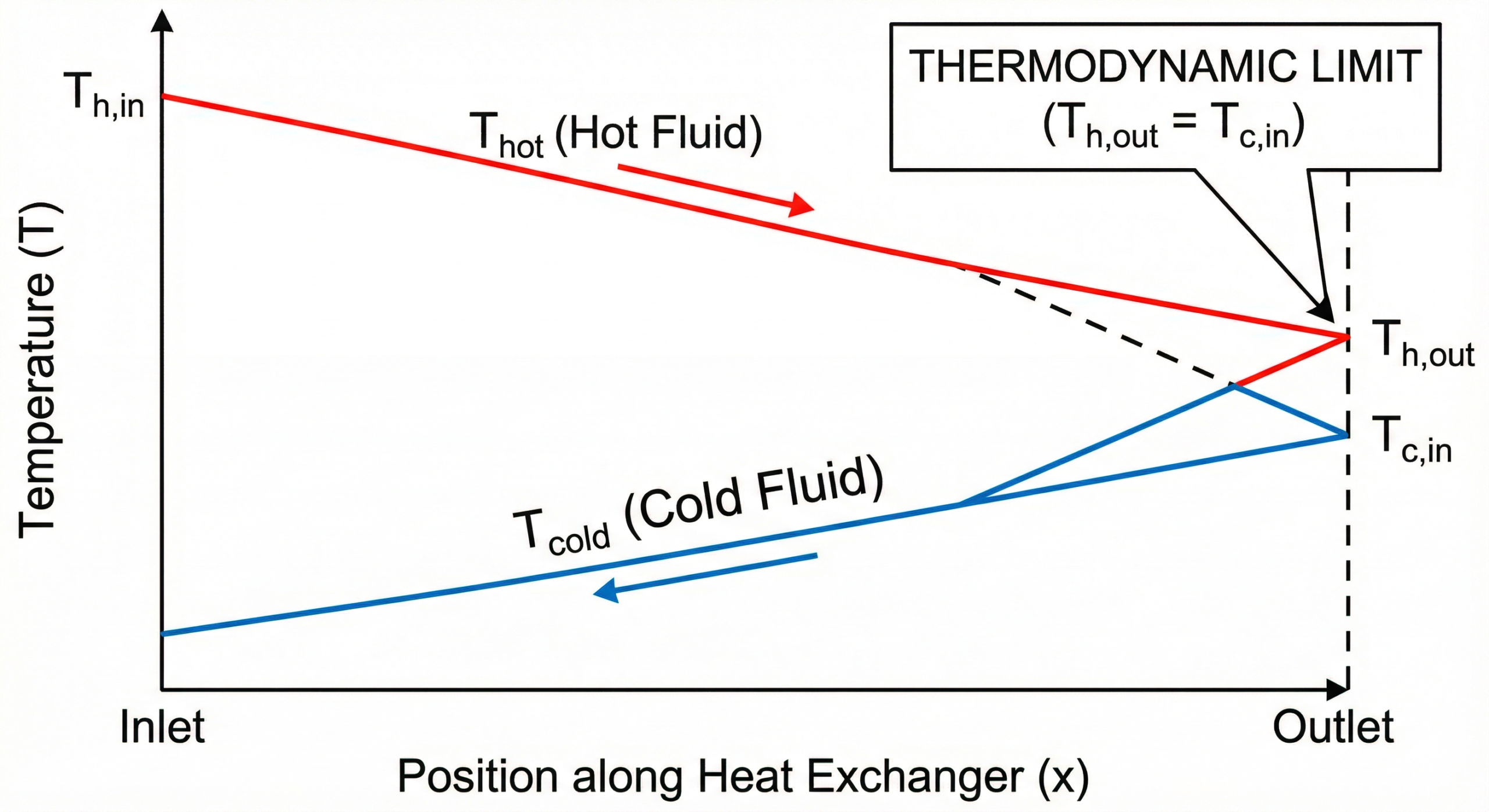
Among all heat exchanger problems, temperature cross is the most misunderstood.
It is often treated as:
- a calculation inconvenience,
- a simulation warning,
- a numerical instability.
In reality, temperature cross is a physical impossibility for sensible heat exchange.
When temperature cross appears in design or operation, it is not signaling poor performance.
It is signaling that the exchanger is being asked to do something thermodynamics does not allow.
This article explains what temperature cross really is, why it breaks exchanger performance completely, and why no amount of area, fouling correction, or operational adjustment can fix it.
Table of Contents
What Is Temperature Cross?
A temperature cross occurs when:
the cold stream outlet temperature becomes higher than the hot stream outlet temperature
(for sensible heat exchange without phase change)
In simple terms:
- the cold side tries to leave hotter than the hot side,
- local temperature difference reverses sign,
- heat would have to flow from cold to hot.
That cannot happen without external work or phase change.
At this point, heat transfer by sensible means becomes impossible.
Why Temperature Cross Is Not a “Small Problem”
Many plant teams treat temperature cross as:
- a minor violation,
- something that can be absorbed by margin,
- a result of conservative simulation.
This is dangerous thinking.
Temperature cross is not a degradation.
It is not inefficiency.
It is not fouling.
It is a hard physical limit.
Once crossed:
- no steady-state solution exists,
- exchanger performance collapses,
- control becomes unstable or impossible.
How Temperature Cross Develops in Practice
Temperature cross rarely appears suddenly.
It is usually approached gradually.
Common contributing factors include:
- aggressive temperature targets,
- tight approach temperatures,
- low correction factor geometry,
- fouling accumulation,
- seasonal utility degradation.
Initially:
- exchanger struggles near outlet,
- additional utility gives diminishing returns.
Eventually:
- the required outlet temperatures violate thermodynamic feasibility,
- temperature cross appears.
The exchanger did not fail.
The specification did.
Why LMTD Fails Completely at Temperature Cross
LMTD relies on two terminal temperature differences.
When temperature cross occurs:
- one terminal ΔT becomes zero or negative,
- logarithmic averaging becomes undefined,
- LMTD collapses mathematically.
This is not a numerical problem.
It is a physical one.
The mathematics is correctly refusing to describe an impossible situation.
Why Adding Area Does Not Fix Temperature Cross
A common instinct is:
“Add more surface area.”
This does not work.
Area increases heat transfer only when driving force exists.
At temperature cross:
- local driving force is zero or negative,
- infinite area would still not produce heat transfer,
- the limitation is thermodynamic, not geometric.
This is why revamps that only add area often fail.
Why Fouling Makes Temperature Cross Appear Suddenly
Fouling increases resistance.
As resistance increases:
- required temperature difference increases,
- approach temperature shrinks,
- pinch tightens.
A design already near feasibility can cross the limit suddenly with modest fouling.
This explains why:
- exchangers work for years,
- then fail abruptly,
- with no obvious mechanical damage.
The system crossed a driving-force boundary.
Temperature Cross vs Pinch Point
Pinch and temperature cross are related but not identical.
- Pinch: minimum ΔT approaches zero
- Temperature cross: ΔT becomes negative
Pinch signals extreme sensitivity.
Temperature cross signals impossibility.
Pinch can sometimes be managed with operational changes.
Temperature cross cannot.
Phase Change Is the Only Exception
Temperature cross can appear acceptable only when phase change is involved.
Examples:
- condensing steam heating liquid,
- boiling refrigerant cooling gas.
In these cases:
- temperature remains constant during phase change,
- heat transfer is driven by latent heat,
- outlet temperature relationships differ.
Outside phase change, temperature cross is non-negotiable.
Operational Symptoms of Approaching Temperature Cross
In real plants, temperature cross proximity appears as:
- outlet temperature stuck despite increased utility,
- rapidly rising utility consumption,
- strong sensitivity to small fouling,
- unstable temperature control,
- operators “chasing” setpoints unsuccessfully.
These are not control problems.
They are thermodynamic limit problems.
Why Temperature Cross Breaks Control Systems
Control systems assume that:
- increasing utility increases duty,
- temperature responds monotonically.
Near temperature cross:
- response becomes non-linear,
- gain collapses,
- controllers saturate.
Operators often compensate manually, masking the real issue.
The exchanger is no longer controllable because it is no longer physically capable.
Design Situations Prone to Temperature Cross
Temperature cross is most likely when:
- approach temperatures are very tight,
- correction factor is low,
- exchanger has multiple passes,
- fouling allowance is minimal,
- seasonal utility variation is ignored.
These designs may meet duty on paper but lack robustness.
Owner Perspective: Why Temperature Cross Is Expensive
From an ownership standpoint, temperature cross leads to:
- exchangers that never meet expectation,
- repeated cleaning with no improvement,
- expensive revamps that underperform,
- production limits blamed on operations.
The real cause is usually unrealistic temperature targets, not equipment failure.
Recognizing temperature cross early prevents wasted capital.
Final Perspective
Temperature cross is not a warning sign.
It is a stop sign.
It tells engineers:
- no steady solution exists,
- no amount of area will help,
- expectations must change.
Plants that respect this limit:
- redesign specifications,
- adjust targets,
- avoid repeated failure.
Plants that ignore it often spend years fighting equipment that can never succeed.
Understanding why temperature cross breaks exchanger performance is not advanced theory.
It is essential thermodynamic literacy.
And it marks the boundary between exchangers that struggle — and exchangers that simply cannot work.
Explore the complete series in the Heat Transfer Engineering Hub.

A practicing chemical engineer with 17+ years of experience in process design, project execution, commissioning, and plant operations. Focused on practical engineering judgment beyond textbook explanations.