Cleaning heat exchangers is widely viewed as good practice.
When performance declines, cleaning restores duty, stabilizes control, and reduces energy consumption. This immediate improvement creates a powerful belief:
More frequent cleaning equals better performance.
In real plants, this belief often leads to over-cleaning — a practice that feels responsible, but quietly increases cost, reduces availability, and shortens equipment life.
This article explains the economic impact of over-cleaning heat exchangers, why it happens, and how well-run plants avoid this trap.
Table of Contents
Over-Cleaning Is Rarely Recognized as a Problem
Under-cleaning is obvious:
- temperatures are missed,
- energy consumption spikes,
- alarms appear.
Over-cleaning is subtle:
- performance looks good,
- equipment appears well-maintained,
- problems seem prevented.
Because the negative effects of over-cleaning are indirect and delayed, they are rarely attributed to cleaning frequency itself.
Yet over time, they dominate lifecycle cost.
Every Cleaning Consumes Availability
Cleaning requires:
- exchanger isolation,
- draining and cooling,
- opening or chemical circulation,
- inspection and reassembly,
- startup and stabilization.
Even when planned efficiently, cleaning causes:
- lost production time,
- startup inefficiency,
- schedule disruption.
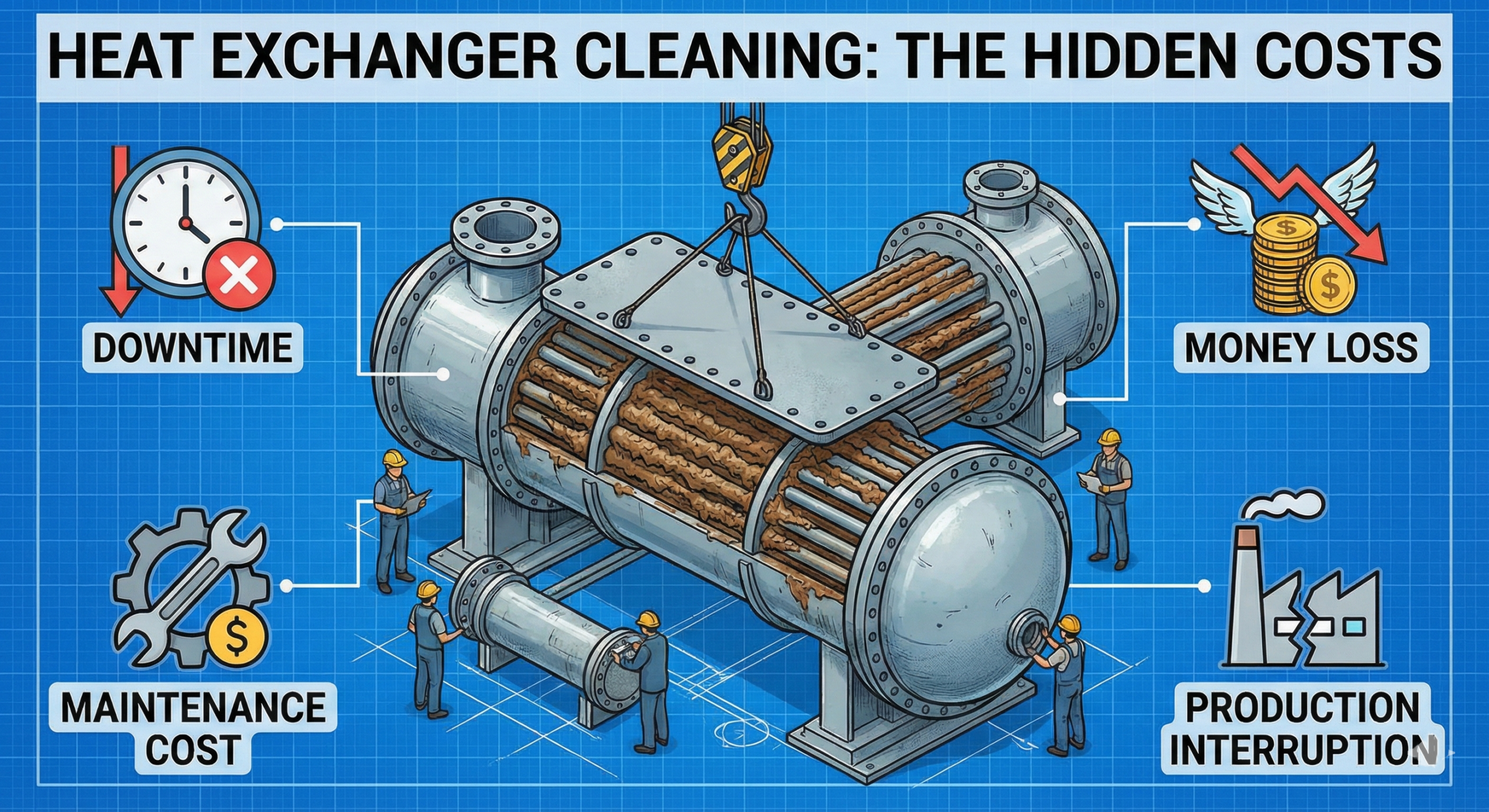
Frequent cleaning fragments availability into many small losses that are rarely captured as a single KPI — but add up significantly over a year.
Cleaning Cost Is More Than Maintenance Cost
The visible cost of cleaning includes:
- labor,
- chemicals,
- equipment rental,
- waste handling.
The invisible costs are often larger:
- lost throughput,
- increased energy during startup,
- quality instability,
- operator time.
Over-cleaning multiplies all of these quietly.
Plants often budget for maintenance — but not for the production value lost to excessive intervention.
Over-Cleaning Accelerates Equipment Degradation
Each cleaning cycle alters the exchanger surface.
Mechanical cleaning:
- increases surface roughness,
- damages protective layers,
- creates new fouling nucleation sites.
Chemical cleaning:
- attacks base metal,
- weakens oxide films,
- accelerates corrosion.
As a result:
- fouling returns faster,
- performance recovery diminishes,
- cleaning intervals shorten.
The exchanger enters a self-reinforcing degradation loop driven by cleaning itself.
Frequent Cleaning Reduces Long-Term Performance Recovery
Early in equipment life:
- cleaning restores performance almost fully.
With repeated cleaning:
- recovery becomes incomplete,
- baseline performance declines,
- “clean” performance is no longer truly clean.
Plants often misinterpret this as:
- worsening fouling tendency,
- feed quality decline.
In reality, the exchanger has been gradually damaged by intervention frequency.
Over-Cleaning Masks Design and Operating Issues
When cleaning is used as a routine performance fix:
- poor flow distribution remains unaddressed,
- hot spots persist,
- maldistribution worsens,
- fouling drivers remain active.
Cleaning treats the symptom — not the cause.
As cleaning frequency increases, attention to root causes often decreases.
Energy Savings Can Be Overestimated
Cleaning usually reduces energy consumption — initially.
But when cleaning is frequent:
- the incremental energy savings per cleaning decline,
- startup inefficiencies offset gains,
- net annual energy benefit shrinks.
In some cases:
- total annual energy cost increases,
- despite “cleaner” exchangers.
Without lifecycle analysis, this paradox goes unnoticed.
Over-Cleaning Shifts Risk Instead of Reducing It
Frequent opening and intervention increase:
- gasket failures,
- tube leaks,
- flange misalignment,
- human error.
These risks accumulate quietly.
Plants that clean frequently often experience:
- more small leaks,
- more unplanned maintenance,
- lower mechanical reliability.
The exchanger looks clean — but becomes fragile.
Why Over-Cleaning Happens
Plants over-clean because:
- fouling is blamed for all performance loss,
- cleaning gives immediate visible improvement,
- long-term damage is not tracked,
- availability loss is fragmented and hidden.
Over-cleaning is rarely a technical decision.
It is a behavioral one.
Fouling Margin Was Added to Avoid Over-Cleaning
Design fouling margin exists so that:
- exchangers can tolerate fouling,
- cleaning is not required at the first sign of degradation,
- operation remains stable within a range.
Over-cleaning ignores this margin.
It treats any fouling as unacceptable — defeating the very purpose of the design allowance.
The Economic Optimum Is Not Maximum Cleanliness
The economically optimal point is where:
- the cost of energy loss due to fouling,
- equals the cost of cleaning and lost availability.
Cleaning before this point wastes money.
Cleaning after this point risks instability.
Maximum cleanliness is not the goal.
Maximum economic value is.
Owner Perspective: Over-Cleaning Is a Hidden Drain
From an ownership standpoint, over-cleaning:
- reduces annual production,
- increases maintenance spend,
- accelerates asset aging,
- raises long-term capital replacement cost.
Because these costs are spread across departments, they often go unchallenged.
Plants that optimize cleaning frequency:
- run fewer cleanings,
- plan them better,
- operate more stably,
- spend less over the life of the exchanger.
Final Perspective
Cleaning heat exchangers is necessary.
Over-cleaning them is costly.
Plants that clean based on fear, habit, or visible discomfort often spend far more than they realize — in availability loss, energy waste, and asset degradation.
Plants that treat cleaning as an economic decision, informed by fouling behavior and margin, achieve:
- higher availability,
- lower lifecycle cost,
- longer equipment life.
Understanding the economic impact of over-cleaning heat exchangers shifts fouling management from reaction to strategy.
And that shift is one of the clearest signs of a mature, economically disciplined process plant.
Explore the complete series in the Heat Transfer Engineering Hub.

A practicing chemical engineer with 17+ years of experience in process design, project execution, commissioning, and plant operations. Focused on practical engineering judgment beyond textbook explanations.