
In heat transfer discussions, one term appears again and again:
- hot-side coefficient
- cold-side coefficient
- film coefficient
It is used in design calculations.
It appears in U-value breakdowns.
It is mentioned when performance is discussed.
But for many people, the film coefficient remains an abstract number.
It is treated like a property from a table.
In reality, the film coefficient represents something very physical and very real:
A thin fluid layer that quietly controls how easily heat can enter or leave a surface.
This article explains what the film coefficient truly represents, why it matters more than the metal wall in many cases, and how it changes with real plant conditions.
Table of Contents
What Is the Film Coefficient?
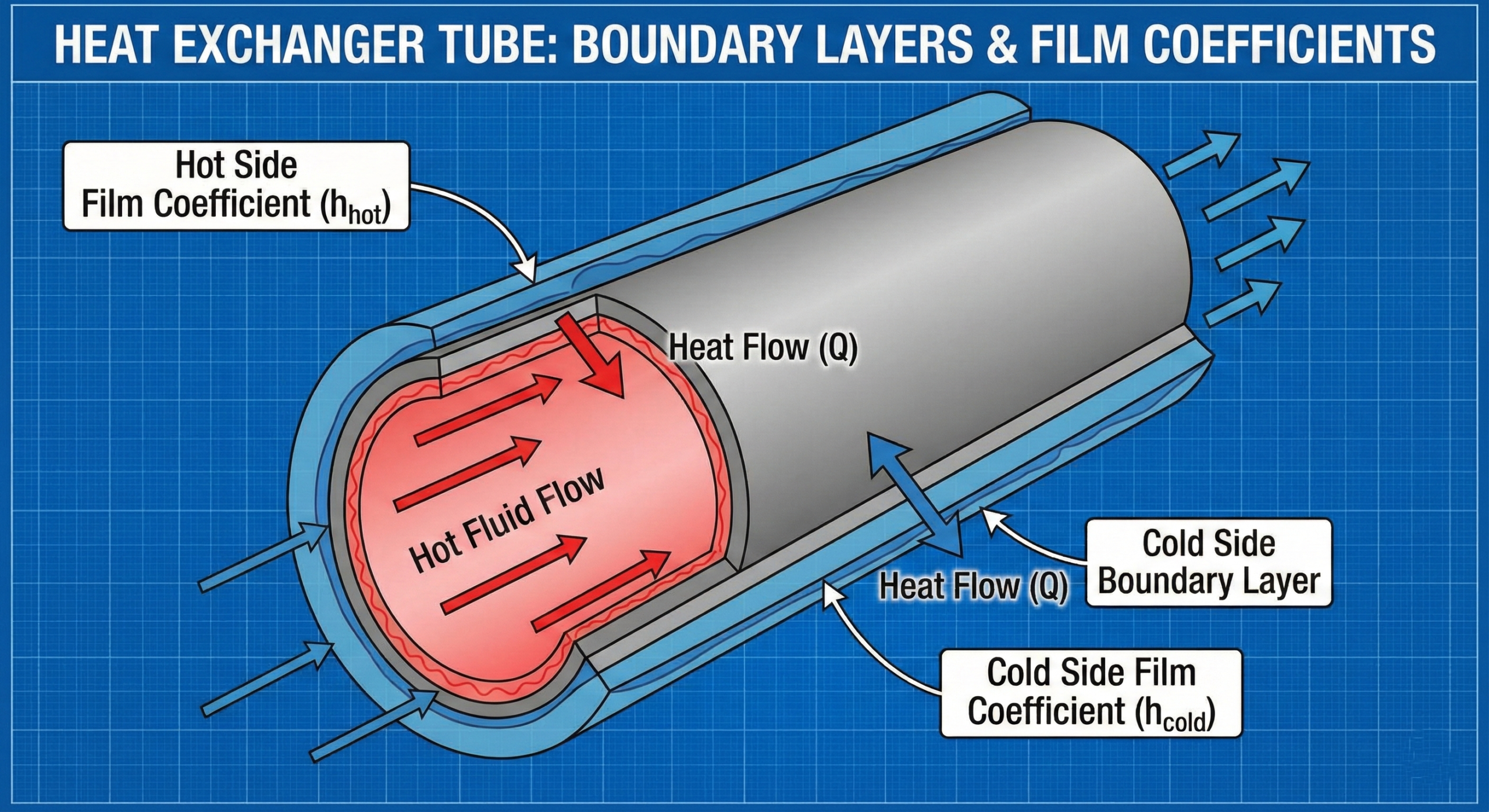
Whenever fluid flows over a surface, a very thin layer of fluid sticks to the wall.
This happens because of friction.
Even when the main flow is fast:
- the fluid right next to the wall moves very slowly
- sometimes it almost does not move at all
This slow-moving layer is called the thermal boundary layer.
Heat must pass through this layer before reaching the bulk fluid.
The film coefficient is simply a way to describe:
How easily heat can cross this thin layer.
A high film coefficient means:
- heat crosses easily
- resistance is low
A low film coefficient means:
- heat struggles to pass
- resistance is high
Why This Thin Layer Matters So Much
Many people assume the metal wall controls heat transfer.
But in most exchangers:
- the metal conducts heat well
- the fluid layer near the wall resists heat more
So the biggest barrier to heat transfer is often not the metal.
It is the fluid film.
This is why changing flow conditions can affect performance more than changing material.
Where Film Resistance Exists
There is always a film layer on both sides of a heat transfer surface:
- hot side fluid film
- cold side fluid film
Heat must cross both.
So the total resistance includes:
- hot-side film resistance
- wall resistance
- cold-side film resistance
In many cases, one of the films dominates.
Why Oil Services Have Low Film Coefficients
Viscous fluids like oil create thicker boundary layers.
Because:
- flow near the wall is slow
- turbulence is weak
- mixing is limited
This makes it harder for heat to reach the surface.
So oil-side film coefficients are usually low.
That is why:
- heating heavy oil requires large surface area
- cooling viscous fluids is slow
The fluid film controls the performance.
Why Water Services Perform Better
Water has:
- lower viscosity
- better mixing
- stronger turbulence at the same velocity
This creates thinner boundary layers.
So heat crosses more easily.
This means:
- higher film coefficient
- better heat transfer performance
This is why cooling water is such an effective utility.
Velocity Has a Strong Influence on Film Coefficient
One of the biggest factors affecting film coefficient is flow speed.
Higher velocity:
- increases turbulence
- breaks the boundary layer
- improves mixing near the wall
This reduces resistance and increases the film coefficient.
Lower velocity:
- allows thicker boundary layers
- increases resistance
- reduces heat transfer rate
This is why exchangers often perform worse at low load conditions.
Why Gas-Side Coefficients Are Low
Gases are poor heat transfer fluids.
They have:
- low density
- low thermal conductivity
So gas-side film coefficients are usually much lower than liquid-side ones.
This is why:
- air coolers need very large surface areas
- fins are used to increase effective area
Even with fins, gas-side resistance often dominates.
Phase Change Creates High Film Coefficients
When phase change occurs, film behavior changes dramatically.
For example:
Condensation
Steam condensing on a surface releases heat rapidly.
The liquid film formed may be thin and highly conductive.
This produces high film coefficients.
Boiling
When liquid boils:
- bubbles form
- mixing becomes intense
This can greatly increase heat transfer.
But it also depends on stable flow conditions.
So phase change services often show very strong film-side heat transfer.
Fouling Acts Like an Extra Film
When deposits form on a surface:
- they create an additional layer
- heat must pass through it
This behaves like another boundary layer.
So effective film resistance increases.
This is why fouling reduces U so quickly.
It adds another barrier in the heat path.
Why Film Coefficients Change Over Time
Film coefficients are not constant.
They change with:
- flow rate
- fluid properties
- temperature
- fouling buildup
- operating load
For example:
- higher flow increases coefficient
- higher viscosity reduces coefficient
- deposits reduce effective transfer
So the film coefficient is a living parameter, not a fixed number.
Why Engineers Talk About “Controlling Side”
In many exchangers, one side has much lower film coefficient than the other.
That side controls performance.
For example:
- oil vs water exchanger
→ oil side usually controls - gas vs liquid exchanger
→ gas side usually controls
Improving the stronger side gives little benefit.
Improving the weaker side makes a big difference.
Why Film Coefficient Matters More Than Wall Material
People often focus on:
- stainless steel vs carbon steel
- copper vs alloy
But changing metal only affects wall resistance.
If film resistance dominates:
- wall improvement gives little gain
This is why increasing turbulence or velocity often improves performance more than changing metal.
How Operators Influence Film Coefficient Without Realizing It
Daily operating changes affect film behavior:
- adjusting flow rate
- changing load
- altering temperature
These actions change:
- turbulence
- viscosity
- mixing
So film coefficient changes.
Operators may see:
- performance improving with higher flow
- cooling becoming weaker at low load
What they are really seeing is film resistance changing.
Owner Perspective: Why Film Behavior Affects Cost
From a plant perspective, film coefficient affects:
- exchanger size needed
- utility consumption
- cleaning frequency
- throughput capacity
Low film coefficients mean:
- larger exchangers
- higher energy use
- tighter limits
So understanding film behavior helps explain why some services are more expensive to operate.
A Simple Way to Visualize Film Resistance
Imagine heat trying to move from metal into a fluid.
If the fluid near the wall is stagnant:
- heat moves slowly
If the fluid is swirling and mixing:
- heat moves quickly
That thin region near the wall decides how easy the transfer is.
That is what the film coefficient represents.
Final Perspective
The film coefficient is not just a number in a calculation.
It represents the real behavior of fluid touching a surface.
It reflects:
- how fast the fluid moves
- how well it mixes
- how easily heat can enter or leave
In many exchangers, this thin fluid layer controls performance more than the metal itself.
Understanding what the film coefficient really represents helps explain:
- why flow rate matters so much
- why fouling hurts performance quickly
- why some services transfer heat easily and others struggle
It is one of the simplest ideas in heat transfer — and one of the most important to truly understand.

A practicing chemical engineer with 17+ years of experience in process design, project execution, commissioning, and plant operations. Focused on practical engineering judgment beyond textbook explanations.