
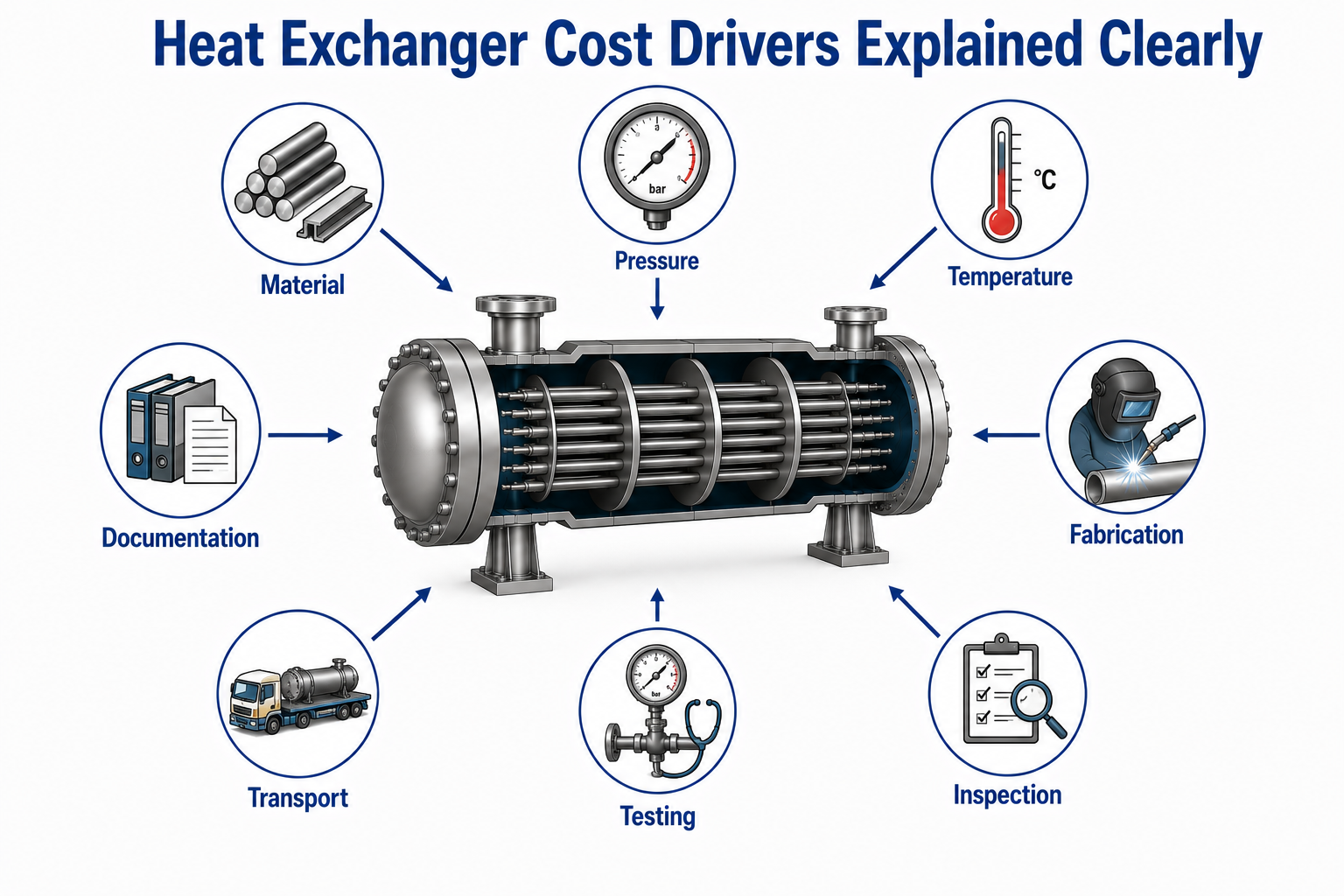
The cost of a heat exchanger is influenced by far more than its size or heat transfer area. Material selection, operating pressure, temperature, mechanical design, fabrication complexity, inspection requirements, transportation, and project specifications all contribute to the final price. Understanding these cost drivers helps engineers make informed technical and commercial decisions, balance capital investment with long-term reliability, and avoid unnecessary expenditure without compromising equipment performance.
One of the first questions asked during any engineering project is:
“Why is this heat exchanger so expensive?”
At first glance, two shell-and-tube heat exchangers may appear almost identical.
Both may have:
- similar dimensions,
- comparable heat transfer area,
- identical nozzle sizes,
- nearly the same weight.
Yet one may cost significantly more than the other.
This difference often surprises engineers who are unfamiliar with equipment procurement.
The reality is that the price of a heat exchanger reflects much more than the quantity of steel used to build it.
Every engineering decision affects manufacturing effort, material cost, inspection requirements, testing, transportation, and long-term reliability.
For this reason, experienced engineers rarely evaluate equipment based on purchase price alone.
Instead, they understand which technical requirements genuinely increase cost and which specifications provide little practical benefit for a particular service.
This knowledge enables engineers to optimize equipment selection while maintaining safety, performance, and reliability.
Table of Contents
Cost Is More Than Material Cost
Raw material is only one component of the total equipment cost.
The final price of a heat exchanger typically includes:
- engineering and design,
- raw materials,
- fabrication,
- machining,
- welding,
- inspection and testing,
- documentation,
- painting and preservation,
- transportation,
- vendor overhead,
- project management.
In many projects, fabrication and quality assurance contribute as much to the final price as the material itself.
Material Selection Is One of the Largest Cost Drivers
The choice of construction material has a major influence on equipment cost.
Material selection depends on:
- corrosion resistance,
- operating temperature,
- operating pressure,
- process fluid compatibility,
- expected service life.
For example, exchangers manufactured from carbon steel generally cost much less than those requiring:
- stainless steel,
- duplex stainless steel,
- titanium,
- nickel alloys,
- high-alloy materials.
However, selecting a lower-cost material for an aggressive service may significantly increase future maintenance and replacement costs.
Material selection should therefore consider lifecycle performance rather than procurement cost alone.
Operating Pressure Increases Manufacturing Complexity
Higher pressure ratings require stronger construction and more demanding fabrication.
As design pressure increases, manufacturers may need:
- thicker shells,
- thicker channel covers,
- heavier flanges,
- stronger nozzles,
- additional reinforcement,
- more extensive welding.
These requirements increase:
- material consumption,
- fabrication time,
- machining effort,
- inspection requirements.
Consequently, pressure rating is often a more significant cost driver than equipment size alone.
Operating Temperature Influences Material and Design Requirements
High and low operating temperatures introduce additional engineering challenges.
Temperature may influence:
- allowable material stress,
- thermal expansion,
- gasket selection,
- welding procedures,
- insulation requirements,
- fabrication tolerances.
Extreme temperatures frequently require specialized materials and more rigorous quality control, increasing overall project cost.
Heat Transfer Area Is Only Part of the Cost
Larger exchangers generally cost more, but the relationship is not always proportional.
Increasing heat transfer area may require:
- longer tubes,
- larger shells,
- additional tube supports,
- heavier foundations,
- larger channel assemblies.
However, a smaller exchanger operating at very high pressure may cost considerably more than a much larger exchanger operating under moderate conditions.
Area alone should never be used to estimate equipment cost.
TEMA Configuration Affects Manufacturing Cost
Different exchanger constructions require different fabrication effort.
For example:
- Fixed tubesheet exchangers are generally simpler to manufacture.
- U-tube exchangers require tube bending and specialized fabrication.
- Floating head exchangers involve additional components, machining, and assembly.
More complex TEMA configurations improve operational flexibility but also increase manufacturing complexity and cost.
Equipment selection should balance operating requirements with economic considerations.
Tube Material and Tube Quantity Significantly Influence Price
The tube bundle often represents a large proportion of the exchanger cost.
Important factors include:
- tube material,
- tube diameter,
- tube thickness,
- tube length,
- number of tubes,
- tube manufacturing quality.
Using corrosion-resistant alloys for thousands of tubes can substantially increase equipment cost even when the shell remains carbon steel.
Fabrication Quality Requirements Add Cost
Higher quality standards require additional manufacturing effort.
Examples include:
- tighter dimensional tolerances,
- qualified welding procedures,
- experienced welders,
- additional machining,
- improved surface finish,
- specialized fabrication techniques.
Although these requirements increase procurement cost, they often improve long-term reliability and reduce maintenance.
Inspection and Testing Increase Procurement Cost
Quality assurance activities require both time and skilled personnel.
Typical inspection requirements include:
- visual inspection,
- dimensional verification,
- radiographic testing,
- ultrasonic testing,
- dye penetrant examination,
- positive material identification,
- hydrostatic testing,
- documentation review.
Projects requiring extensive client witness inspections generally cost more than those with standard inspection requirements.
These costs represent an investment in quality rather than unnecessary expenditure.
Code and Project Specifications Influence Cost
Different design codes and client specifications require different levels of engineering effort.
Additional project requirements may include:
- enhanced documentation,
- third-party inspection,
- higher corrosion allowance,
- special painting systems,
- traceability requirements,
- export packaging,
- client-specific testing.
Even when the physical exchanger remains similar, project specifications can significantly influence the final quotation.
Transportation and Packaging Are Often Overlooked
Large heat exchangers require careful handling before they ever reach the plant.
Transportation cost depends on:
- equipment dimensions,
- weight,
- shipping distance,
- export requirements,
- lifting arrangements,
- preservation methods,
- special packaging.
Very large exchangers may require:
- oversized transport,
- route surveys,
- specialized trailers,
- heavy lifting equipment.
These logistics costs can become a significant part of the overall project budget.
Engineering Documentation Has Commercial Value
Preparing project documentation requires considerable engineering effort.
Documentation may include:
- general arrangement drawings,
- fabrication drawings,
- stress calculations,
- inspection reports,
- welding records,
- material certificates,
- operating manuals,
- quality dossiers.
Comprehensive documentation increases project cost but simplifies commissioning, maintenance, regulatory compliance, and future modifications.
Why Two Similar Heat Exchangers May Have Very Different Prices
Visual appearance rarely reflects manufacturing complexity.
Two exchangers with similar external dimensions may differ significantly because of:
- material grade,
- pressure rating,
- tube alloy,
- inspection requirements,
- fabrication tolerances,
- code requirements,
- testing scope,
- delivery schedule.
Understanding these hidden cost drivers allows engineers to evaluate vendor quotations more effectively.
Balancing Cost and Reliability
The objective is not to purchase the least expensive exchanger but the one that provides the best long-term value.
Good engineering balances:
- capital cost,
- operating efficiency,
- maintenance requirements,
- inspection quality,
- expected service life,
- lifecycle cost.
An exchanger with a higher purchase price may ultimately become the more economical choice if it:
- consumes less energy,
- requires fewer shutdowns,
- lasts longer,
- reduces maintenance,
- improves production reliability.
Common Misunderstandings About Heat Exchanger Cost
Many procurement decisions are influenced by misconceptions about equipment pricing.
“Bigger Heat Exchangers Always Cost More”
Size influences cost, but pressure, material, fabrication complexity, and inspection requirements often have a greater impact.
“Material Cost Is the Largest Part of the Price”
Engineering, fabrication, machining, inspection, documentation, and testing collectively represent a significant portion of the total equipment cost.
“All Vendor Quotations Should Be Similar”
Different vendors may interpret specifications differently, apply varying fabrication methods, include different inspection scopes, or use alternative material sources.
A detailed technical evaluation should accompany every commercial comparison.
“The Lowest Purchase Price Represents the Best Value”
The initial purchase price represents only one part of the equipment’s total lifecycle cost.
Maintenance, energy consumption, reliability, and service life often have a much greater financial impact over decades of operation.
Operator Perspective
Operators experience the long-term consequences of procurement decisions made years before the equipment enters service.
Higher-quality equipment generally provides:
- more stable operation,
- fewer maintenance interruptions,
- lower utility consumption,
- longer operating campaigns,
- improved process reliability.
Good procurement decisions simplify operation throughout the exchanger’s life.
Owner Perspective
For plant owners, understanding cost drivers supports better investment decisions.
Selecting equipment based solely on the lowest quotation may increase:
- maintenance costs,
- production losses,
- energy consumption,
- replacement frequency,
- lifecycle expenditure.
Evaluating both technical suitability and commercial value helps maximize return on capital investment.
Final Perspective
The cost of a heat exchanger is not determined by its appearance or its weight alone.
It reflects hundreds of engineering and manufacturing decisions—from material selection and pressure rating to welding quality, inspection scope, documentation, and transportation.
Experienced engineers understand that every additional technical requirement carries both a cost and a purpose.
The challenge is not to eliminate cost wherever possible, but to invest where it creates meaningful improvements in safety, reliability, maintainability, and operational performance.
Ultimately, the best-value heat exchanger is rarely the one with the lowest purchase price. It is the one that delivers dependable service, minimizes lifecycle costs, and continues supporting plant production efficiently throughout its operating life.
Explore the complete series in the Heat Exchanger Engineering Hub.

A practicing chemical engineer with 17+ years of experience in process design, project execution, commissioning, and plant operations. Focused on practical engineering judgment beyond textbook explanations.