
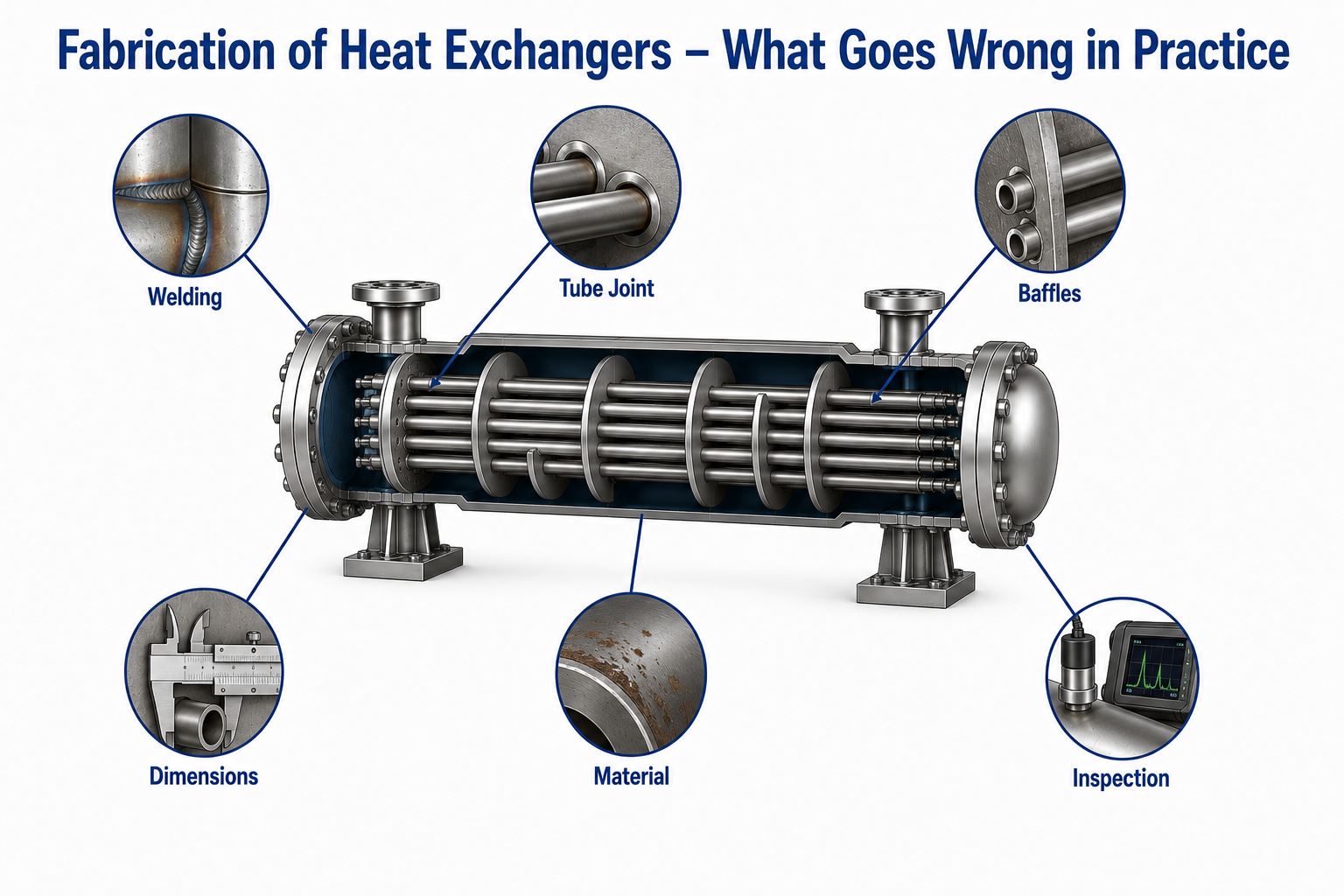
The reliability of a heat exchanger depends not only on its design but also on how accurately it is fabricated. Even a perfectly engineered exchanger can experience leakage, vibration, reduced thermal performance, or premature failure if manufacturing defects are introduced during fabrication. Understanding common fabrication problems enables engineers to review vendor quality more effectively, recognize potential risks before commissioning, and ensure that the finished equipment performs as intended throughout its service life.
When engineers discuss heat exchanger reliability, attention is often focused on thermal calculations, material selection, or operating conditions.
However, there is another stage that has an equally significant influence on equipment performance—fabrication.
A shell-and-tube heat exchanger consists of hundreds or even thousands of individual components that must be manufactured, machined, welded, assembled, and inspected with great precision.
Every fabrication activity influences the final product.
For example:
- a slightly misaligned tubesheet may complicate tube installation,
- poor weld quality may lead to leakage,
- incorrect baffle spacing may affect vibration,
- improper tube expansion may reduce joint integrity,
- dimensional inaccuracies may create assembly difficulties.
Most fabrication defects are not immediately visible during plant operation.
Instead, they often appear months or years later as recurring maintenance problems, unexplained performance losses, or unexpected equipment failures.
Experienced engineers therefore understand that successful fabrication is not simply about building equipment according to drawings.
It is about consistently achieving the design intent through disciplined manufacturing practices and rigorous quality control.
Table of Contents
Why Fabrication Quality Matters
Fabrication transforms engineering drawings into physical equipment, making it one of the most critical stages in determining long-term reliability.
Design calculations specify:
- dimensions,
- materials,
- pressure ratings,
- thermal performance,
- allowable stresses.
Fabrication must reproduce these requirements accurately.
Small manufacturing deviations may affect:
- heat transfer,
- hydraulic performance,
- mechanical strength,
- inspection results,
- maintenance accessibility.
Once the exchanger enters service, correcting fabrication defects is often far more difficult and expensive than preventing them during manufacturing.
Stage 1: Material Identification Errors
Reliability begins with using the correct material for every component.
Fabrication problems sometimes originate before manufacturing even starts.
Typical material-related issues include:
- incorrect material issued from storage,
- mixed material grades,
- missing material traceability,
- improper identification markings,
- substitution without engineering approval.
Installing the wrong alloy may result in:
- accelerated corrosion,
- reduced pressure capability,
- shortened equipment life,
- unexpected failures.
Good Engineering Practice
Verify material certificates and perform Positive Material Identification (PMI) where project specifications require it.
Stage 2: Poor Welding Quality
Welding is one of the most critical fabrication activities in heat exchanger manufacturing.
Common welding problems include:
- lack of fusion,
- incomplete penetration,
- porosity,
- slag inclusions,
- weld cracking,
- excessive distortion.
Poor weld quality may cause:
- leakage,
- reduced pressure integrity,
- fatigue failure,
- repeated repair welding.
Good Engineering Practice
Use qualified welding procedures, certified welders, and appropriate non-destructive examination to verify weld quality.
Stage 3: Tube-to-Tubesheet Joint Problems
The tube-to-tubesheet joint is one of the most critical leak-tight connections in a shell-and-tube heat exchanger.
Problems may arise from:
- improper tube expansion,
- incorrect rolling force,
- inadequate welding,
- damaged tube ends,
- oversized tube holes,
- poor surface finish.
Failures at these joints frequently result in:
- process contamination,
- utility leakage,
- reduced thermal performance,
- costly shutdowns.
Good Engineering Practice
Control tube expansion procedures carefully and inspect joints according to project specifications.
Stage 4: Baffle Fabrication and Alignment Errors
Baffles guide shell-side flow and support the tube bundle.
Fabrication issues include:
- incorrect spacing,
- damaged baffles,
- oversized clearances,
- poor alignment,
- improper hole machining.
These defects may lead to:
- flow bypass,
- vibration,
- tube wear,
- reduced heat transfer,
- increased maintenance.
Good Engineering Practice
Verify dimensional accuracy during bundle assembly before final closure.
Stage 5: Tube Damage During Assembly
Heat exchanger tubes are vulnerable throughout fabrication.
Damage may occur due to:
- careless handling,
- impact,
- improper lifting,
- scratching,
- denting,
- contamination,
- excessive force during assembly.
Even minor mechanical damage may become a future leak location under cyclic service.
Good Engineering Practice
Protect tube bundles throughout fabrication, storage, and transportation.
Stage 6: Dimensional Tolerance Problems
Small dimensional deviations can create significant assembly and operational problems.
Examples include:
- nozzle misalignment,
- shell ovality,
- flange mismatch,
- incorrect support dimensions,
- channel distortion,
- tube bundle interference.
Dimensional inaccuracies complicate installation and may introduce unnecessary mechanical stresses.
Good Engineering Practice
Perform dimensional inspections at multiple fabrication stages rather than only after final assembly.
Stage 7: Inadequate Cleaning Before Shipment
Contamination introduced during fabrication may remain inside the exchanger after installation.
Potential contaminants include:
- welding slag,
- grinding particles,
- rust,
- grease,
- machining chips,
- moisture,
- foreign objects.
Residual contamination can:
- block tubes,
- damage pumps,
- contaminate process fluids,
- accelerate corrosion.
Good Engineering Practice
Implement thorough internal cleaning and preservation procedures before shipment.
Stage 8: Poor Surface Protection and Preservation
Fabrication quality extends beyond manufacturing to equipment preservation.
Common preservation problems include:
- inadequate painting,
- moisture ingress,
- damaged protective coatings,
- unsealed nozzles,
- corrosion during storage,
- UV degradation of protective coverings.
Poor preservation may reduce equipment quality before it even reaches the construction site.
Good Engineering Practice
Apply appropriate preservation methods based on transportation duration, storage conditions, and environmental exposure.
Stage 9: Incomplete Quality Documentation
Good fabrication must be supported by complete documentation.
Essential records include:
- material certificates,
- welding records,
- inspection reports,
- NDT reports,
- hydrotest certificates,
- dimensional inspection reports,
- repair history.
Missing documentation complicates:
- commissioning,
- regulatory approval,
- future maintenance,
- failure investigations.
Good Engineering Practice
Maintain complete manufacturing records throughout fabrication.
Stage 10: Rushing Fabrication to Meet Delivery Deadlines
Schedule pressure is one of the most common contributors to fabrication quality issues.
Compressed fabrication schedules may lead to:
- reduced inspection time,
- incomplete documentation,
- insufficient weld repairs,
- missed dimensional checks,
- inadequate preservation.
Although delivery dates are important, compromising quality often results in much greater costs during plant operation.
Good Engineering Practice
Maintain quality assurance requirements even when project schedules become demanding.
How Fabrication Defects Affect Plant Operation
Many operational problems originate from manufacturing defects introduced months before startup.
Fabrication issues may eventually appear as:
- recurring tube leakage,
- excessive vibration,
- premature fouling,
- high pressure drop,
- unexpected shutdowns,
- reduced equipment life,
- increased maintenance frequency.
Because these symptoms often emerge gradually, their connection to fabrication quality may not be immediately recognized.
Practical Fabrication Review Checklist for Engineers
Engineers can improve equipment reliability by reviewing key fabrication activities before accepting the exchanger.
A practical review should include:
- Confirm material traceability and certificates.
- Review welding procedure qualifications and welder certifications.
- Verify tube-to-tubesheet joint quality.
- Check dimensional inspection reports.
- Review NDT and hydrotest results.
- Inspect preservation and protective coatings.
- Confirm cleanliness before shipment.
- Verify that all quality documentation is complete.
This systematic review reduces the likelihood of hidden manufacturing defects entering plant service.
Common Misunderstandings About Heat Exchanger Fabrication
Fabrication quality is often underestimated because many defects remain hidden until the exchanger has been operating for some time.
“Good Design Guarantees Good Equipment”
An excellent design can still fail if fabrication quality does not match engineering requirements.
Manufacturing execution is just as important as design.
“Hydrotest Confirms Everything Is Perfect”
Hydrostatic testing verifies pressure integrity at the time of testing.
It cannot identify every dimensional error, fabrication defect, vibration risk, or future reliability issue.
“Minor Fabrication Deviations Do Not Matter”
Small manufacturing inaccuracies may influence flow distribution, mechanical stresses, maintenance accessibility, and long-term performance.
Precision matters.
“Quality Inspection Can Correct Poor Fabrication”
Inspection identifies defects, but it cannot compensate for poor workmanship.
Quality should be built into fabrication rather than relying solely on final inspection.
Operator Perspective
Operators depend on fabrication quality even though they are rarely involved during manufacturing.
Well-fabricated heat exchangers generally provide:
- stable thermal performance,
- fewer leaks,
- lower maintenance requirements,
- longer operating campaigns,
- more predictable operation.
High manufacturing quality simplifies plant operation throughout the equipment’s lifecycle.
Owner Perspective
For plant owners, investing in fabrication quality reduces lifecycle risk.
Reliable manufacturing practices help achieve:
- fewer warranty claims,
- reduced maintenance costs,
- longer equipment life,
- improved plant availability,
- lower lifecycle expenditure,
- stronger return on capital investment.
The cost of preventing fabrication defects is usually far lower than the cost of correcting them after commissioning.
Final Perspective
Fabrication is the stage where engineering concepts become physical equipment.
Every weld, every tube expansion, every dimensional check, and every inspection contributes to the exchanger’s ability to operate safely and reliably for years.
Many failures that appear during plant operation are not caused by poor operation or inadequate maintenance—they are the delayed consequences of manufacturing defects that escaped detection during fabrication.
For this reason, experienced engineers view fabrication as more than a manufacturing activity.
It is a critical engineering process that demands precision, discipline, traceability, and quality at every step.
Ultimately, the reliability of a heat exchanger depends not only on how well it was designed, but also on how well that design was translated into a finished piece of equipment.
Explore the complete series in the Heat Exchanger Engineering Hub.

A practicing chemical engineer with 17+ years of experience in process design, project execution, commissioning, and plant operations. Focused on practical engineering judgment beyond textbook explanations.