
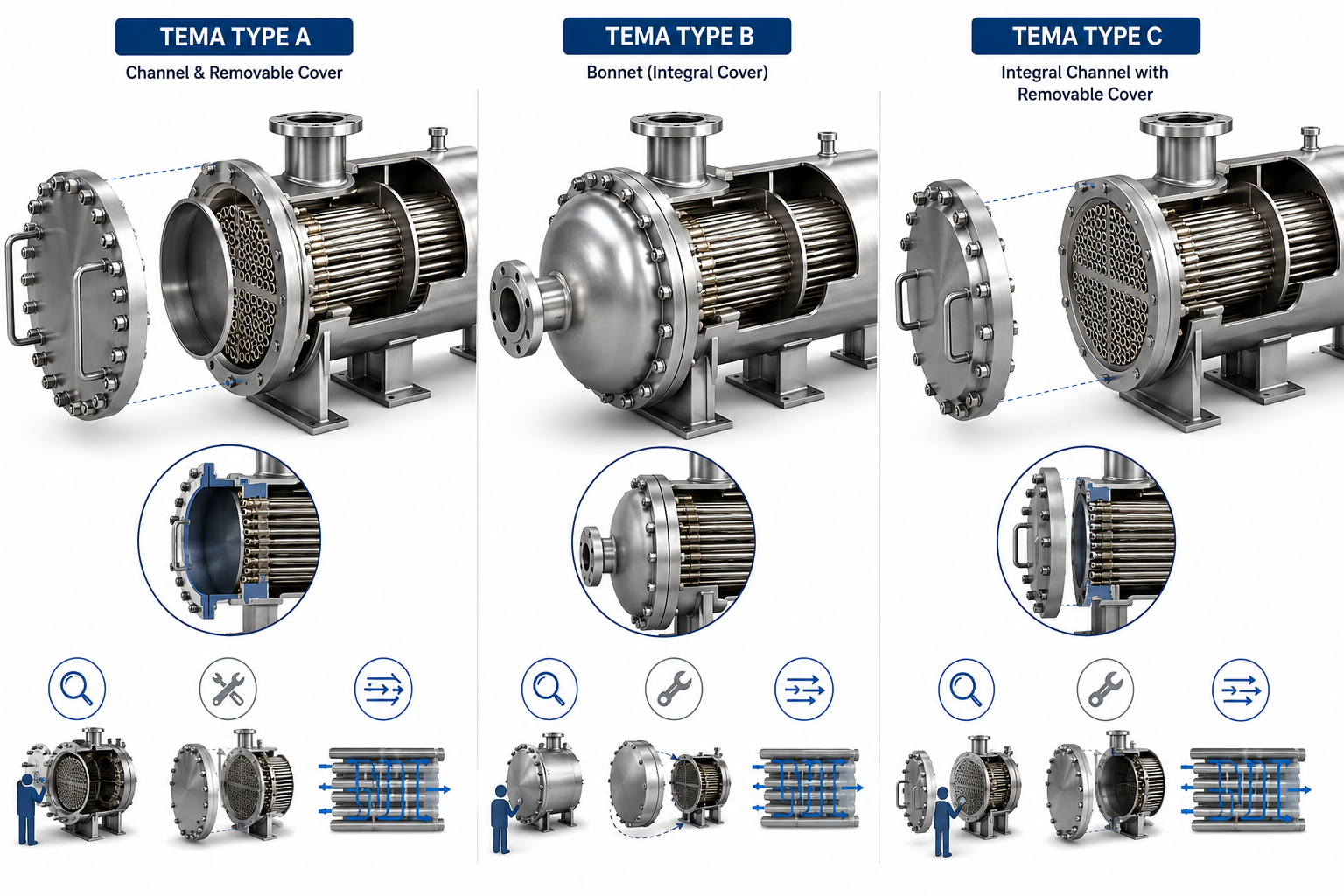
The Front Head Determines How the Process Fluid Enters, Leaves, and Can Be Maintained
When engineers first learn about TEMA classifications, they usually notice designations such as:
- BEM
- AES
- BEU
- AET
Most people immediately focus on the entire three-letter code.
However, each letter has a specific meaning.
The first letter identifies the front head (stationary head)—the section where the tube-side fluid enters and exits the exchanger.
At first glance, all front heads appear to perform the same function.
They all allow fluid to enter the tubes.
They all allow fluid to leave the tubes.
But in practice, the front head design influences:
- maintenance accessibility
- cleaning method
- pressure capability
- construction cost
- operating flexibility
Choosing the wrong front head can increase maintenance time, complicate inspections, and raise lifecycle costs.
This article explains the three most common TEMA front head types—A, B, and C—their construction, applications, and the engineering logic behind selecting each one.
Table of Contents
What Is the Front Head in a Shell-and-Tube Heat Exchanger?
The Front Head Is the Tube-Side Entry Section
A shell-and-tube exchanger has three major mechanical sections:
- Front Head
- Shell
- Rear Head
The front head is mounted on the inlet side of the exchanger.
Its primary functions are to:
- distribute tube-side flow
- collect outlet flow
- separate tube passes
- provide access for inspection and maintenance
Although it occupies only one end of the exchanger, its design has a significant influence on maintenance and fabrication.
Why TEMA Classifies Front Heads
Different Services Require Different Access Arrangements
Not every process requires the same level of maintenance.
Some services involve:
- clean cooling water
- filtered process fluids
Others involve:
- fouling hydrocarbons
- scale-forming water
- polymerizing chemicals
TEMA provides different front head arrangements so engineers can match the exchanger construction to the expected operating conditions.
The three most commonly used front head types are:
- Type A
- Type B
- Type C
Each offers different advantages and trade-offs.
Type A Front Head – Channel with Removable Cover
Basic Construction
Type A consists of:
- a channel
- a removable channel cover
- a stationary tubesheet
The channel cover can be removed without disturbing the shell or tube bundle.
This provides direct access to the tube ends.
Why Type A Is Popular
The removable cover makes tube-side inspection straightforward.
Maintenance personnel can:
- inspect tube entrances
- perform mechanical cleaning
- remove deposits
- inspect tube plugging
without dismantling the exchanger.
This is especially valuable when tube-side fouling is expected.
Typical Applications
Type A front heads are commonly selected for:
- cooling water services
- refinery exchangers
- hydrocarbon processing
- chemical plants
- dirty tube-side fluids
Whenever regular tube cleaning is anticipated, Type A is often the preferred option.
Advantages of Type A
- Excellent tube-side accessibility
- Easy mechanical cleaning
- Suitable for fouling services
- Simplifies inspection during shutdowns
- Widely accepted across industries
Limitations of Type A
The removable cover requires:
- additional bolting
- gasket sealing
- more machining
As a result:
- fabrication cost is higher
- more maintenance sealing surfaces exist
These disadvantages are usually acceptable when maintenance accessibility is important.
Type B Front Head – Bonnet (Integral Cover)
Basic Construction
Unlike Type A, Type B uses a bonnet instead of a removable channel cover.
The bonnet forms a single enclosed component attached directly to the tubesheet.
There is no separate removable cover.
Why Type B Is Simpler
Because fewer components are used:
- construction becomes simpler
- fabrication cost decreases
- fewer gasket joints are required
This creates a mechanically simple design.
Typical Applications
Type B is generally selected when:
- tube-side fluids are clean
- mechanical cleaning is rarely required
- operating conditions remain stable
- maintenance access is not critical
Examples include:
- clean utility services
- treated water
- closed-loop systems
Advantages of Type B
- Lower fabrication cost
- Fewer gasket joints
- Reduced leakage paths
- Simple construction
- Compact design
Limitations of Type B
The major disadvantage is maintenance.
Since there is no removable cover:
- tube inspection becomes more difficult
- mechanical cleaning requires greater disassembly
- maintenance time increases
Therefore, Type B is rarely selected for fouling services.
Type C Front Head – Channel Integral with Tubesheet and Removable Cover
Basic Construction
Type C combines features of the previous designs.
The channel is integrated with the tubesheet, while the front cover remains removable.
This arrangement provides maintenance access while reducing some construction complexity.
Why Type C Exists
Type C offers a compromise between:
- accessibility
- fabrication simplicity
- structural rigidity
It is often chosen when engineers want removable access but do not require the fully removable channel arrangement of Type A.
Typical Applications
Type C is used in:
- moderate fouling services
- general chemical processing
- utility exchangers
- applications requiring occasional inspection
It is less common than Types A and B but remains an important TEMA option.
Advantages of Type C
- Good inspection access
- Fewer major removable components
- Better structural rigidity
- Suitable for moderate maintenance requirements
Limitations of Type C
Compared with Type A:
- maintenance flexibility is slightly lower
- some repairs may require additional dismantling
Compared with Type B:
- fabrication is more complex
- cost is somewhat higher
It occupies a middle position between the two.
Comparing the Three Front Head Types
| Feature | Type A | Type B | Type C |
|---|---|---|---|
| Removable Front Cover | Yes | No | Yes |
| Mechanical Tube Cleaning | Excellent | Limited | Good |
| Fabrication Cost | Higher | Lower | Moderate |
| Maintenance Access | Excellent | Limited | Good |
| Typical Service | Fouling Fluids | Clean Fluids | Moderate Fouling |
The table illustrates an important engineering principle:
No front head is universally superior.
Each is designed for different operating priorities.
How Engineers Select the Right Front Head
Step 1 – Evaluate Tube-Side Fouling
If frequent tube cleaning is expected:
Type A is often the preferred choice.
If cleaning is rarely required:
Type B may be sufficient.
Step 2 – Consider Maintenance Philosophy
Plants with long operating campaigns may prioritize:
- easy inspection
- faster shutdown maintenance
These facilities often justify the higher cost of Type A.
Plants with clean services may prioritize simpler construction.
Step 3 – Evaluate Lifecycle Cost
Choosing the lowest-cost front head does not always reduce project cost.
An exchanger that is difficult to clean may:
- increase shutdown duration
- increase maintenance labor
- reduce plant availability
Lifecycle economics are often more important than fabrication cost alone.
Common Misunderstanding About Front Heads
A common misconception is that the front head only determines where the fluid enters.
In reality, it also determines:
- how tubes are inspected
- how cleaning is performed
- how maintenance is planned
- how easily the exchanger can be repaired
The front head is therefore a maintenance decision as much as a hydraulic one.
Why Most Engineers Prefer Type A in Process Plants
Many refinery and petrochemical services involve:
- fouling
- scale formation
- periodic tube cleaning
Under these conditions, the additional cost of a removable channel cover is usually recovered through:
- shorter shutdowns
- easier maintenance
- reduced labor
- improved exchanger availability
That is why Type A is widely used in heavy process industries.
Operator Perspective
Operators rarely interact directly with the front head.
However, they experience its impact during turnarounds.
A front head that allows rapid inspection and cleaning helps return the unit to service sooner.
Although operators may not see the design differences during normal operation, maintenance teams certainly do.
Owner Perspective
For plant owners, front head selection affects:
- fabrication cost
- maintenance cost
- shutdown duration
- equipment availability
- lifecycle economics
A small difference in purchase price can translate into significant savings over decades of operation.
That is why experienced engineers evaluate front head design based on total ownership cost rather than initial cost alone.
Final Perspective
The front head may appear to be a relatively small part of a shell-and-tube heat exchanger, but it has a major influence on maintenance strategy and equipment lifecycle.
Type A prioritizes accessibility.
Type B prioritizes simplicity.
Type C balances maintenance with construction efficiency.
Selecting the right front head is not about choosing the most advanced design.
It is about selecting the arrangement that best matches the process fluid, maintenance philosophy, and long-term operating requirements of the plant.
Explore the complete series in the Heat Exchanger Engineering Hub.

A practicing chemical engineer with 17+ years of experience in process design, project execution, commissioning, and plant operations. Focused on practical engineering judgment beyond textbook explanations.