
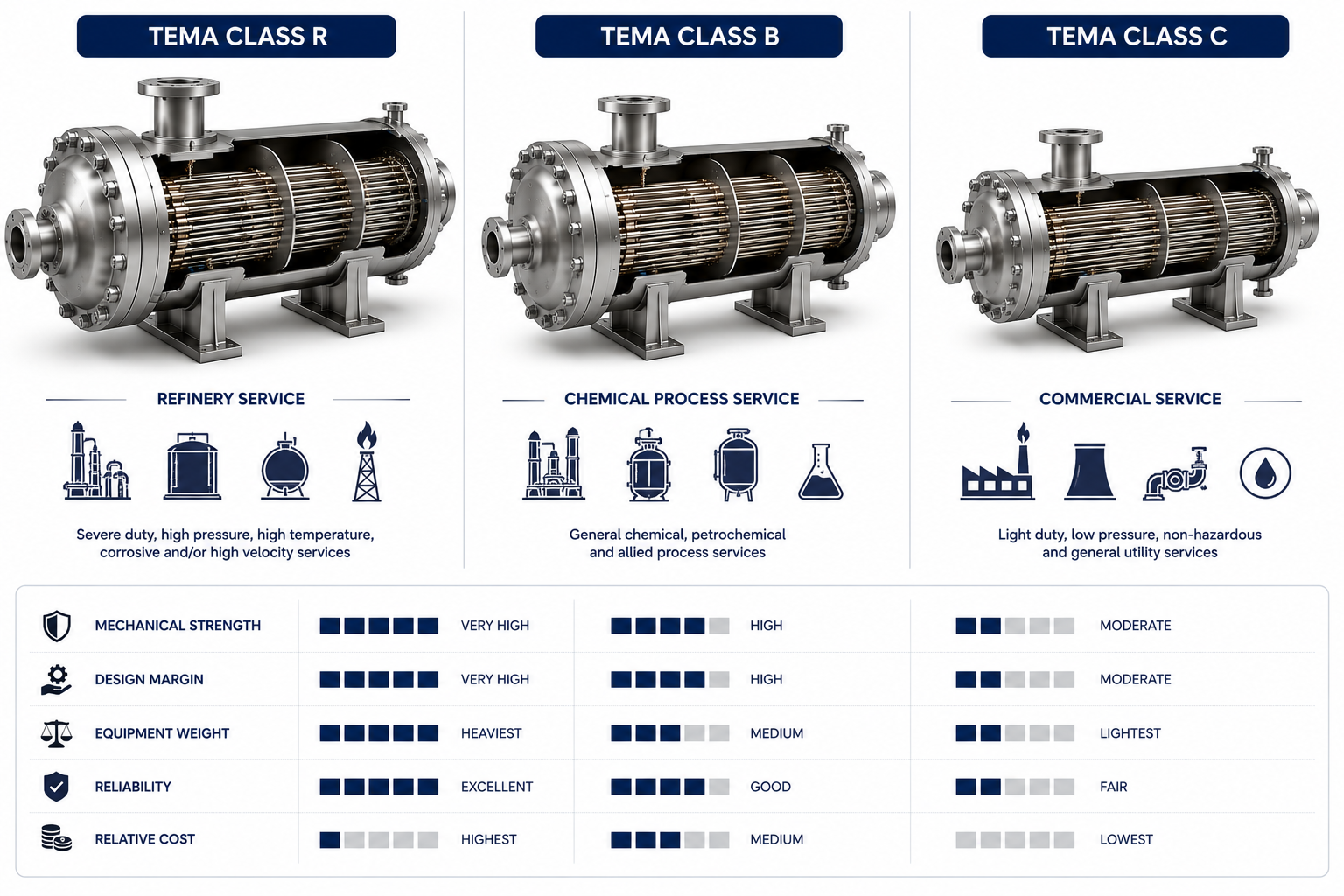
The Same Heat Duty Can Have Three Different TEMA Classes—and Three Very Different Lifecycle Costs
When engineers discuss TEMA, they usually focus on designations like:
- BEM
- BEU
- AES
- AET
These codes describe the exchanger’s mechanical construction.
However, there is another part of the TEMA standard that is equally important but often overlooked:
TEMA Class.
A shell-and-tube heat exchanger may be built as:
- Class R
- Class B
- Class C
At first glance, they may look almost identical.
They may even perform the same heat duty.
Yet their:
- mechanical robustness
- fabrication requirements
- inspection standards
- design margins
- purchase cost
can differ significantly.
Selecting the wrong TEMA class can result in either:
- paying for strength you never needed, or
- installing equipment that is not suitable for the intended service.
This article explains the differences between TEMA Class R, B, and C, their typical applications, and how they influence both design philosophy and project cost.
Table of Contents
What Is a TEMA Class?
It Defines the Construction Standard—Not the Flow Arrangement
One of the most common misunderstandings is assuming that TEMA Class is another part of the three-letter code.
It is not.
For example:
- BEM
- AES
- BEU
describe how the exchanger is constructed mechanically.
The TEMA Class defines how robustly that exchanger must be designed and manufactured.
In simple terms:
The three-letter code tells you what the exchanger looks like.
The TEMA Class tells you how heavily it is built.
Why TEMA Created Three Classes
Not Every Industry Needs the Same Design Margin
Different industries operate under different levels of severity.
Consider these examples:
A refinery heat exchanger may experience:
- high pressure
- thermal cycling
- corrosive hydrocarbons
- demanding operating conditions
A food processing heat exchanger may handle:
- clean water
- moderate pressure
- stable operating temperatures
Designing both exchangers to the same construction standard would not be economical.
TEMA therefore created three construction classes to match different industrial requirements.
TEMA Class R
Designed for the Most Demanding Industrial Services
The letter R stands for Refinery Service.
This is the heaviest-duty TEMA construction class.
It is intended for industries where:
- reliability is critical
- operating conditions are severe
- shutdown costs are extremely high
Typical Applications
Class R is commonly used in:
- oil refineries
- petrochemical complexes
- hydrocarbon processing
- gas processing plants
- high-pressure process units
These facilities often operate continuously for years between major shutdowns.
Equipment failure can result in significant production losses.
Design Philosophy
Class R emphasizes:
- mechanical robustness
- conservative design margins
- long service life
- resistance to severe operating conditions
Compared with other classes, it generally includes:
- heavier shell construction
- stronger supports
- more robust flanges
- greater allowance for demanding service
The objective is long-term reliability rather than minimum fabrication cost.
Advantages
- Highest mechanical strength
- Suitable for severe process conditions
- Excellent long-term reliability
- Preferred for refinery and petrochemical applications
- Well suited for continuous operation
Limitations
The increased robustness results in:
- higher fabrication cost
- greater equipment weight
- larger structural requirements
Class R should therefore be selected only when the service justifies it.
TEMA Class B
Designed for General Chemical Processing
The letter B represents Chemical Process Service.
This is the most widely used TEMA class in the chemical industry.
It provides an effective balance between:
- reliability
- construction cost
- operational flexibility
Typical Applications
Class B is common in:
- chemical plants
- pharmaceutical facilities
- fertilizer units
- specialty chemical production
- general industrial processing
Most chemical process exchangers fall into this category.
Design Philosophy
Compared with Class R:
- design margins are moderate
- construction is lighter
- fabrication cost is lower
However, Class B still provides:
- reliable operation
- good mechanical integrity
- compliance with industrial process requirements
It is designed for demanding industrial service—but not necessarily refinery-level severity.
Advantages
- Good balance of strength and cost
- Suitable for most chemical industries
- Lower weight than Class R
- Broad applicability
Limitations
Although highly reliable, Class B may not provide the additional conservatism required for the most severe refinery services.
TEMA Class C
Designed for Commercial and General Industrial Applications
The letter C represents Commercial Service.
This class is intended for applications where operating conditions are relatively moderate.
The emphasis is on:
- economy
- standardization
- lower fabrication cost
Typical Applications
Class C exchangers are commonly found in:
- HVAC systems
- commercial buildings
- general utility services
- light industrial applications
- non-critical heating and cooling systems
They are generally not selected for severe refinery or petrochemical process duties.
Design Philosophy
Class C focuses on providing adequate performance without unnecessary construction conservatism.
Compared with Classes R and B, it generally involves:
- lighter construction
- lower material usage
- reduced fabrication cost
The goal is cost-effective performance rather than maximum mechanical robustness.
Advantages
- Lowest fabrication cost
- Lower equipment weight
- Economical for moderate services
- Suitable for commercial applications
Limitations
Class C is not intended for:
- severe thermal cycling
- refinery process units
- high mechanical loading
- highly demanding process environments
Selecting Class C for such services may reduce equipment reliability.
Comparing TEMA Classes
| Feature | Class R | Class B | Class C |
|---|---|---|---|
| Primary Industry | Refinery & Petrochemical | Chemical Processing | Commercial & Utility |
| Mechanical Robustness | Highest | Moderate | Standard |
| Design Conservatism | Highest | Medium | Lowest |
| Equipment Weight | Highest | Moderate | Lowest |
| Fabrication Cost | Highest | Medium | Lowest |
| Typical Operating Severity | Severe | Moderate | Light |
The comparison illustrates an important point:
The heat duty may remain identical.
The construction philosophy changes.
Does TEMA Class Affect Heat Transfer?
No—It Affects Construction
A common misconception is that Class R transfers heat more effectively than Class C.
It does not.
Heat transfer depends primarily on:
- surface area
- fluid properties
- flow arrangement
- operating conditions
TEMA Class influences:
- mechanical strength
- fabrication details
- durability
- lifecycle performance
The thermal calculations remain essentially unchanged.
Why Class R Costs More
Strength Requires More Material
Class R exchangers generally require:
- thicker components
- stronger supports
- more demanding fabrication
- additional inspection
These requirements increase:
- material consumption
- fabrication hours
- transportation weight
The result is a higher purchase price.
Why Choosing Class R Is Not Always Better
Overdesign Can Waste Money
Some engineers believe:
“If Class R is the strongest, we should always use it.”
This is rarely economical.
For moderate chemical services:
- Class B often provides all the required reliability.
Using Class R unnecessarily can increase project cost without delivering meaningful operational benefits.
Good engineering avoids both:
- underdesign
- overdesign
Why Choosing Class C for Process Plants Can Be Risky
Initial Savings May Become Future Costs
Selecting a lighter construction class simply to reduce capital cost can create problems later.
Equipment operating beyond its intended service level may experience:
- higher maintenance frequency
- shorter service life
- increased reliability concerns
The apparent savings at procurement may disappear over years of operation.
How Engineers Select the Correct TEMA Class
Step 1 – Identify the Industry
Refinery or petrochemical service?
Class R often becomes the starting point.
General chemical processing?
Class B is usually appropriate.
Commercial utility systems?
Class C may be sufficient.
Step 2 – Evaluate Process Severity
Consider:
- operating pressure
- operating temperature
- cyclic loading
- consequence of failure
Higher severity generally requires a more robust construction class.
Step 3 – Consider Lifecycle Economics
The lowest purchase price does not always produce the lowest ownership cost.
Engineers evaluate:
- expected operating life
- maintenance requirements
- shutdown consequences
- replacement cost
before selecting the construction class.
Common Misunderstandings About TEMA Classes
“Class R Means Better Heat Transfer”
False.
Heat transfer performance depends on thermal design—not construction class.
“Class C Cannot Be Used in Industry”
Also false.
Many industrial utility services successfully use Class C equipment.
The key is matching the construction class to the service.
“Class B Is Simply a Cheaper Version of Class R”
Not exactly.
Class B follows a different design philosophy.
It is optimized for chemical processing rather than refinery service.
Operator Perspective
Operators rarely know whether an exchanger is Class R, B, or C during normal operation.
However, they experience the results through:
- equipment reliability
- maintenance frequency
- shutdown performance
A properly selected class contributes to stable long-term operation.
Owner Perspective
For plant owners, TEMA Class directly influences:
- capital investment
- equipment longevity
- maintenance cost
- plant availability
- lifecycle economics
Selecting the appropriate class ensures that the exchanger is neither overbuilt nor underbuilt for its intended service.
Final Perspective
TEMA Class does not change how heat is transferred.
It changes how confidently the exchanger can withstand years of industrial service.
- Class R is designed for the severe demands of refineries and petrochemical plants.
- Class B provides an excellent balance for most chemical processing facilities.
- Class C offers an economical solution for commercial and light industrial applications.
Selecting the correct TEMA Class is not about choosing the strongest option.
It is about selecting the level of construction that matches the process, the operating environment, and the long-term reliability expectations of the plant.
Explore the complete series in the Heat Exchanger Engineering Hub.

A practicing chemical engineer with 17+ years of experience in process design, project execution, commissioning, and plant operations. Focused on practical engineering judgment beyond textbook explanations.