
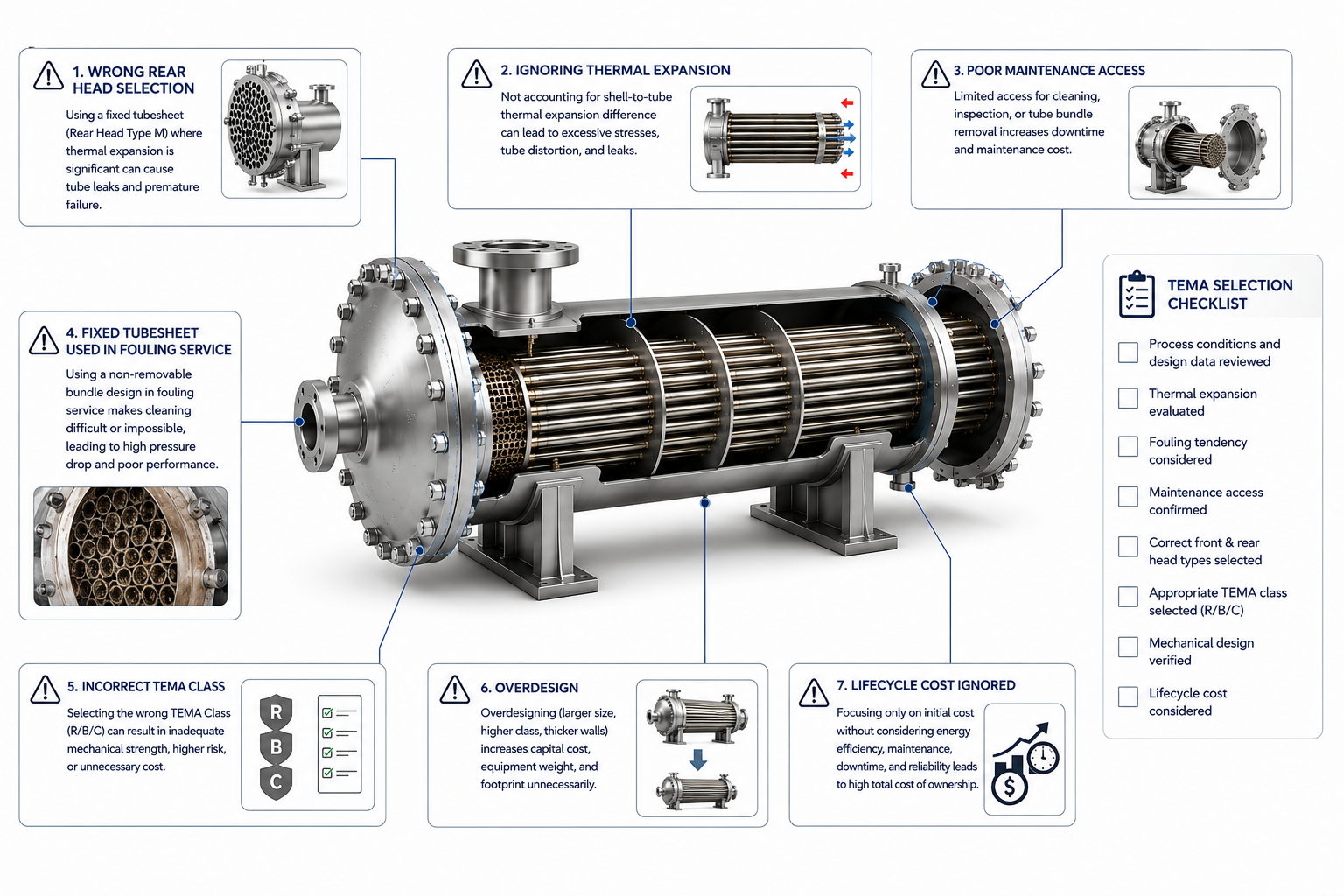
Most Heat Exchanger Problems Start During Selection—Not During Operation
When a shell-and-tube heat exchanger underperforms, engineers often blame:
- fouling
- poor operation
- maintenance
- utility fluctuations
Sometimes those are the real causes.
But in many industrial plants, the problem began much earlier—during TEMA selection.
The exchanger may have been sized correctly.
The thermal calculations may have been accurate.
The fabrication quality may have been excellent.
Yet the exchanger still becomes:
- difficult to maintain
- expensive to clean
- vulnerable to thermal stress
- unnecessarily costly
- unreliable in long-term operation
The reason is simple.
The wrong TEMA configuration was selected.
TEMA is not just a coding system.
It is a mechanical design philosophy that must match the process, maintenance strategy, and operating conditions.
This article discusses the most common mistakes engineers make while selecting TEMA configurations and how those mistakes can be avoided.
Table of Contents
Why TEMA Selection Is More Than Choosing a Three-Letter Code
Every Letter Influences Plant Operation
Many engineers treat TEMA selection as a standard practice.
They simply copy the TEMA designation used in previous projects.
For example:
- BEM
- BEU
- AES
- AET
without asking why that configuration was originally selected.
However, every letter affects:
- maintenance accessibility
- thermal expansion
- shell-side cleaning
- fabrication cost
- lifecycle performance
Selecting a TEMA type without understanding these implications often leads to long-term operational problems.
Mistake 1 – Selecting Based Only on Previous Projects
“We Used BEM Last Time”
This is one of the most common mistakes.
A previous project may have used:
- BEM
But that does not mean it is appropriate for the current process.
Every project has different:
- operating temperatures
- fouling tendencies
- maintenance philosophy
- pressure requirements
Copying a previous design without reviewing current process conditions often results in poor equipment selection.
Mistake 2 – Choosing the Lowest-Cost Configuration
Initial Cost Is Only One Part of the Story
Many procurement decisions focus on purchase price.
For example:
A Fixed Tubesheet exchanger usually costs less than a Floating Head exchanger.
This may encourage selecting the simpler design.
However, if shell-side fouling develops:
- cleaning becomes difficult
- shutdown time increases
- maintenance costs rise
The initial savings may disappear within a few operating cycles.
Good engineering evaluates lifecycle cost—not only equipment cost.
Mistake 3 – Ignoring Thermal Expansion
Differential Expansion Creates Mechanical Stress
When shell-side and tube-side temperatures differ significantly:
- tubes expand
- shell expands
But they do not always expand equally.
If thermal expansion is ignored:
- excessive stress develops
- tube sheet joints become highly loaded
- long-term reliability decreases
Selecting a Fixed Tubesheet exchanger for a service requiring thermal flexibility is one of the most common design mistakes.
Mistake 4 – Ignoring Maintenance Philosophy
Every Exchanger Will Eventually Need Cleaning
During design, exchangers appear perfectly clean.
In real plants, they eventually experience:
- fouling
- scaling
- corrosion products
- deposits
If maintenance accessibility is ignored during selection:
future shutdowns become:
- longer
- more expensive
- more difficult
Engineers should always ask:
How will this exchanger be cleaned five years from now?
Not simply:
How much does it cost today?
Mistake 5 – Choosing Floating Head for Every Service
More Complex Does Not Always Mean Better
Some engineers assume:
“Floating Head is the most advanced design, so we should always select it.”
This increases:
- fabrication cost
- gasket count
- maintenance inventory
- spare parts
without providing meaningful operational benefits in clean services.
If:
- fouling is minimal
- thermal expansion is small
a simpler configuration may perform equally well for decades.
Mistake 6 – Ignoring Shell-Side Cleaning Requirements
Fixed Tubesheet Limitations Are Often Overlooked
A Fixed Tubesheet exchanger performs well when shell-side fluids remain clean.
However, if shell-side fouling develops:
mechanical cleaning becomes extremely difficult.
Some projects discover this only during the first major shutdown.
Proper TEMA selection requires evaluating:
- which side is likely to foul
- how cleaning will be performed
- whether tube bundle removal will be required
Mistake 7 – Treating All Fouling the Same
Not Every Fouling Mechanism Requires the Same Solution
Some fouling can be removed using:
- chemical cleaning
Others require:
- mechanical brushing
- hydrojetting
- tube bundle removal
Selecting the rear head without understanding the fouling mechanism often creates maintenance difficulties later.
The type of fouling matters as much as the amount of fouling.
Mistake 8 – Selecting U-Tube Without Considering Tube Cleaning
Thermal Expansion Is Not the Only Consideration
U-Tube exchangers handle thermal expansion very well.
However, the tube bends introduce maintenance limitations.
Mechanical cleaning of the U-bend is difficult.
If heavy tube-side fouling is expected, a Floating Head exchanger may provide a better long-term solution.
Selecting U-Tube solely because of thermal expansion ignores maintenance reality.
Mistake 9 – Ignoring Pressure Drop During Shell Selection
Shell Type Influences Hydraulics
Some engineers choose:
- Type E shell
simply because it is the most common.
However, pressure-sensitive services may benefit from:
- Type F
- Type G
- Type H
- Type J
Selecting the shell without considering hydraulic behavior may increase:
- pumping cost
- compressor power
- operating expense
Thermal design and hydraulic design must always be evaluated together.
Mistake 10 – Choosing TEMA Class Incorrectly
Stronger Is Not Always Better
Some projects automatically specify:
Class R
even for moderate chemical services.
This increases:
- equipment weight
- fabrication cost
- project budget
without improving plant performance.
Conversely, selecting Class C for severe refinery service may compromise reliability.
The construction class should always match the operating environment.
Mistake 11 – Ignoring Future Plant Expansion
Today’s Design May Become Tomorrow’s Bottleneck
Plants frequently increase production after commissioning.
If exchanger selection leaves no flexibility for:
- higher flow
- additional maintenance
- increased heat duty
future revamps become more expensive.
Selection should consider expected plant evolution whenever practical.
Mistake 12 – Assuming Thermal Design Alone Determines Success
Mechanical Design Matters Equally
A heat exchanger may satisfy:
- heat duty
- outlet temperatures
- pressure drop
on paper.
Yet poor mechanical selection may result in:
- difficult maintenance
- excessive downtime
- thermal stress
- cleaning problems
Thermal calculations and TEMA selection must work together.
One cannot compensate for the other.
A Practical Selection Checklist
Questions Every Engineer Should Ask
Before finalizing a TEMA designation, consider:
Process Conditions
- What are the operating temperatures?
- Is thermal expansion significant?
- Are pressure conditions severe?
Fouling
- Which side is more likely to foul?
- How will fouling be removed?
- Is mechanical cleaning required?
Maintenance
- Can the tube bundle be removed?
- Will turnaround duration be acceptable?
- Is inspection straightforward?
Economics
- What is the purchase cost?
- What will maintenance cost over twenty years?
- Which design minimizes lifecycle cost?
Answering these questions often leads naturally to the correct TEMA configuration.
Operator Perspective
Operators generally inherit the consequences of exchanger selection.
Poor selections often appear as:
- frequent shutdowns
- cleaning difficulties
- unstable operation
- recurring maintenance issues
Well-selected exchangers receive very little attention because they simply continue operating reliably.
That is usually the best outcome.
Owner Perspective
For plant owners, incorrect TEMA selection can increase:
- maintenance expenditure
- turnaround duration
- production losses
- lifecycle cost
A slightly higher investment during design often prevents much larger expenses during operation.
Final Perspective
Most TEMA selection mistakes do not cause immediate failure.
Instead, they quietly increase:
- maintenance effort
- operating cost
- shutdown duration
- equipment stress
for years after the plant starts operating.
The best TEMA selection is not the most expensive configuration or the one copied from the previous project.
It is the configuration that matches:
- the process conditions,
- the expected fouling behavior,
- the maintenance philosophy,
- the thermal expansion requirements,
- and the long-term operating objectives of the plant.
A well-selected TEMA configuration is rarely noticed during normal operation.
A poorly selected one is remembered at every plant turnaround.
Explore the complete series in the Heat Exchanger Engineering Hub.

A practicing chemical engineer with 17+ years of experience in process design, project execution, commissioning, and plant operations. Focused on practical engineering judgment beyond textbook explanations.