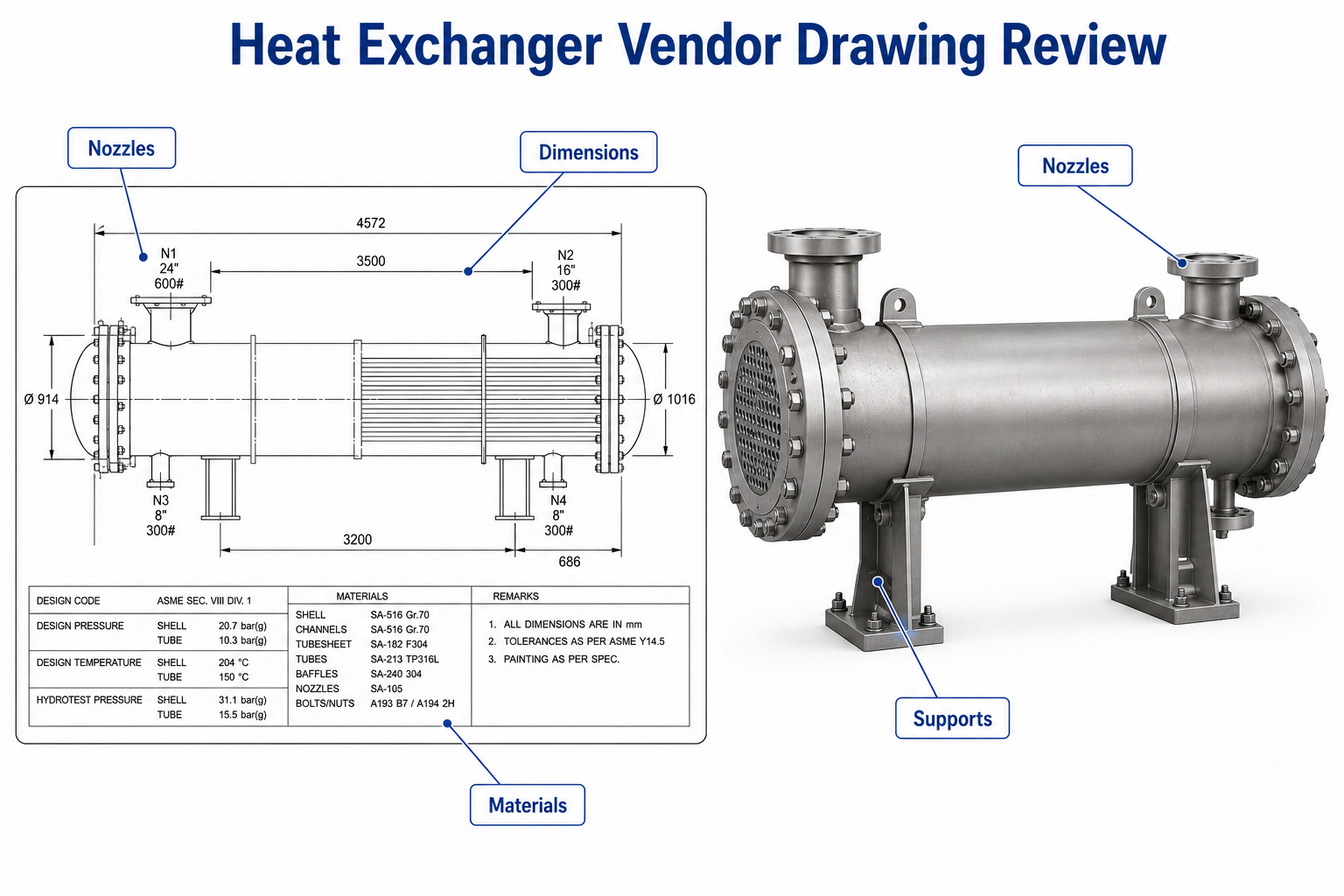
Approving a heat exchanger vendor drawing is far more than a documentation exercise. It is often the final opportunity to identify design issues before fabrication begins. Once manufacturing starts, correcting mistakes becomes expensive, time-consuming, and sometimes impossible. While detailed mechanical calculations remain the responsibility of the equipment manufacturer, process engineers play a vital role in verifying that the exchanger satisfies the process requirements, integrates properly with the plant, and supports safe, reliable, and maintainable operation throughout its service life.
Many process engineers believe that reviewing a vendor drawing is primarily the responsibility of the mechanical department.
That is only partly true.
Mechanical engineers verify:
- pressure design,
- code compliance,
- structural integrity,
- fabrication details.
Process engineers, however, must ensure that the exchanger being fabricated is the same exchanger that was originally specified in the design basis.
A seemingly minor discrepancy can result in:
- insufficient heat transfer,
- excessive pressure drop,
- maintenance difficulties,
- piping modifications,
- operational problems,
- delayed commissioning.
For this reason, vendor drawing review is one of the most important stages in the procurement process.
The objective is not to redesign the exchanger.
It is to confirm that the vendor has correctly interpreted the project requirements before the equipment enters fabrication.
Table of Contents
Why Vendor Drawing Review Is So Important
A vendor drawing becomes the approved design that the manufacturer will fabricate.
Once the drawing receives approval:
- materials are ordered,
- fabrication begins,
- inspections are scheduled,
- project timelines proceed.
Any mistake discovered afterward may require:
- engineering revisions,
- fabrication changes,
- delivery delays,
- additional project cost.
Careful review protects both the project schedule and the equipment’s long-term reliability.
Verify That the Process Design Basis Has Been Followed
The vendor drawing should accurately reflect the approved process design conditions.
Begin by confirming that the drawing matches the process datasheet.
Check items such as:
- design pressure,
- design temperature,
- operating pressure,
- operating temperature,
- heat duty,
- flow rates,
- fluid allocation,
- pressure drop limits.
Even small discrepancies should be clarified before approval.
The drawing should never become the source of revised process data without formal engineering review.
Confirm the Correct Exchanger Type
The supplied construction should match the approved mechanical concept.
Verify that the exchanger construction is consistent with project specifications.
Examples include:
- fixed tubesheet,
- floating head,
- U-tube.
Also confirm that the correct TEMA configuration has been supplied if specified in the purchase documents.
Selecting the wrong construction may affect:
- thermal expansion,
- maintenance,
- cleaning,
- future reliability.
Review Nozzle Locations and Orientation
Correct nozzle arrangement simplifies installation and plant operation.
Confirm that:
- inlet nozzles are correctly located,
- outlet nozzles match the piping layout,
- vent connections are provided where required,
- drain nozzles are properly positioned,
- instrument connections meet project requirements.
Incorrect nozzle orientation may require costly piping modifications during construction.
Check Overall Dimensions
Physical dimensions determine whether the exchanger fits within the plant layout.
Review:
- overall length,
- shell diameter,
- support spacing,
- centerline elevation,
- nozzle projection,
- maintenance clearances.
The exchanger should fit the allocated equipment space without interfering with:
- nearby equipment,
- pipe racks,
- structural steel,
- access platforms.
Dimensional verification prevents installation problems during site construction.
Verify Tube Bundle Accessibility
Maintenance requirements should already be reflected in the drawing.
Confirm that adequate space exists for:
- channel cover removal,
- floating head removal,
- tube bundle extraction,
- cleaning operations,
- lifting activities.
For removable bundle designs, verify the required bundle pull clearance.
Ignoring this detail often creates maintenance difficulties that remain throughout the equipment’s operating life.
Review Material Specifications Carefully
Material selection affects both performance and equipment life.
Check that materials specified for:
- shell,
- tubes,
- tubesheets,
- channel,
- flanges,
- gaskets,
- bolting,
match the approved material specification.
Do not assume substitutions are acceptable.
Even minor material changes should undergo formal engineering evaluation.
Confirm Design Pressures and Temperatures
Mechanical ratings should always exceed the expected operating conditions.
Review the drawing to ensure:
- shell-side design pressure is correct,
- tube-side design pressure is correct,
- design temperatures are appropriate,
- corrosion allowance matches project requirements.
Any mismatch between the drawing and process specification requires clarification before approval.
Verify Support Arrangement
Proper support design influences installation and long-term reliability.
Review:
- saddle locations,
- support orientation,
- anchor points,
- sliding supports where applicable,
- lifting lugs.
The support arrangement should accommodate:
- operating loads,
- thermal expansion,
- transportation,
- maintenance.
Check Nameplate Information
The equipment nameplate should accurately represent the approved design.
Confirm details such as:
- equipment tag number,
- design code,
- design pressure,
- design temperature,
- serial number,
- project identification.
Incorrect nameplate information creates confusion throughout the equipment lifecycle.
Review Inspection and Testing Requirements
Inspection requirements should be clearly defined before fabrication begins.
Confirm that project requirements for:
- hydrostatic testing,
- non-destructive examination,
- material certification,
- pressure testing,
- inspection hold points,
are incorporated into the vendor documentation.
These requirements become part of quality assurance during manufacturing.
Ensure Compliance with Project Specifications
Vendor standard practice should never override project requirements without approval.
Compare the drawing against:
- purchase specification,
- project standards,
- client specifications,
- applicable design codes,
- approved datasheets.
Any deviation should be formally documented and reviewed before acceptance.
Think Beyond Fabrication
The drawing should support the exchanger throughout its operating life.
Ask practical questions such as:
- Can operators reach the vents and drains?
- Is there sufficient space for maintenance?
- Can the bundle be removed safely?
- Are lifting provisions adequate?
- Can inspection be performed easily?
- Will future maintenance require dismantling nearby equipment?
These considerations often determine lifecycle performance more than fabrication quality alone.
Common Mistakes During Vendor Drawing Review
Many costly project issues originate from overlooked drawing details rather than poor fabrication.
Frequently overlooked items include:
- incorrect nozzle orientation,
- inadequate maintenance clearance,
- material substitutions,
- incorrect support arrangement,
- inconsistent process conditions,
- missing vents or drains,
- inaccessible instrumentation,
- overlooked vendor deviations.
A structured review checklist helps prevent these errors.
Common Misunderstandings About Vendor Drawing Approval
Approving a drawing is an engineering verification—not an administrative signature.
“The Vendor Has Already Checked Everything”
The vendor verifies compliance with their design.
The project team must verify compliance with the project requirements.
“Mechanical Engineers Review the Drawing”
Mechanical engineers review structural aspects.
Process engineers verify process suitability.
Both reviews are essential.
“Minor Differences Can Be Corrected Later”
After fabrication begins, even small modifications may require:
- rework,
- schedule changes,
- additional cost.
Resolving issues before fabrication is always preferable.
“Drawing Approval Means the Equipment Is Perfect”
Approval indicates that the drawing has been reviewed based on available information.
It does not eliminate the need for:
- fabrication inspection,
- factory acceptance testing,
- site verification,
- commissioning checks.
Operator Perspective
Operators benefit when maintainability is considered during drawing review rather than after installation.
A properly reviewed exchanger provides:
- accessible nozzles,
- convenient drains,
- easier inspections,
- safer maintenance,
- fewer operational difficulties.
Many everyday operating conveniences originate from decisions made during vendor drawing approval.
Owner Perspective
Careful drawing review reduces project risk and lifecycle cost.
For plant owners, thorough vendor drawing review contributes to:
- smoother construction,
- reduced fabrication errors,
- fewer field modifications,
- improved reliability,
- lower maintenance costs,
- faster commissioning.
A few extra hours spent reviewing drawings can prevent weeks of project delay and years of operational inconvenience.
Final Perspective
Approving a vendor drawing is one of the last opportunities to influence the quality, reliability, and maintainability of a shell-and-tube heat exchanger before steel is cut and fabrication begins.
A successful review goes beyond checking dimensions or signatures.
It confirms that the equipment satisfies the process design basis, supports safe operation, accommodates maintenance, integrates with the plant layout, and reflects the engineering intent established at the beginning of the project.
The most valuable vendor drawing review is not the one that finds every mistake.
It is the one that prevents those mistakes from ever reaching the fabrication shop.
Explore the complete series in the Heat Exchanger Engineering Hub.

A practicing chemical engineer with 17+ years of experience in process design, project execution, commissioning, and plant operations. Focused on practical engineering judgment beyond textbook explanations.