
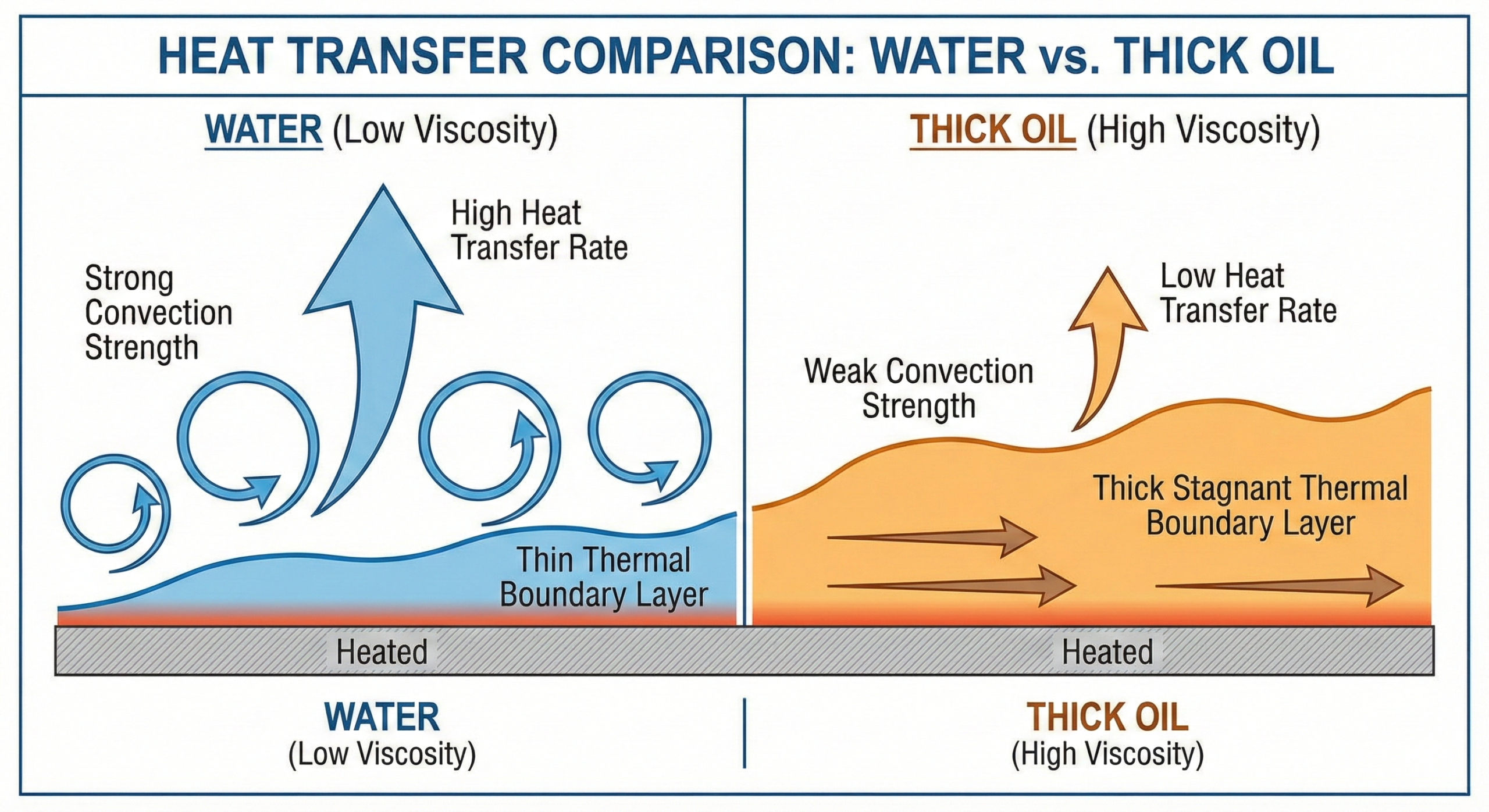
Convection is the main mechanism that allows heat to move between a surface and a flowing fluid.
In most process equipment, heat transfer depends heavily on how well the fluid can:
- flow
- mix
- carry heat away from the surface
When fluids move easily and mix well, convection is strong and heat transfer is efficient.
But not all fluids behave this way.
In many real plant services, convection is limited by the nature of the fluid itself — especially when the fluid is:
- highly viscous
- sticky
- prone to fouling
- temperature-sensitive
In these situations, even large exchangers and high flow rates may struggle to deliver expected performance.
This article explains why convection becomes weak in viscous and fouling fluids, how it limits heat transfer, and why these services are among the most challenging to handle in real plants.
Table of Contents
Convection Depends on Fluid Movement Near the Surface
For heat to move effectively through convection:
- fluid near the wall must mix with fluid in the bulk
- warmer fluid must move away
- cooler fluid must replace it
This continuous movement keeps heat transfer active.
But if fluid near the wall does not move easily, heat transfer slows down.
That thin near-wall region becomes a major resistance.
Why Viscous Fluids Resist Convection
Viscous fluids are thicker and flow more slowly.
Examples include:
- heavy oils
- resins
- syrups
- polymer melts
- some chemical intermediates
In these fluids:
- motion near the wall is sluggish
- mixing is weak
- turbulence is difficult to generate
So the boundary layer near the surface becomes thick.
A thicker boundary layer means:
- higher resistance
- lower film coefficient
- weaker heat transfer
Temperature Makes Viscosity Even More Challenging
Many viscous fluids change properties with temperature.
At lower temperatures:
- viscosity increases sharply
- flow becomes even slower
This creates a difficult situation:
- at the inlet, fluid may be very thick
- convection is weak
- heat transfer is poor
As the fluid warms up:
- viscosity reduces
- convection improves
So performance varies across the exchanger length.
This makes design and operation more complex.
Why Increasing Velocity Has Limited Effect
In low-viscosity fluids, increasing velocity improves turbulence and heat transfer.
In viscous fluids, the effect is weaker.
Even at higher flow rates:
- turbulence may still not develop fully
- boundary layers remain thick
So pushing more flow does not always create strong convection.
It may increase pumping cost without giving much improvement especially once higher velocity stops producing meaningful improvement in the fluid film near the wall.
Fouling Makes Convection Even Harder
Fouling adds another layer of resistance on the surface.
This layer:
- slows heat transfer
- reduces contact between fluid and metal
- traps fluid near the wall
In fouling-prone services:
- the surface becomes rough
- deposits trap fluid pockets
- mixing near the wall becomes weaker
So convection becomes even less effective over time.
Sticky Fluids Create Stable Deposit Layers
Some fluids naturally tend to stick to surfaces.
Examples include:
- polymer solutions
- food processing materials
- heavy hydrocarbons
These fluids form deposits that:
- hold onto the wall
- create an insulating layer
- prevent fresh fluid from reaching the surface
This reduces convection strength significantly.
Even if the main flow is fast, the fluid near the wall may remain stagnant.
Why Heating Viscous Fluids Is Particularly Difficult
When heating a thick fluid:
- the fluid near the wall heats first
- but it does not move easily
- cooler bulk fluid does not mix quickly
So the hot layer near the wall grows thicker.
This limits how much heat can enter the bulk fluid.
As a result:
- large surface areas are required
- heating takes longer
- performance may feel slow
Cooling Viscous Fluids Has Similar Challenges
Cooling a thick fluid also faces limits.
When fluid near the wall cools:
- it may become even more viscous
- movement slows further
- boundary layer thickens
So convection weakens.
This creates a cycle:
- cooling increases viscosity
- higher viscosity reduces convection
- reduced convection slows cooling
Fouling-Prone Fluids Need Extra Thermal Margin
In services where fouling is expected:
- convection starts reasonable
- but declines over time
Deposits grow:
- film resistance increases
- heat transfer reduces
- temperature difference must increase to maintain duty
Eventually, performance drops significantly.
So exchangers in fouling services need:
- larger area
- higher margins
- regular cleaning plans
Why Viscous Services Often Need Special Designs
To overcome convection limits, special designs are sometimes used:
- wider channels
- slower flow to avoid pressure drop
- enhanced surface geometry
- mechanical mixing in some systems
The goal is to improve contact between fluid and surface.
But even with these designs, convection remains weaker than in water-like fluids.
Why Energy Demand Is Higher in These Services
Because convection is weak:
- more surface area is needed
- more temperature difference is required
- more energy must be supplied
This is why:
- heating heavy oils consumes more steam
- cooling thick liquids requires larger exchangers
The limitation is not just equipment size.
It is the nature of the fluid itself.
Operators Often Notice Slow Response
In viscous and fouling services, operators often observe:
- slow temperature response
- delayed heating or cooling
- gradual performance loss
This is not always a control issue. In many cases, it is the same convection limitation that controls overall equipment performance.
It is often a convection limitation.
Heat simply takes longer to move into or out of the fluid.
Owner Perspective: These Are High-Cost Services
From a plant perspective, viscous and fouling fluids often bring:
- larger capital investment
- higher utility usage
- frequent cleaning requirements
- operational constraints
Because convection is weaker, everything must work harder to maintain performance.
So understanding these limitations helps set realistic expectations.
Why Convection Limits Become Visible at Higher Load
At higher throughput:
- more heat must be transferred
- but convection strength does not increase proportionally
So the exchanger may struggle to maintain outlet temperatures.
This makes viscous and fouling services common bottlenecks during capacity increases especially when increasing velocity no longer improves heat transfer efficiently.
A Simple Way to Understand the Challenge
Think of heat moving into water vs into thick syrup.
In water:
- heat spreads quickly
- mixing is strong
- temperature equalizes faster
In syrup:
- heat stays near the surface
- mixing is slow
- bulk fluid warms slowly
That difference is convection strength.
And it directly affects performance.
Final Perspective
Convection is the main driver of heat transfer in most process equipment.
But its strength depends on how easily the fluid can move and mix.
In viscous and fouling fluids:
- movement near the wall is slow
- boundary layers are thick
- deposits grow easily
So convection becomes limited.
And when convection is limited, heat transfer becomes difficult — no matter how good the metal, how large the exchanger, or how strong the utility.
These limitations become visible because convection inside real equipment depends strongly on fluid behavior near the wall surface.
Understanding these limitations helps explain why some services always feel harder to heat or cool, and why they demand more attention in both design and operation.
Explore the complete series in the Heat Transfer Engineering Hub.

A practicing chemical engineer with 17+ years of experience in process design, project execution, commissioning, and plant operations. Focused on practical engineering judgment beyond textbook explanations.