
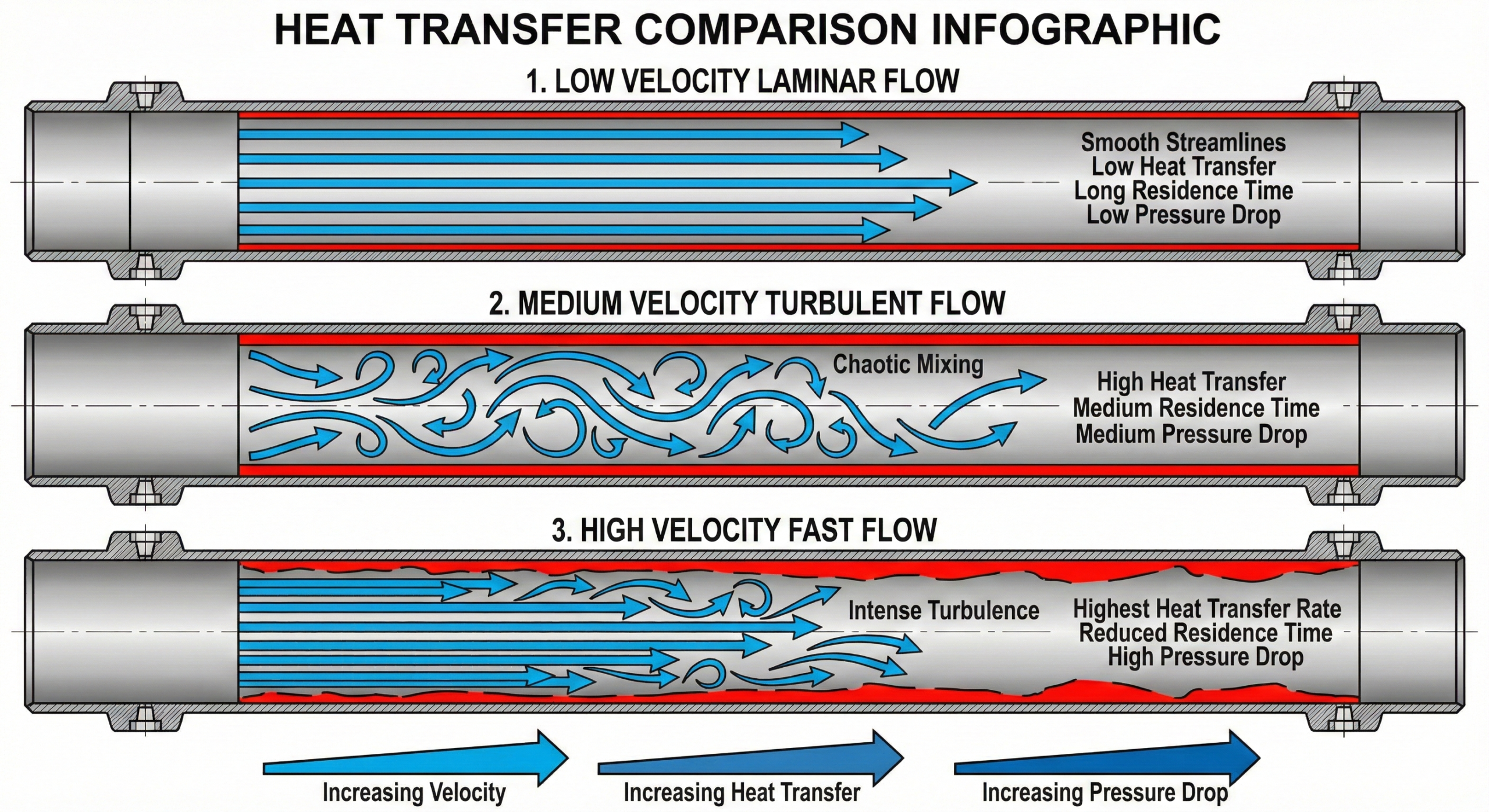
In heat transfer discussions, one principle is repeated so often that it becomes almost unquestioned:
Higher velocity improves heat transfer because stronger convection reduces thermal resistance near the wall surface.
And in many cases, this is true.
When fluid flows faster:
- turbulence increases
- boundary layers become thinner
- film resistance reduces
- heat transfer improves
Because of this, operators and engineers often assume:
- increasing flow will increase performance
- pushing velocity higher will solve thermal problems
But in real process plants, there are situations where increasing velocity does the opposite.
Instead of improving heat transfer, it can:
- reduce effective performance
- create instability
- increase resistance elsewhere
- lower overall duty
This article explains why increasing velocity does not always improve heat transfer, and why the relationship is more complex than it first appears.
Table of Contents
Velocity Helps — But Only Up to a Point
At moderate levels, increasing velocity is beneficial.
It improves mixing.
It breaks up stagnant layers.
It increases film coefficient.
This is why many exchangers are designed to maintain minimum velocities.
But beyond a certain point, the benefits start competing with other effects.
And sometimes, those other effects become more important.
Reduced Residence Time Can Limit Heat Transfer
When fluid flows faster, it spends less time inside the exchanger.
This means:
- heat has less time to transfer
- temperature change per pass may reduce
In cases where:
- temperature difference is already small
- exchanger area is limited
higher velocity can reduce how much heat the fluid absorbs or releases.
So even though the film coefficient improves, total heat transfer may not increase.
Flow Maldistribution Becomes Worse at High Velocity
At higher velocities:
- fluid may not distribute evenly
- some tubes or paths may carry more flow
- others may receive less
This creates:
- uneven heat transfer
- underutilized surface area
So part of the exchanger becomes less effective.
The overall performance may drop even if local heat transfer improves in some areas.
Pressure Drop Increases Rapidly
Velocity and pressure drop are closely linked.
As velocity increases:
- friction increases
- pressure drop rises sharply
This creates two issues:
- Pumps or compressors may not maintain the required flow.
- Energy consumption increases.
In some cases, increased pressure drop reduces flow elsewhere in the system.
So trying to increase velocity in one exchanger may reduce flow stability across the network.
This can lower overall performance.
Vapor Formation Can Change the Heat Transfer Regime
In heating services, high velocity can sometimes cause:
- local pressure drop
- flashing or vapor formation
When vapor forms:
- heat transfer behavior changes
- film conditions become unstable
- effective contact between liquid and surface reduces
Instead of improving heat transfer, the process becomes less predictable.
Boiling Services Can Become Unstable
In boiling systems:
- higher velocity can disturb boiling patterns
- bubbles may form differently
- liquid contact with surface may reduce
In extreme cases:
- vapor blanketing can occur
- heat transfer becomes less efficient
So more flow does not always mean better boiling heat transfer.
Fouling Can Increase with Higher Velocity in Some Services
It is often said that higher velocity reduces fouling.
This is true in many cases because:
- deposits are less likely to settle
- shear removes buildup
But in some services:
- higher velocity brings more particles
- erosion-corrosion increases
- rough surfaces form
- deposits attach more easily
So over time, the exchanger may foul faster.
And faster fouling reduces heat transfer.
Pump and System Limits May Change Operating Conditions
When velocity is increased:
- pump loads increase
- energy use rises
- control valves adjust
These changes can affect:
- upstream temperature
- downstream pressure
- system balance
So the exchanger may not operate under the same conditions as before.
This indirect effect can reduce heat transfer even if velocity locally increases.
Thermal Boundary Layer May Already Be Optimized
At certain velocities, the boundary layer is already thin.
Further increasing velocity:
- gives only small improvement in film coefficient
- but increases pressure drop significantly
So the gain in heat transfer becomes very small compared to the cost and side effects.
This is where increasing velocity stops being beneficial.
Gas-Side Systems Are Especially Sensitive
In air coolers and gas exchangers:
- velocity increases require more fan power
- pressure drop increases rapidly
- distribution problems can appear
If air flow becomes uneven:
- some areas cool well
- others do not
This reduces effective area use. This is another example of convection becoming the practical limiting resistance in real operation.
So increasing velocity without improving distribution may lower overall performance.
Heat Transfer Depends on the Whole System
Velocity affects only one part of the heat transfer process because convection itself is only one part of the complete thermal behavior inside equipment.
But performance depends on:
- temperature driving force
- fouling resistance
- distribution quality
- surface condition
- residence time
If any of these become limiting, increasing velocity alone cannot solve the problem.
And sometimes, it makes other limitations more severe.
Why Performance Improvements Are Sometimes Temporary
When velocity is increased, plants may see:
- short-term improvement
- better outlet temperatures
- improved heat pickup
But after some time:
- pressure drop issues appear
- fouling behavior changes
- system balance shifts
So the benefit may not last.
This is why velocity adjustments sometimes give temporary relief but not long-term solutions.
Owner Perspective: Energy vs Benefit Balance
Higher velocity means:
- higher pumping cost
- more power consumption
- higher wear and tear
If heat transfer improvement is small, the extra energy cost may not justify the change.
So the best operating point is often a balance:
- enough velocity for good heat transfer
- not so high that other problems begin.
A Simple Way to Understand the Trade-Off
Imagine water flowing through a pipe to pick up heat.
If it flows too slowly:
- it does not mix well
- heat transfer is weak
If it flows too fast:
- it passes quickly
- has less time to absorb heat
- pressure drop becomes large
So somewhere in between lies the best performance point.
That is where most exchangers are designed to operate.
Final Perspective
Velocity is one of the strongest drivers of convection heat transfer.
But it is not a magic solution.
At moderate levels, it improves performance.
At very high levels, it can create new limitations.
Heat transfer depends on:
- turbulence
- residence time
- distribution
- pressure balance
- system stability
So the best results come not from pushing velocity to the maximum, but from operating within a balanced range.
Velocity improves heat transfer primarily by changing the fluid film behavior near the wall.
Understanding why increasing velocity sometimes reduces heat transfer helps prevent overcorrection and supports smarter operating decisions.
Velocity can improve convection only when the fluid itself is capable of mixing effectively near the wall surface.
In viscous and fouling-prone services, fluid behavior creates additional resistance that limits how much convection can improve heat transfer.
Convection Limitations in Viscous & Fouling Fluids
This article explains why highly viscous and fouling fluids resist strong convection, why these services are difficult to heat or cool, and why they often become long-term plant bottlenecks.
Explore the complete series in the Heat Transfer Engineering Hub.

A practicing chemical engineer with 17+ years of experience in process design, project execution, commissioning, and plant operations. Focused on practical engineering judgment beyond textbook explanations.