
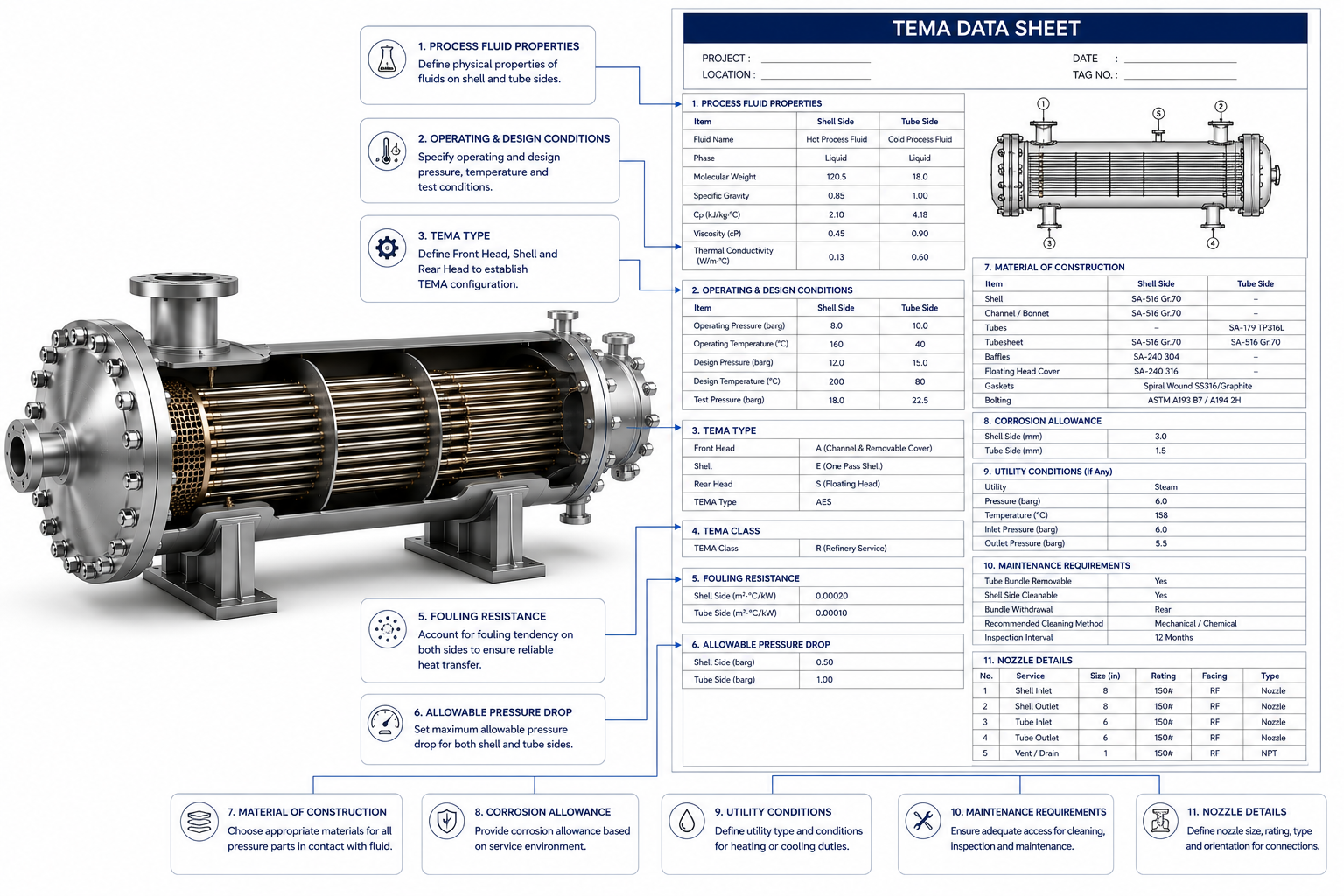
A Heat Exchanger Is Only as Good as the Information Provided in Its Data Sheet
In most engineering companies, the thermal design of a shell-and-tube heat exchanger begins with a TEMA data sheet.
This document appears straightforward.
It contains:
- process conditions
- temperatures
- pressures
- materials
- TEMA type
- design requirements
Many young engineers assume that once the process data is entered, the exchanger vendor will take care of everything else.
Unfortunately, that assumption has caused countless design revisions, procurement delays, and operational problems.
A heat exchanger vendor can only design around the information that is provided.
If important data is missing—or worse, incorrect—the exchanger may still satisfy the heat duty but fail to meet the plant’s operational requirements.
This article discusses the TEMA data sheet items that engineers most commonly overlook and explains why these seemingly small details have a major impact on exchanger selection, fabrication, and long-term performance.
Table of Contents
Why the TEMA Data Sheet Is More Than a Procurement Document
It Is the Foundation of the Entire Mechanical and Thermal Design
A common misconception is that the TEMA data sheet is simply a purchase specification.
In reality, it becomes the foundation for:
- thermal calculations
- mechanical design
- material selection
- fabrication drawings
- inspection planning
- vendor guarantees
Every design decision begins with the data sheet.
If incorrect information enters at this stage, every downstream activity is affected.
Process Fluid Properties
Engineers Often Enter Only the Fluid Name
One of the most common mistakes is writing:
- Cooling Water
- Process Liquid
- Hydrocarbon
- Solvent
without providing the actual physical properties.
However, thermal design depends on properties such as:
- density
- viscosity
- specific heat
- thermal conductivity
- vapor pressure
These properties determine:
- heat transfer coefficient
- pressure drop
- flow distribution
- exchanger size
Fluid name alone is never enough.
Operating and Design Conditions
Operating Values Are Frequently Confused with Design Values
The data sheet normally requires both:
- operating pressure
- design pressure
- operating temperature
- design temperature
Young engineers sometimes enter the same numbers for both.
These values serve different purposes.
Operating conditions describe normal plant operation.
Design conditions define the maximum conditions the exchanger must safely withstand.
Incorrect design values may lead to:
- underdesigned equipment
- unnecessary overdesign
- increased project cost
Fouling Resistance
“Use Standard Fouling Factor” Is Not Always Correct
Many engineers simply copy fouling resistance values from previous projects.
However, fouling depends on:
- fluid composition
- operating temperature
- plant cleanliness
- maintenance philosophy
Overestimating fouling can produce:
- oversized exchangers
- unnecessary capital cost
Underestimating fouling can reduce exchanger performance within months of startup.
Fouling resistance should always reflect the actual service.
Allowable Pressure Drop
One of the Most Frequently Missed Data Sheet Entries
The exchanger can always be made smaller by accepting a higher pressure drop.
Likewise, it can be made larger by restricting pressure loss.
Without allowable pressure drop values, vendors must make assumptions.
These assumptions may produce exchangers that:
- overload pumps
- increase compressor power
- reduce process capacity
Pressure drop is not merely a hydraulic parameter.
It directly influences exchanger size and operating cost.
Thermal Expansion Considerations
Temperature Difference Alone Is Not Enough
Engineers often specify:
- inlet temperature
- outlet temperature
but overlook thermal expansion implications.
Large shell-to-tube temperature differences influence:
- rear head selection
- tube bundle construction
- stress analysis
Failure to identify severe thermal expansion may result in selecting an unsuitable TEMA configuration.
Utility Conditions
Utilities Need Complete Information Too
Cooling water and steam are often treated as “standard utilities.”
In reality, the data sheet should include:
- supply temperature
- return temperature
- available pressure
- allowable pressure loss
- seasonal variations (where applicable)
Incomplete utility information often results in unrealistic thermal designs.
Phase Change Information
Simply Writing “Condensing” Is Not Enough
When condensation or boiling occurs, engineers should specify:
- vapor quality
- condensate requirements
- boiling conditions
- expected vapor fraction
- operating pressure
Phase-change services require different design approaches than sensible heating or cooling.
Incomplete information increases design uncertainty.
Fluid Cleanliness
Vendors Cannot Guess Fouling Severity
Two process streams may have identical thermal properties but behave very differently.
One may remain perfectly clean.
The other may contain:
- catalyst fines
- suspended solids
- polymer deposits
- scaling compounds
These characteristics influence:
- TEMA type
- tube diameter
- cleaning method
- maintenance accessibility
Fluid cleanliness should always be clearly communicated.
Corrosion Allowance
Often Left Blank Until Mechanical Review
Some engineers assume corrosion allowance is purely a mechanical issue.
However, it influences:
- wall thickness
- equipment weight
- fabrication cost
The corrosion allowance should reflect:
- process chemistry
- expected equipment life
- company standards
Leaving this field blank often delays vendor clarification.
Material Compatibility
Material Selection Is More Than Corrosion Resistance
Many data sheets specify:
- Carbon Steel
- Stainless Steel
without considering:
- chloride concentration
- erosion
- galvanic compatibility
- temperature limits
Material selection affects:
- fabrication method
- inspection requirements
- long-term reliability
Choosing materials solely based on corrosion resistance can overlook other important service conditions.
Maintenance Requirements
Cleaning Philosophy Should Be Stated Clearly
The data sheet should indicate whether the exchanger requires:
- mechanical tube cleaning
- chemical cleaning
- shell-side access
- removable tube bundle
Without this information, the vendor may propose a TEMA configuration that is difficult to maintain.
Maintenance philosophy is a design requirement—not an afterthought.
Orientation
Horizontal or Vertical Matters
Some engineers overlook exchanger orientation.
However, orientation influences:
- condensate drainage
- vapor distribution
- maintenance accessibility
- support design
Examples include:
- vertical thermosiphon reboilers
- horizontal condensers
- vertical vaporizers
Orientation should be defined based on process requirements rather than construction convenience.
Future Capacity Margin
Plants Rarely Operate at Original Design Capacity Forever
Many facilities eventually increase production.
If future expansion is expected, the data sheet should communicate:
- anticipated flow increase
- future heat duty
- operating flexibility requirements
Ignoring future expansion may create an exchanger that becomes the first bottleneck during plant debottlenecking.
Applicable Codes and Standards
More Than Just TEMA
A complete data sheet often references:
- TEMA
- pressure vessel codes
- client engineering standards
- material specifications
- inspection requirements
These standards define fabrication expectations.
Failure to specify them early may lead to procurement delays.
Nozzle Requirements
Small Details That Affect Installation
Nozzle information should include:
- size
- orientation
- flange rating
- facing type
Incorrect nozzle specifications can create piping conflicts during installation.
Although these appear to be mechanical details, correcting them after fabrication is expensive.
Instrument Connections
Often Forgotten Until Commissioning
Heat exchangers may require connections for:
- temperature measurement
- pressure indication
- venting
- draining
Missing these connections during procurement frequently results in costly field modifications.
Instrumentation requirements should be identified during the data sheet stage.
Typical Data Sheet Review Checklist
Before Sending the Inquiry to Vendors
Experienced engineers usually confirm:
Process Data
- Are all fluid properties available?
- Are operating and design conditions clearly separated?
- Are flow rates realistic?
Thermal Information
- Is the heat duty verified?
- Are pressure drops specified?
- Are utility conditions complete?
Mechanical Information
- Is the TEMA type identified?
- Is the TEMA class specified?
- Are materials confirmed?
- Is corrosion allowance defined?
Operational Information
- Is fouling behaviour described?
- Is maintenance philosophy stated?
- Are cleaning requirements identified?
- Is future expansion expected?
Completing this review significantly reduces clarification cycles with vendors.
Common Data Sheet Mistakes
Relying on Old Project Templates
One of the biggest mistakes is copying a previous data sheet without validating:
- process conditions
- fluid properties
- maintenance philosophy
Every service deserves its own engineering review.
Assuming the Vendor Will Fill the Gaps
Vendors can optimize exchanger design.
They cannot accurately guess missing process information.
Every missing item increases:
- engineering assumptions
- clarification requests
- redesign effort
Good vendor performance begins with a complete client data sheet.
Operator Perspective
Operators may never see the original TEMA data sheet.
However, they experience its consequences every day.
Missing design information can lead to:
- poor temperature control
- excessive pressure drop
- difficult maintenance
- limited operating flexibility
Many operating problems originate long before commissioning.
Owner Perspective
For plant owners, a complete data sheet helps achieve:
- accurate vendor quotations
- fewer design revisions
- reduced procurement delays
- better equipment reliability
- lower lifecycle cost
The effort invested during specification often saves significant time and money during operation.
Final Perspective
A TEMA data sheet is far more than a form to be completed before procurement.
It is the engineering blueprint that guides every major design decision.
Critical information such as:
- fluid properties
- pressure limits
- fouling behaviour
- maintenance requirements
- thermal expansion
- utility conditions
- material selection
must be complete and technically accurate.
A well-prepared data sheet allows vendors to design the right exchanger the first time.
An incomplete one almost guarantees design revisions, procurement delays, and long-term operational compromises.
In heat exchanger engineering, the quality of the final equipment often reflects the quality of the information provided at the very beginning.
Explore the complete series in the Heat Exchanger Engineering Hub.

A practicing chemical engineer with 17+ years of experience in process design, project execution, commissioning, and plant operations. Focused on practical engineering judgment beyond textbook explanations.