Why a Thermally Correct Heat Exchanger on Paper May Still Underperform in a Real Plant
Heat exchanger thermal design is often viewed as a calculation exercise.
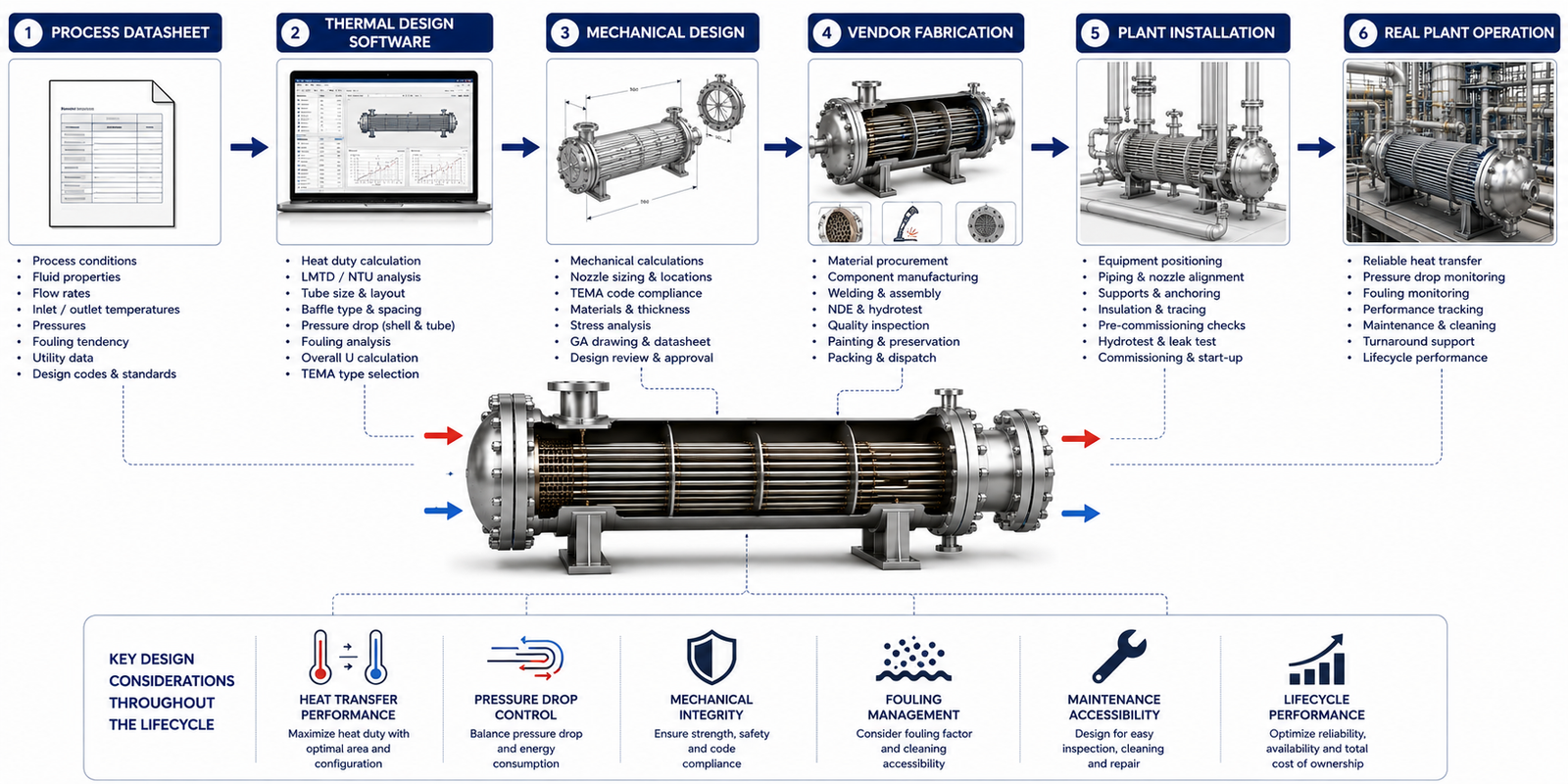
An engineer receives a process datasheet, enters the operating conditions into thermal design software, checks the calculated results, and issues the exchanger for detailed engineering.
On paper, the exchanger appears perfect.
It satisfies:
- required heat duty
- outlet temperatures
- allowable pressure drop
- mechanical constraints
The project proceeds, the exchanger is fabricated, installed, commissioned, and handed over to operations.
Then, a few months later, familiar complaints begin to appear.
The exchanger is not cooling enough.
Steam consumption is higher than expected.
Pressure drop has increased.
The process cannot achieve the design temperature.
The first reaction is often to suspect poor operation or equipment problems.
However, experienced engineers know that many of these issues originate much earlier—during thermal design itself.
Not because the calculations were wrong, but because thermal design is never performed in a perfect world.
Every calculation contains assumptions.
Every process value has uncertainty.
Every plant behaves slightly differently from its design basis.
This is why successful heat exchanger design is not about producing mathematically correct calculations.
It is about designing equipment that continues to perform reliably despite the unavoidable differences between design conditions and plant reality.
This article explains how thermal design is actually performed in engineering companies, what assumptions designers make, why operating performance often differs from calculated performance, and how experienced engineers bridge the gap between theory and reality.
Table of Contents
Thermal Design Begins Long Before Any Calculation
The Datasheet Is the Starting Point—Not the Design
Every exchanger project begins with a process datasheet.
It typically includes:
- process fluid names
- flow rates
- inlet temperatures
- outlet temperatures
- operating pressures
- allowable pressure drops
- fluid properties
- fouling resistance
- material requirements
Many young engineers believe these values are absolute.
They are not.
The datasheet represents the best available information at a particular stage of the project.
In early engineering phases:
- process simulation may still be evolving
- utility conditions may change
- equipment around the exchanger may not yet be finalized
Thermal design therefore starts with assumptions—not certainty.
Heat Duty Is Only the First Requirement
Matching Duty Does Not Guarantee Good Design
The first calculation usually determines the required heat duty.
This establishes how much energy must be transferred between the two process streams.
Once the duty is known, many engineers assume the design problem is nearly solved.
In reality, it has only begun.
A successful exchanger must also satisfy:
- pressure drop limits
- fouling expectations
- mechanical constraints
- maintenance requirements
- future operating flexibility
Two exchangers may transfer exactly the same amount of heat.
One may operate reliably for twenty years.
The other may become a maintenance problem within its first shutdown.
The difference lies in the quality of the overall design—not the heat duty calculation.
Thermal Design Is an Optimization Process
There Is Never a Single Correct Answer
Unlike many textbook problems, industrial thermal design does not produce one unique solution.
Changing one design variable immediately affects several others.
For example:
Increasing tube velocity may:
- improve heat transfer
- reduce exchanger size
But it may also:
- increase pressure drop
- increase erosion risk
- increase pumping power
Similarly:
Increasing heat transfer area may:
- improve thermal performance
But it also:
- increases equipment size
- increases capital cost
- requires more plot space
Every exchanger design becomes a balance between competing objectives.
The Process Datasheet Is Rarely Perfect
Engineers Design with Incomplete Information
One of the biggest differences between textbooks and industry is data quality.
During project execution:
- fluid properties may be estimated
- fouling behaviour may be uncertain
- future operating cases may not be fully defined
- utility conditions may change
Thermal designers constantly work with incomplete information.
Experience helps identify which uncertainties matter most.
Software Does Not Replace Engineering Judgment
Thermal Programs Are Design Tools, Not Decision Makers
Modern thermal design software performs sophisticated calculations within seconds.
It can evaluate:
- heat transfer coefficients
- pressure drops
- flow distribution
- exchanger geometry
However, software cannot determine whether:
- the exchanger will be easy to maintain
- the selected fouling resistance is realistic
- the plant will operate as expected after five years
Those decisions remain engineering responsibilities.
Software calculates.
Engineers decide.
Every Thermal Design Contains Practical Assumptions
Assumptions Are Necessary—But They Must Be Realistic
No thermal calculation is completely free of assumptions.
Typical assumptions include:
- constant fluid properties
- uniform flow distribution
- clean heat transfer surfaces
- steady operating conditions
- accurate instrumentation
- stable utility supply
Real plants rarely satisfy all of these assumptions simultaneously.
That is why experienced engineers avoid designing too close to theoretical limits.
The Design Must Survive More Than Normal Operation
Plants Spend Less Time at Design Conditions Than Many Engineers Expect
Ironically, many exchangers spend only a small fraction of their operating life exactly at design conditions.
Actual operation includes:
- startup
- shutdown
- reduced production
- overload conditions
- utility fluctuations
- seasonal weather changes
- varying feed composition
A robust thermal design performs acceptably throughout this operating range rather than only at one design point.
Pressure Drop Is as Important as Heat Transfer
Excellent Thermal Performance Can Still Produce Poor Plant Performance
A designer may improve heat transfer by increasing fluid velocity.
However, this often increases pressure drop.
Higher pressure drop can mean:
- larger pumps
- greater compressor load
- increased operating cost
- reduced plant throughput
Thermal optimization and hydraulic optimization must always be considered together.
Ignoring one usually creates problems in the other.
Fouling Begins the Day the Plant Starts
Clean Exchanger Performance Is Temporary
Thermal design software normally evaluates clean exchanger performance first.
Actual plants begin accumulating fouling almost immediately.
Over time:
- heat transfer decreases
- pressure drop increases
- outlet temperatures drift
A successful design anticipates this gradual performance decline.
The objective is not merely to satisfy clean conditions but to maintain acceptable performance between cleaning intervals.
Mechanical Design and Thermal Design Cannot Be Separated
Good Thermal Design Must Be Buildable
An exchanger may appear excellent thermally but prove difficult to fabricate or maintain.
For example:
A designer may reduce exchanger size by selecting:
- smaller tube pitch
- higher tube count
- tighter geometry
Mechanically, however, this may complicate:
- fabrication
- inspection
- tube replacement
- cleaning
Thermal and mechanical engineers must therefore work together throughout the design process.
Vendor Selection Influences Thermal Performance
Two Vendors May Produce Different Designs for the Same Datasheet
This surprises many young engineers.
Different vendors may produce different exchanger geometries while satisfying exactly the same process requirements.
Why?
Because they may use different approaches for:
- tube diameter
- tube length
- baffle spacing
- shell diameter
- design margins
There is rarely a single “correct” exchanger.
Instead, there are multiple technically acceptable solutions with different strengths and trade-offs.
Operating Plants Continuously Challenge Thermal Designs
Real Equipment Ages
During years of operation:
- fouling increases
- tube roughness changes
- utilities vary
- process conditions evolve
- maintenance quality differs
The exchanger gradually moves away from its original design condition.
Good thermal design anticipates this reality.
The Best Thermal Design Is Not the Smallest Exchanger
Optimizing Only Capital Cost Can Become Expensive
Reducing exchanger size may lower purchase cost.
However, it may also:
- reduce operating flexibility
- increase fouling sensitivity
- increase maintenance frequency
A slightly larger exchanger often provides:
- better operating margin
- improved reliability
- longer cleaning intervals
Lifecycle economics frequently justify this additional investment.
Communication Between Disciplines Matters
Thermal Design Is Never Done in Isolation
Successful exchanger design requires coordination between:
- process engineers
- mechanical engineers
- piping engineers
- instrumentation engineers
- operations personnel
- equipment vendors
Many thermal problems arise not from incorrect calculations but from poor communication between disciplines.
What Experienced Engineers Do Differently
They Design for Reality, Not Perfection
Experienced thermal designers rarely ask:
“Can the exchanger meet today’s duty?”
Instead, they ask:
- What happens if fouling doubles?
- What happens during summer?
- What if cooling water temperature increases?
- What if production rises by 15%?
- How will maintenance clean this exchanger?
These questions often determine whether the exchanger succeeds over the next twenty years.
Common Reasons Thermal Designs Fail After Commissioning
Typical causes include:
- unrealistic fouling assumptions
- incorrect fluid properties
- underestimated pressure drop
- changing process conditions
- poor utility quality
- inadequate operating margin
- maintenance limitations
Notice that most of these are not mathematical errors.
They are engineering judgment issues.
Operator Perspective
Operators rarely think about thermal design calculations.
They judge exchangers by practical questions:
- Does it achieve the required temperature?
- Does pressure drop remain acceptable?
- Can production targets be maintained?
- Does it require frequent cleaning?
Ultimately, plant performance is the real validation of the design.
Owner Perspective
For plant owners, successful thermal design delivers:
- reliable production
- lower utility consumption
- longer operating campaigns
- predictable maintenance
- lower lifecycle cost
The objective is not simply to install an exchanger that works.
It is to install one that continues working efficiently throughout its service life.
Final Perspective
Thermal design is often presented as a series of equations.
In reality, it is a process of engineering judgment.
Successful heat exchanger design requires much more than calculating heat duty or selecting an exchanger size.
It requires understanding:
- process uncertainty,
- operating variability,
- fouling behaviour,
- hydraulic limitations,
- maintenance philosophy,
- and long-term plant operation.
The best thermal designs are rarely those that produce the most elegant calculations.
They are the designs that continue to perform reliably long after the calculations have been forgotten and the plant has entered everyday operation.
Explore the complete series in the Heat Exchanger Engineering Hub.

A practicing chemical engineer with 17+ years of experience in process design, project execution, commissioning, and plant operations. Focused on practical engineering judgment beyond textbook explanations.