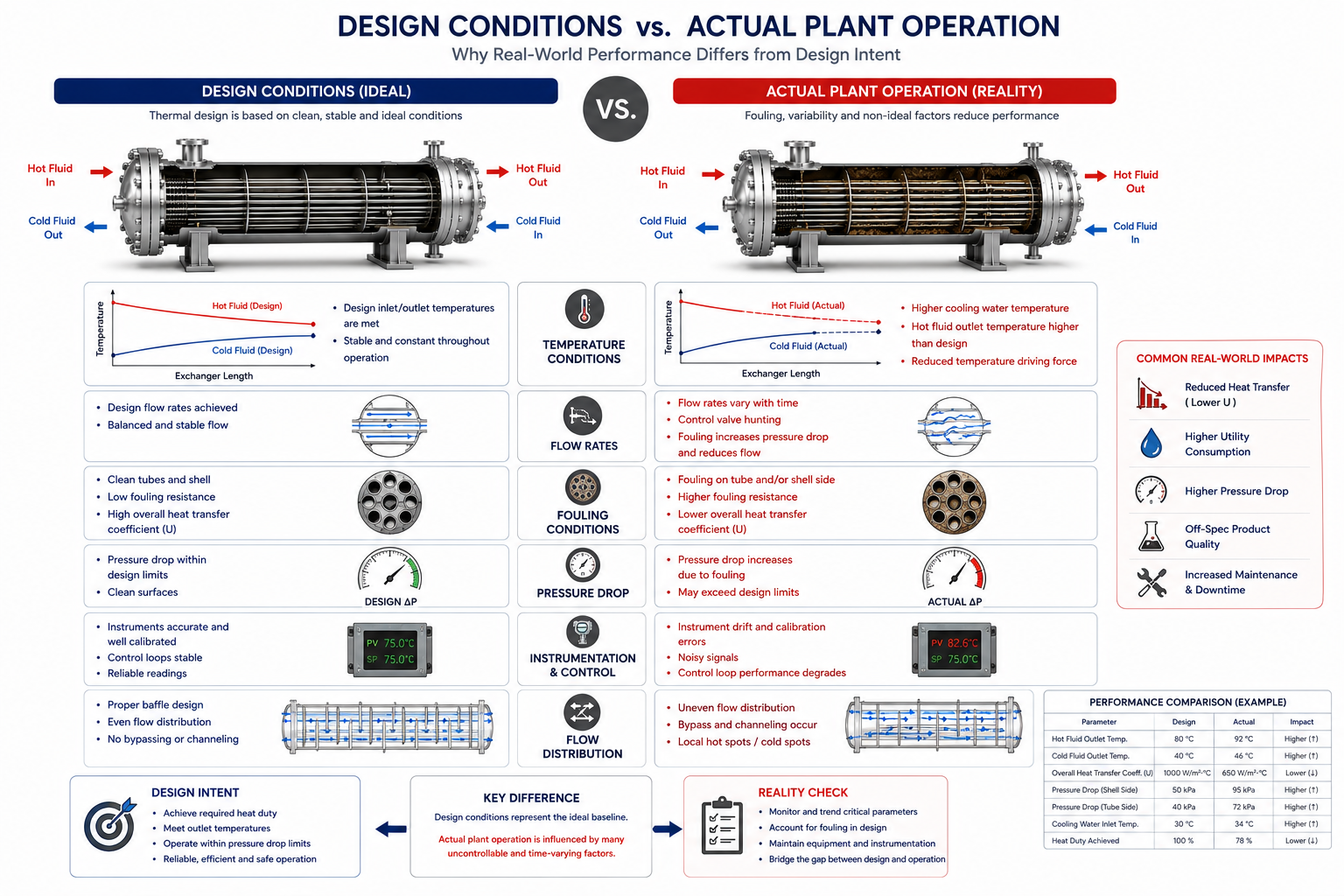
A heat exchanger can satisfy every thermal calculation during design and still fail to achieve the required performance after commissioning. The reason is usually not a mistake in the equations—it is the difference between design assumptions and real plant operation.
Table of Contents
A Good Thermal Design Does Not Guarantee Good Plant Performance
Thermal calculations are based on a design basis. Plants operate under changing conditions that rarely remain identical to that basis.
Every process engineer has experienced this situation.
A heat exchanger is designed using proven software.
The thermal calculations are verified.
The vendor guarantees the required duty.
Factory acceptance tests are completed successfully.
The exchanger is installed, commissioned, and handed over to operations.
Initially, everything appears normal.
Then, over the following weeks or months, operators begin reporting problems such as:
- The outlet temperature is higher than expected.
- Cooling water consumption is increasing.
- Steam demand is higher than estimated.
- Pressure drop is rising.
- Production cannot reach design capacity.
The first question usually asked is:
“Was the thermal design wrong?”
In many cases, the answer is no.
The thermal design may have been perfectly correct for the design conditions.
The problem is that the plant is no longer operating under those exact conditions.
Understanding this difference is one of the most important lessons in heat exchanger engineering.
Design Conditions and Operating Conditions Are Rarely Identical
The exchanger is designed for one set of conditions but spends most of its life operating under different ones.
Every thermal design begins with a process datasheet.
It defines:
- flow rates
- temperatures
- pressures
- fluid properties
- utility conditions
These values become the design basis.
However, once the plant starts operating, many of these parameters begin to change.
For example:
- feed composition varies
- production rates increase or decrease
- utilities fluctuate
- ambient temperature changes
- operating strategies evolve
Although each change may appear small, their combined effect can significantly alter exchanger performance.
Fouling Begins Earlier Than Many Engineers Expect
A clean exchanger exists only for a short period after startup.
Thermal calculations usually begin with clean heat transfer surfaces.
During operation, deposits gradually develop because of:
- scaling
- suspended solids
- corrosion products
- biological growth
- polymer formation
These deposits increase thermal resistance.
As fouling increases:
- heat transfer decreases
- pressure drop increases
- utility demand rises
A thermal design that performs perfectly during commissioning may gradually lose capacity simply because the exchanger is no longer clean.
This is one of the most common reasons operating performance differs from design predictions.
Process Fluids Do Not Always Match the Original Design Basis
Small changes in fluid properties can produce noticeable changes in heat transfer performance.
During project design, fluid properties are usually obtained from:
- laboratory data
- process simulations
- design specifications
After commissioning, the actual process stream may contain:
- different compositions
- impurities
- suspended particles
- varying moisture content
These changes affect:
- viscosity
- density
- specific heat
- thermal conductivity
Consequently, the actual heat transfer coefficient may differ from the design value.
Even though the exchanger itself has not changed, its thermal performance may change significantly.
Utility Systems Rarely Operate at Ideal Conditions
The utility available in the plant may be different from the utility assumed during design.
Cooling water is a common example.
The design basis may assume:
- stable inlet temperature
- constant flow rate
- clean water quality
In reality:
- summer temperatures increase water temperature
- cooling tower performance changes
- pumps operate at different flow rates
- water quality deteriorates over time
Similarly, steam systems may experience:
- pressure fluctuations
- varying condensate conditions
- load sharing between multiple users
The exchanger cannot perform as originally designed if its utilities are no longer operating at their design conditions.
Flow Distribution Inside the Exchanger May Not Be Ideal
Thermal calculations often assume uniform flow. Real exchangers rarely achieve perfect distribution.
Design software generally assumes that fluids distribute evenly through:
- shell-side passages
- tube bundles
- multiple passes
In practice, manufacturing tolerances and operating conditions may produce:
- bypass flow
- dead zones
- uneven velocity distribution
- local recirculation
These effects reduce effective heat transfer without changing the exchanger’s overall size.
The result is lower thermal performance than predicted.
Instrument Errors Can Mislead Engineers
Sometimes the exchanger is performing correctly—the measurements are not.
Operators frequently evaluate exchanger performance using:
- inlet temperatures
- outlet temperatures
- flow measurements
- pressure readings
If one temperature transmitter drifts by only a few degrees, the calculated heat duty may appear significantly different.
Similarly:
- inaccurate flow meters
- pressure gauge errors
- poorly calibrated instruments
can make a healthy exchanger appear to be underperforming.
Before concluding that the exchanger has failed, experienced engineers verify the measurement system.
Design Margins Are Sometimes Consumed During Normal Operation
The safety built into the design can gradually disappear as operating conditions change.
Engineers often include reasonable thermal margins to account for:
- fouling
- process uncertainty
- operating variability
Over time, these margins may be consumed by:
- production increases
- higher utility temperatures
- unexpected fouling
- process modifications
Once the available margin is exhausted, the exchanger begins operating at its limit.
Any additional process change may cause noticeable performance loss.
Plant Debottlenecking Can Create New Thermal Problems
Increasing production without reviewing the thermal design often overloads existing exchangers.
Many plants eventually increase capacity.
Additional feed means:
- higher flow rates
- greater heat duty
- different temperature profiles
If the original exchanger is expected to handle the increased load without evaluation, performance problems are almost inevitable.
The exchanger may simply have reached the limit of its original design.
Maintenance Quality Influences Thermal Performance
Two identical exchangers can perform very differently depending on maintenance practices.
Thermal design assumes that cleaning restores the exchanger close to its original condition.
In practice:
- incomplete cleaning
- damaged tubes
- blocked passages
- improperly installed baffles
may reduce thermal performance.
Maintenance quality becomes part of the thermal performance equation, even though it was never included in the original calculation.
Operators May Change the Process Without Realizing the Thermal Impact
Small operational adjustments sometimes have unintended consequences.
To stabilize production, operators may:
- reduce cooling water flow
- throttle valves
- change pump operating points
- bypass part of the exchanger
- modify production rates
These changes often improve one part of the process while reducing heat exchanger performance.
The exchanger may appear to have failed when, in reality, it is responding to changed operating conditions.
Thermal Design Cannot Predict Every Future Condition
Engineers design for the expected operating envelope—not every possible scenario.
No exchanger is designed for every imaginable operating case.
Instead, designers select a practical operating range based on:
- process requirements
- project economics
- available utilities
- expected plant operation
If the plant later operates well outside that range, the exchanger may no longer meet performance expectations.
That does not necessarily indicate poor design.
It may simply indicate that the operating envelope has changed.
Communication Gaps Between Disciplines Can Affect Performance
Thermal design depends on information from multiple engineering disciplines.
A process engineer may assume:
- certain flow conditions
A piping engineer may modify piping arrangements.
A mechanical engineer may revise nozzle locations.
An operations team may request different control strategies.
Each change may appear independent.
Together, they can influence exchanger performance.
Many operating problems originate from communication gaps rather than calculation errors.
Common Reasons Thermal Designs Fail in Operating Plants
Most failures originate from changing plant conditions rather than incorrect equations.
The most common reasons include:
- unexpected fouling
- changing process fluid properties
- higher production rates
- utility fluctuations
- incorrect operating practices
- poor maintenance
- instrument inaccuracies
- uneven flow distribution
- plant modifications after commissioning
- operation outside the original design basis
Notice that very few of these involve mathematical mistakes.
Most are practical engineering realities.
How Experienced Engineers Investigate Performance Problems
They verify the operating conditions before questioning the original design.
When an exchanger underperforms, experienced engineers typically ask:
- Are the current flow rates the same as the design values?
- Have fluid properties changed?
- Is fouling present?
- Are utility conditions normal?
- Are instruments calibrated?
- Has the process been modified?
- Is pressure drop consistent with previous operation?
Only after answering these questions do they begin reviewing the original thermal calculations.
This systematic approach prevents unnecessary redesign.
Operator Perspective
Operators experience thermal design through plant performance rather than engineering calculations.
For operators, exchanger problems usually appear as:
- inability to reach target temperatures
- increasing steam consumption
- higher cooling water demand
- reduced production
- more frequent cleaning
Understanding that these issues often result from changing operating conditions helps operators work more effectively with engineering teams during troubleshooting.
Owner Perspective
Reliable exchanger performance depends as much on plant operation as on the original thermal design.
For plant owners, maintaining design performance requires:
- proper maintenance
- regular performance monitoring
- utility management
- periodic thermal reviews
- accurate instrumentation
These activities often extend exchanger life and delay expensive equipment replacement.
Final Perspective
A thermal design is not a guarantee that a heat exchanger will always perform exactly as calculated.
It is a design prepared using the best available information and reasonable engineering assumptions.
Once the exchanger enters service, the plant begins to change.
Fouling develops.
Utilities fluctuate.
Production changes.
Fluid properties evolve.
Maintenance practices differ.
These realities gradually move the exchanger away from its original design conditions.
The most successful heat exchanger designs are not those that perform perfectly on the day of commissioning.
They are the ones that continue delivering reliable performance despite the inevitable changes that occur throughout years of plant operation.
Explore the complete series in the Heat Exchanger Engineering Hub.
A practicing chemical engineer with 17+ years of experience in process design, project execution, commissioning, and plant operations. Focused on practical engineering judgment beyond textbook explanations.