
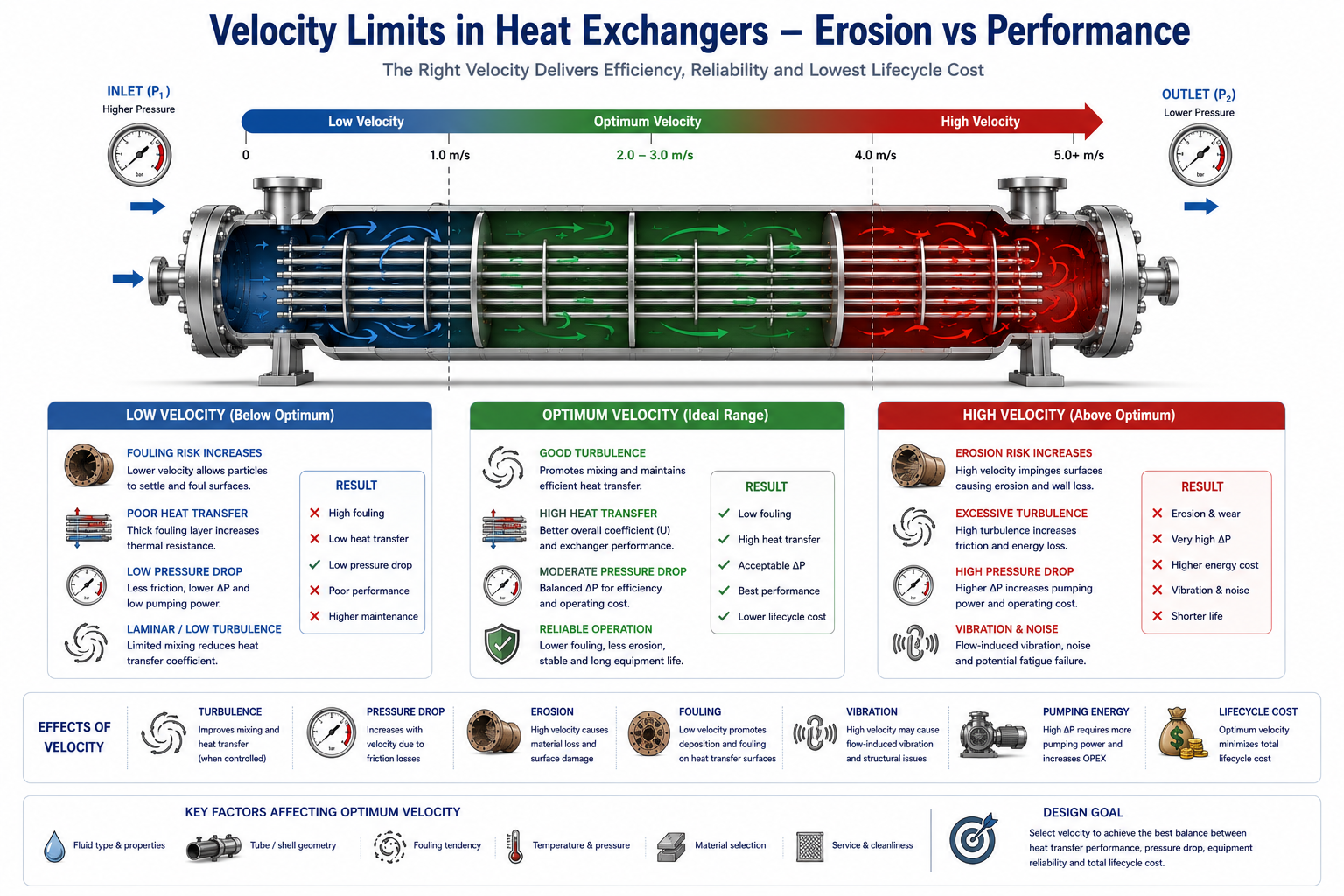
Fluid velocity is one of the most influential design parameters in a heat exchanger. Higher velocity generally improves heat transfer and reduces fouling, but beyond a certain point it also increases pressure drop, erosion, vibration, and maintenance costs. Successful heat exchanger design is therefore not about achieving the highest possible velocity—it is about selecting the optimum velocity for long-term, reliable operation.
One of the first instincts of many young engineers is simple:
If higher velocity improves heat transfer, why not always increase it?
At first, the idea seems logical.
Higher velocity creates greater turbulence, reduces the thickness of the thermal boundary layer, and improves the overall heat transfer coefficient. On paper, the exchanger appears more efficient.
However, experienced heat exchanger designers know that velocity has another side.
As velocity increases:
- pressure drop rises,
- pumping power increases,
- erosion becomes more likely,
- vibration forces become stronger,
- operating costs increase.
Eventually, the exchanger reaches a point where every additional increase in velocity provides only a small improvement in heat transfer while creating much larger hydraulic and mechanical penalties.
This is why industrial heat exchanger design never aims for maximum velocity.
Instead, engineers determine a velocity range that provides effective heat transfer without compromising equipment reliability or operating economics.
Understanding this balance is essential for designing heat exchangers that continue performing successfully throughout their service life.
Table of Contents
Why Velocity Matters in Heat Exchanger Design
Velocity directly influences both thermal and hydraulic performance.
Fluid moving through a heat exchanger transfers heat by convection.
The efficiency of this process depends largely on how effectively the fluid contacts the heat transfer surface.
Higher velocity generally:
- increases turbulence,
- reduces boundary layer thickness,
- improves the film heat transfer coefficient,
- increases the overall heat transfer coefficient (U).
For this reason, increasing velocity is one of the simplest ways to improve heat transfer.
However, every improvement comes with hydraulic consequences that must also be considered.
Higher Velocity Improves Heat Transfer
Greater turbulence allows heat to move more easily between the fluid and the heat transfer surface.
When fluid velocity is low, a relatively thick boundary layer forms along the tube wall.
This layer acts as an insulating barrier that slows heat transfer.
As velocity increases:
- turbulence disrupts the boundary layer,
- fresh fluid continually contacts the surface,
- thermal resistance decreases.
The result is:
- higher heat transfer rates,
- improved exchanger effectiveness,
- smaller required heat transfer area in many applications.
This explains why engineers often increase velocity during preliminary thermal optimization.
Higher Velocity Also Increases Pressure Drop
The same turbulence that improves heat transfer also creates greater hydraulic resistance.
As fluid moves faster through the exchanger, friction between the fluid and the walls increases.
Consequently:
- pressure drop rises,
- pumping requirements increase,
- compressor energy increases,
- operating costs become higher.
Unlike heat transfer, which eventually reaches diminishing returns, pressure drop often increases rapidly with velocity.
This is one of the most important trade-offs in exchanger design.
There Is a Practical Velocity Limit
Beyond a certain point, the disadvantages of higher velocity outweigh the thermal benefits.
Initially, increasing velocity provides significant improvements in heat transfer.
Eventually, however:
- heat transfer improvements become smaller,
- pressure drop continues increasing,
- operating costs rise,
- equipment reliability begins to decline.
This point represents the practical velocity limit.
The optimum design is usually located before this limit is reached.
Excessive Velocity Causes Erosion
Fast-moving fluids can gradually remove material from heat transfer surfaces.
One of the greatest concerns at high velocity is erosion.
As fluid velocity increases, suspended particles strike the tube wall with greater force.
Over time, this may remove small amounts of metal from:
- tube inlets,
- tube outlets,
- return bends,
- areas near nozzles.
Services containing:
- sand,
- catalyst particles,
- corrosion products,
- scale,
- other solids
are particularly susceptible.
Although erosion may occur slowly, it gradually reduces wall thickness and can eventually lead to tube failure.
Tube Inlets Are Especially Vulnerable
Velocity damage often begins where fluid first enters the tubes.
The highest local velocity often occurs at the tube entrance.
If the incoming stream contains suspended solids, repeated particle impact may cause:
- inlet erosion,
- thinning of the tube wall,
- localized leakage,
- premature tube replacement.
For severe services, engineers may specify:
- impingement plates,
- ferrules,
- inlet protection devices,
- erosion-resistant materials.
These measures help protect the exchanger while allowing acceptable operating velocity.
Low Velocity Creates a Different Set of Problems
Designing for very low velocity can be just as harmful as designing for excessive velocity.
Reducing velocity lowers pressure drop.
However, it also:
- reduces turbulence,
- lowers heat transfer,
- increases boundary layer thickness,
- promotes fouling.
Low-velocity regions may become areas where:
- solids settle,
- deposits accumulate,
- biological growth develops.
Eventually:
- heat transfer declines,
- pressure drop begins increasing because of fouling,
- cleaning frequency rises.
The exchanger becomes less efficient despite its low initial hydraulic resistance.
Velocity Influences Fouling Behaviour
Proper velocity helps keep heat transfer surfaces cleaner.
Many industrial fluids naturally deposit material on heat transfer surfaces.
Adequate velocity helps minimize these deposits by:
- maintaining turbulence,
- reducing stagnant regions,
- preventing particle settling,
- improving surface sweeping.
This does not eliminate fouling.
However, it often slows its development.
Engineers therefore consider fouling behaviour when selecting design velocity.
Different Fluids Require Different Velocity Limits
The optimum velocity depends on the process fluid rather than a universal design rule.
A cooling water exchanger may tolerate significantly higher velocity than a slurry service.
Similarly:
- clean hydrocarbons,
- viscous oils,
- condensate,
- gases,
- corrosive chemicals
all behave differently.
Factors influencing acceptable velocity include:
- viscosity,
- density,
- corrosiveness,
- solids content,
- material of construction,
- operating temperature.
Experienced engineers therefore avoid applying one standard velocity to every service.
Tube Side and Shell Side Have Different Velocity Considerations
Velocity behaves differently inside tubes and on the shell side.
Tube-side velocity is generally easier to estimate because the flow path is well defined.
Shell-side velocity depends on:
- shell diameter,
- tube layout,
- baffle spacing,
- baffle cut,
- leakage streams.
Consequently, shell-side velocity distribution is often less uniform.
Some regions may experience:
- high local velocity,
- low-velocity dead zones,
- recirculation.
Proper shell-side design aims to minimize these extremes.
Velocity Also Influences Vibration
High fluid velocity can create mechanical forces that affect exchanger reliability.
As velocity increases, flow-induced forces acting on the tubes also increase.
If these forces become excessive, they may produce:
- tube vibration,
- fretting wear,
- tube-to-baffle damage,
- fatigue failure.
This risk becomes particularly important in:
- long tube bundles,
- gas services,
- high-velocity shell-side flow.
Mechanical designers therefore evaluate vibration alongside thermal and hydraulic performance.
Velocity Selection Is an Optimization Process
Engineers rarely choose velocity directly—they optimize around it.
During thermal design, engineers adjust variables such as:
- tube diameter,
- number of tube passes,
- shell diameter,
- baffle spacing,
- flow arrangement.
Each modification changes the resulting velocity.
The preferred design is the one that provides:
- acceptable heat transfer,
- allowable pressure drop,
- manageable fouling,
- low erosion risk,
- reliable long-term operation.
Velocity is therefore a consequence of the overall design rather than an isolated design objective.
Common Misunderstandings About Velocity Limits
Many exchanger problems originate from oversimplifying the relationship between velocity and performance.
“Higher Velocity Always Improves the Exchanger”
Higher velocity improves heat transfer only up to a practical limit.
Beyond that point, pressure drop, erosion, vibration, and operating costs increase much faster than thermal performance.
“Lower Velocity Always Saves Energy”
Lower velocity reduces pumping power but may:
- reduce heat transfer,
- increase fouling,
- require larger exchangers,
- increase cleaning frequency.
The lowest operating cost is rarely achieved at the lowest velocity.
“Velocity Limits Are the Same for Every Fluid”
Every process service behaves differently.
Acceptable velocity depends on:
- fluid properties,
- solids content,
- material selection,
- operating conditions.
“Pressure Drop Alone Determines Velocity”
Pressure drop is only one consideration.
Engineers must also evaluate:
- erosion,
- fouling,
- vibration,
- maintenance,
- lifecycle cost.
Operator Perspective
Velocity-related problems often appear gradually during normal plant operation.
Operators may observe:
- increasing differential pressure,
- declining heat transfer,
- unexpected tube leaks,
- vibration,
- more frequent cleaning.
These symptoms often indicate that the selected operating velocity is no longer appropriate because of changing process conditions or progressive fouling.
Monitoring both thermal and hydraulic performance helps identify these issues before major equipment damage occurs.
Owner Perspective
Selecting the correct velocity reduces both operating cost and maintenance over the life of the exchanger.
For plant owners, an optimized velocity provides:
- efficient heat transfer,
- acceptable pumping power,
- lower erosion risk,
- reduced maintenance,
- longer equipment life,
- improved lifecycle economics.
Although a slightly lower or higher velocity may appear attractive during design, long-term operating performance usually determines the true value of the exchanger.
Final Perspective
Fluid velocity is one of the most powerful variables available to a heat exchanger designer.
Increasing velocity usually improves heat transfer and helps control fouling.
At the same time, it increases pressure drop, operating cost, erosion potential, and mechanical loading.
Designing for extremely high velocity sacrifices reliability.
Designing for very low velocity sacrifices thermal performance.
The most successful heat exchangers operate between these two extremes, where velocity is carefully optimized to provide efficient heat transfer, acceptable hydraulic performance, long equipment life, and economical plant operation.
Explore the complete series in the Heat Exchanger Engineering Hub.

A practicing chemical engineer with 17+ years of experience in process design, project execution, commissioning, and plant operations. Focused on practical engineering judgment beyond textbook explanations.