
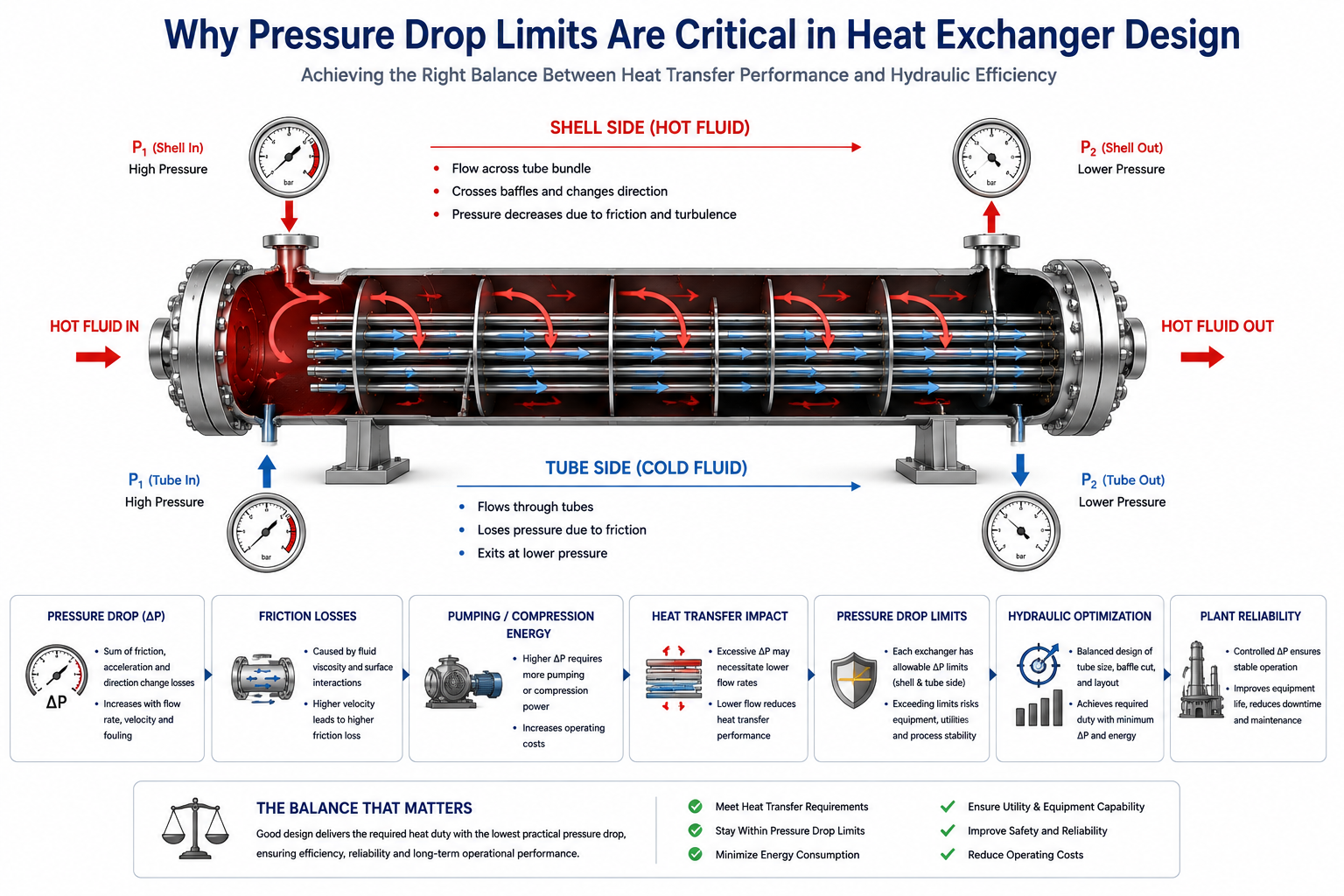
A heat exchanger is expected to transfer heat efficiently, but it must also allow fluids to flow through it without excessive resistance. If pressure drop exceeds the allowable limit, even a thermally perfect exchanger can become a costly operational problem, reducing plant capacity, increasing energy consumption, and affecting equipment throughout the process.
Every heat exchanger has two equally important responsibilities.
The first is obvious—it must transfer the required amount of heat.
The second is often overlooked, especially by engineers new to heat exchanger design—it must do so without creating unacceptable pressure loss.
In many engineering calculations, thermal performance naturally receives more attention than hydraulic performance. Designers spend considerable time evaluating heat duty, LMTD, overall heat transfer coefficient (U), and heat transfer area. Pressure drop is sometimes viewed as a secondary check performed near the end of the design.
Experienced engineers think differently.
They know that an exchanger delivering the required heat duty but causing excessive pressure drop is not a successful design. Higher pressure losses increase pump and compressor power, reduce process flow, limit production, and often become the first bottleneck during plant expansion.
For this reason, pressure drop is not merely a hydraulic calculation—it is a key design constraint that influences exchanger geometry, operating cost, maintenance strategy, and long-term plant reliability.
This article explains why allowable pressure drop is one of the most critical parameters in heat exchanger design and why successful exchangers always balance thermal performance with hydraulic reality.
Table of Contents
Pressure Drop Is a Design Constraint, Not Just a Calculation
The allowable pressure drop is usually defined before the exchanger is designed because it determines how much hydraulic resistance the process can tolerate.
Unlike heat duty, which defines how much energy must be transferred, pressure drop defines how much resistance the process can accept while moving fluids through the exchanger.
Every process has a hydraulic limit.
That limit may be determined by:
- available pump head
- compressor capability
- upstream equipment
- downstream pressure requirements
- process control philosophy
- operating flexibility
The exchanger must be designed within those limits.
If it exceeds them, the entire process may be affected.
This is why pressure drop is treated as a design input rather than simply an output of the calculations.
Pressure Drop Represents Lost Mechanical Energy
Every pressure loss inside a heat exchanger must be overcome somewhere else in the process.
As fluid flows through:
- tubes,
- shell passages,
- baffle windows,
- nozzles,
- return headers,
it encounters friction.
This friction converts useful mechanical energy into heat, resulting in a pressure loss.
The process must compensate for this loss by supplying additional energy through:
- pumps,
- compressors,
- process pressure,
- gravity in specific applications.
Although pressure drop is expressed in units such as kPa or bar, it ultimately represents an ongoing energy cost.
Excessive Pressure Drop Increases Operating Cost
The cost of pressure drop continues throughout the life of the exchanger, not just during its purchase.
Consider two heat exchangers that achieve exactly the same heat duty.
The first has a moderate pressure drop.
The second has a significantly higher pressure drop.
Both may have similar purchase prices.
However, the second exchanger requires:
- more pumping power,
- greater compressor work,
- higher electricity consumption,
- increased operating expenses.
Since industrial heat exchangers often operate continuously for many years, the additional energy cost can far exceed any difference in initial capital cost.
Lifecycle economics therefore make pressure drop an important financial consideration.
Pumps and Compressors Depend on Acceptable Pressure Drop
The exchanger is only one component of a larger hydraulic system.
A heat exchanger never operates alone.
It is connected to:
- pumps,
- compressors,
- reactors,
- vessels,
- pipelines,
- control valves.
If the exchanger creates excessive resistance, the entire system responds.
Typical consequences include:
- reduced pump flow
- higher motor current
- compressor operating away from its design point
- unstable flow control
- reduced process throughput
A pressure drop problem inside one exchanger can therefore affect equipment throughout the plant.
Pressure Drop Directly Influences Production Capacity
Many plants become hydraulically limited before they become thermally limited.
During debottlenecking studies, engineers often expect insufficient heat transfer area to be the primary concern.
In reality, production increases usually require:
- higher flow rates,
- greater pumping capacity,
- increased fluid velocity.
Since pressure drop rises rapidly with increasing flow, the exchanger may become hydraulically overloaded long before its heat transfer area is fully utilized.
This explains why many plant capacity limitations originate from hydraulic constraints rather than thermal ones.
Low Pressure Drop Is Not Always Better
Reducing pressure drop too much can also reduce exchanger performance.
Some engineers assume the ideal exchanger should have the lowest possible pressure drop.
This is another misconception.
Reducing pressure drop generally means lowering fluid velocity.
Lower velocity usually results in:
- reduced turbulence,
- lower heat transfer coefficient,
- thicker boundary layers,
- increased fouling tendency.
An exchanger with extremely low pressure drop may therefore require:
- larger surface area,
- larger shell diameter,
- higher capital cost.
The objective is not minimum pressure drop.
It is the optimum pressure drop that balances hydraulic performance with thermal efficiency.
Higher Velocity Improves Heat Transfer but Increases Pressure Drop
One of the biggest design trade-offs in heat exchanger engineering is the relationship between velocity and hydraulic resistance.
Increasing velocity generally improves:
- turbulence,
- film heat transfer coefficient,
- overall heat transfer coefficient (U).
However, it also increases:
- friction,
- pressure drop,
- pumping power,
- erosion risk.
This relationship forces engineers to optimize rather than maximize performance.
Every increase in thermal efficiency must be evaluated against its hydraulic consequences.
Pressure Drop Changes Throughout the Exchanger’s Life
The pressure drop measured during commissioning is rarely the pressure drop observed years later.
A new exchanger begins operation with:
- clean tubes,
- clean shell passages,
- unobstructed flow.
Over time:
- fouling develops,
- deposits accumulate,
- corrosion products form,
- flow passages narrow.
The result is a gradual increase in pressure drop.
Operators may notice:
- declining process flow,
- increasing pump load,
- rising differential pressure,
- reduced production.
Good hydraulic design anticipates this gradual deterioration.
Pressure Drop Determines Maintenance Strategy
Hydraulic performance often indicates when an exchanger should be cleaned.
Operators commonly monitor:
- inlet pressure,
- outlet pressure,
- differential pressure.
A steadily increasing pressure drop often indicates:
- fouling,
- plugging,
- flow restriction.
In many plants, differential pressure is one of the earliest indicators that maintenance is required.
Waiting until heat transfer performance declines may unnecessarily reduce production.
Pressure Drop Limits Influence Exchanger Geometry
Hydraulic requirements affect almost every mechanical design decision.
To satisfy allowable pressure drop, engineers may adjust:
- shell diameter,
- tube diameter,
- tube length,
- number of tube passes,
- baffle spacing,
- nozzle size.
Each modification influences both:
- thermal performance,
- hydraulic performance.
This explains why heat exchanger design is an iterative optimization process rather than a single calculation.
Different Fluids Have Different Hydraulic Behaviour
Pressure drop depends not only on the exchanger but also on the fluid flowing through it.
Two exchangers with identical geometry may experience very different pressure losses because the fluids differ in:
- viscosity,
- density,
- flow rate,
- phase,
- temperature.
For example:
A viscous oil produces significantly more friction than cooling water flowing through the same exchanger.
Similarly, compressible gases respond differently from liquids.
Hydraulic calculations must therefore reflect the actual process fluid rather than relying on generic assumptions.
Pressure Drop Affects Control Stability
Hydraulic performance influences process control as well as equipment performance.
When exchanger pressure drop becomes excessive, control systems may experience:
- unstable flow control,
- poor temperature regulation,
- valve hunting,
- limited operating flexibility.
Operators often notice these symptoms before identifying the exchanger as the root cause.
Good hydraulic design contributes to stable plant operation.
Common Misunderstandings About Pressure Drop
Many exchanger problems begin with incorrect assumptions about hydraulic performance rather than incorrect calculations.
“If Heat Duty Is Achieved, Pressure Drop Doesn’t Matter”
This is false.
The exchanger must satisfy both:
- thermal requirements,
- hydraulic requirements.
Ignoring either one produces an incomplete design.
“Pressure Drop Is Only a Mechanical Engineer’s Concern”
Pressure drop influences:
- process capacity,
- energy consumption,
- equipment selection,
- operating cost.
It is a process engineering responsibility as much as a mechanical one.
“Pressure Drop Remains Constant”
Pressure drop changes continuously because of:
- fouling,
- process changes,
- maintenance condition,
- production rate.
Monitoring pressure drop is therefore an important operational activity.
“More Pump Power Solves Everything”
Increasing pump capacity may overcome higher pressure losses temporarily.
However, it also increases:
- operating cost,
- equipment loading,
- maintenance requirements.
The preferred solution is usually to maintain acceptable hydraulic performance within the exchanger itself.
Operator Perspective
Operators often detect hydraulic problems before thermal problems become visible.
Typical field observations include:
- increasing differential pressure,
- declining process flow,
- higher pump current,
- unstable temperature control,
- reduced production rates.
These symptoms often indicate that hydraulic resistance inside the exchanger is increasing and should be investigated before significant production losses occur.
Owner Perspective
Controlling pressure drop is one of the most effective ways to reduce long-term operating cost.
For plant owners, an exchanger with well-balanced hydraulic performance provides:
- lower energy consumption,
- greater operating flexibility,
- fewer production bottlenecks,
- improved equipment reliability,
- lower lifecycle cost.
Although hydraulic optimization may require additional engineering effort during design, it often delivers continuous savings throughout the life of the plant.
Final Perspective
Pressure drop is far more than a number reported in a thermal design report.
It represents the hydraulic cost of transferring heat.
An exchanger that minimizes pressure loss may sacrifice thermal performance.
An exchanger that maximizes heat transfer may consume excessive pumping power.
Successful heat exchanger design lies between these two extremes.
The best exchangers are not those with the highest heat transfer coefficient or the lowest pressure drop.
They are the ones that achieve the required thermal performance while remaining within the hydraulic limits of the process, ensuring reliable, economical, and stable operation throughout the plant’s operating life.
Explore the complete series in the Heat Exchanger Engineering Hub.

A practicing chemical engineer with 17+ years of experience in process design, project execution, commissioning, and plant operations. Focused on practical engineering judgment beyond textbook explanations.