
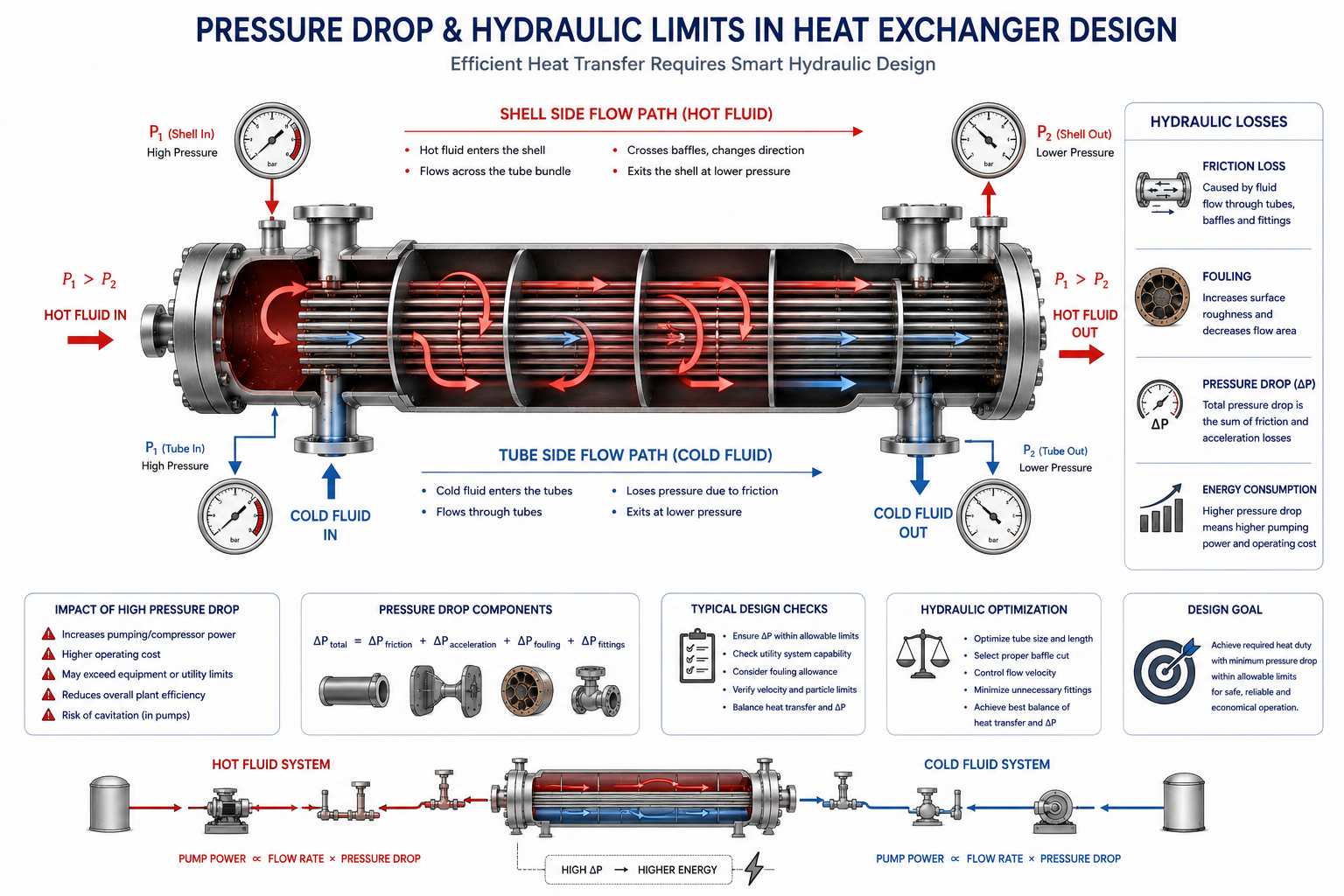
A heat exchanger is considered successful only when it achieves both the required heat transfer and an acceptable pressure drop. Optimizing one while ignoring the other often leads to higher operating costs, reduced plant capacity, and long-term reliability issues.
Why Pressure Drop Is Just as Important as Heat Transfer
Many engineers focus on thermal performance during heat exchanger design, but hydraulic performance often determines whether the exchanger is practical to operate throughout its service life.
When engineers first learn heat exchanger design, the primary objective appears straightforward:
Transfer the required amount of heat from one process stream to another.
Naturally, attention is directed toward:
- heat duty
- outlet temperatures
- overall heat transfer coefficient
- heat transfer area
- LMTD
These are all essential parameters.
However, there is another parameter that quietly influences almost every design decision:
Pressure drop.
Unlike heat duty, pressure drop does not improve the process.
Instead, it represents the energy required to move fluids through the exchanger.
Every additional kilopascal of pressure loss must be overcome by:
- pumps
- compressors
- process pressure
- gravity (in certain systems)
If pressure drop becomes excessive, even a thermally perfect heat exchanger may become unacceptable.
This is why experienced engineers never evaluate thermal performance without simultaneously considering hydraulic performance.
Table of Contents
Heat Transfer and Pressure Drop Are Closely Connected
Improving one often affects the other, making heat exchanger design an optimization exercise rather than a simple calculation.
Suppose an engineer wants to improve heat transfer.
A common solution is to increase fluid velocity.
Higher velocity generally:
- increases turbulence,
- reduces boundary layer thickness,
- improves the heat transfer coefficient.
From a thermal perspective, this is beneficial.
However, increasing velocity also increases friction.
That friction produces:
- higher pressure drop,
- greater pumping power,
- increased operating cost,
- higher erosion potential.
The opposite is also true.
Reducing velocity decreases pressure loss but usually lowers heat transfer performance.
Successful exchanger design therefore requires balancing two competing objectives.
Pressure Drop Represents Energy Consumption
Every unit of pressure lost inside a heat exchanger must be recovered elsewhere in the process.
Unlike heat transfer, pressure drop is not free.
It consumes energy.
For liquid systems, excessive pressure drop often means:
- larger pumps,
- higher motor power,
- greater electricity consumption.
For gas systems, it may require:
- larger compressors,
- additional compression stages,
- higher fuel or electrical demand.
Over the life of a plant, the operating cost associated with pressure drop may exceed the initial purchase cost of the exchanger.
This is one reason experienced engineers pay close attention to hydraulic performance during the earliest stages of design.
Thermal Design Alone Cannot Produce a Good Heat Exchanger
A thermally correct exchanger may still be hydraulically unacceptable.
Imagine two exchangers that both satisfy the required heat duty.
The first design produces:
- moderate pressure drop,
- stable flow,
- acceptable operating cost.
The second achieves the same heat duty but causes:
- excessive pressure loss,
- overloaded pumps,
- reduced plant throughput.
From a purely thermal standpoint, both exchangers appear successful.
From an operational perspective, only one is truly suitable.
Thermal design and hydraulic design must always be evaluated together.
Neither should dominate the design process.
Pressure Drop Exists on Both Sides of the Exchanger
Every heat exchanger has two independent hydraulic systems.
A shell-and-tube heat exchanger contains:
- the tube side,
- the shell side.
Each side experiences its own pressure losses.
These losses depend on factors such as:
- flow rate,
- fluid properties,
- exchanger geometry,
- flow path,
- internal components.
An acceptable tube-side pressure drop does not guarantee an acceptable shell-side pressure drop.
Both must satisfy their respective process requirements.
The following support articles in this pillar will explore these two hydraulic systems separately.
Pressure Drop Influences Equipment Selection
Hydraulic limitations often determine the final exchanger configuration.
During thermal design, engineers may evaluate several possible exchanger arrangements.
For example:
- different shell diameters,
- different tube diameters,
- varying tube lengths,
- alternative pass arrangements,
- different baffle spacing.
Each option influences:
- heat transfer,
- pressure drop,
- equipment cost,
- maintenance.
Sometimes the hydraulically acceptable design is not the smallest exchanger.
Likewise, the most compact exchanger may not satisfy pressure drop limitations.
Pumps and Compressors Depend on Hydraulic Design
Poor exchanger hydraulics affect equipment far beyond the exchanger itself.
An exchanger does not operate independently.
It forms part of a complete process system.
If exchanger pressure drop increases beyond the design value:
Pumps may experience:
- reduced flow,
- higher power consumption,
- operation away from the Best Efficiency Point (BEP),
- increased maintenance.
Compressors may experience:
- reduced capacity,
- increased compression ratio,
- higher energy consumption.
Therefore, exchanger hydraulics directly influence the performance of rotating equipment throughout the plant.
Pressure Drop Changes Throughout Plant Life
The hydraulic performance measured during commissioning is rarely maintained permanently.
When an exchanger is first commissioned:
- surfaces are clean,
- flow passages are unobstructed,
- pressure losses are relatively low.
As the plant operates:
- fouling develops,
- deposits accumulate,
- corrosion products form,
- flow passages become partially restricted.
Consequently:
- pressure drop gradually increases,
- pumping requirements rise,
- plant capacity may decrease.
Good hydraulic design anticipates these long-term changes rather than focusing only on clean operating conditions.
Pressure Drop Can Become the First Plant Bottleneck
Many production limitations originate from hydraulic constraints rather than insufficient heat transfer area.
When production increases, engineers often assume additional heat duty is the primary concern.
In reality:
Higher flow rates usually increase:
- pressure drop,
- pumping power,
- velocity,
- erosion risk.
An exchanger may still possess adequate heat transfer surface while becoming hydraulically overloaded.
This explains why many plant debottlenecking studies begin with a hydraulic review rather than a thermal review.
Hydraulic Design Requires Practical Engineering Judgment
Pressure drop limits are rarely chosen arbitrarily.
Allowable pressure drop depends on the entire process.
Engineers consider factors such as:
- available pump head,
- compressor capability,
- upstream equipment,
- downstream equipment,
- control valve requirements,
- process stability,
- operating flexibility.
The allowable pressure loss is therefore a system decision—not simply an exchanger decision.
Thermal Software Evaluates Hydraulics Too
Modern design software simultaneously evaluates thermal and hydraulic performance.
Heat exchanger software calculates:
- heat transfer,
- overall heat transfer coefficient,
- outlet temperatures,
- tube-side pressure drop,
- shell-side pressure drop,
- flow velocities.
This allows engineers to evaluate both thermal and hydraulic performance during every design iteration.
However, software only performs calculations.
Engineers decide whether the calculated pressure losses are acceptable for the process.
Why Experienced Engineers Review Pressure Drop Early
Hydraulic limitations are easier to solve during design than after installation.
If excessive pressure drop is discovered during plant operation, the available solutions are usually limited.
Possible actions include:
- reducing production,
- increasing pump size,
- replacing the exchanger,
- modifying internal components.
All of these involve cost and downtime.
By contrast, reviewing hydraulic performance during design allows engineers to optimize the exchanger before fabrication begins.
Common Misunderstandings About Pressure Drop
Many hydraulic problems originate from misconceptions developed during early engineering.
“Lower Pressure Drop Is Always Better”
Not necessarily.
Reducing pressure drop often requires lower velocity.
Lower velocity may reduce heat transfer and encourage fouling.
The objective is not minimum pressure drop.
It is the optimum pressure drop.
“Heat Transfer Is More Important Than Pressure Drop”
Both are equally important.
An exchanger that transfers heat but restricts process flow cannot be considered a successful design.
“Pressure Drop Is Only a Mechanical Issue”
Pressure drop directly affects:
- thermal performance,
- operating cost,
- equipment selection,
- plant capacity.
It is a process engineering issue as much as a mechanical one.
“Hydraulic Design Ends After Commissioning”
Hydraulic performance continues changing because of:
- fouling,
- ageing,
- production changes,
- maintenance quality.
Monitoring pressure drop remains important throughout the exchanger’s operating life.
Operator Perspective
Operators often recognize hydraulic problems before thermal problems.
Increasing pressure drop may appear as:
- declining process flow,
- rising pump current,
- unstable flow control,
- higher compressor load,
- reduced production.
These symptoms frequently develop gradually, making trend monitoring extremely valuable.
For operators, pressure drop is often the first indication that the exchanger requires attention.
Owner Perspective
Good hydraulic design reduces operating cost throughout the life of the plant.
For plant owners, an exchanger with balanced hydraulic performance provides:
- lower pumping power,
- reduced compressor energy,
- greater production flexibility,
- fewer operational bottlenecks,
- longer equipment life.
Although optimizing hydraulics may slightly increase the initial engineering effort, the resulting energy savings often continue for decades.
Final Perspective
Heat transfer and pressure drop are inseparable aspects of heat exchanger design.
Improving thermal performance usually increases hydraulic resistance.
Reducing hydraulic resistance often lowers heat transfer performance.
The role of the heat exchanger designer is not to maximize one parameter while ignoring the other.
It is to achieve the best balance between:
- heat transfer,
- pressure drop,
- energy consumption,
- equipment cost,
- maintenance,
- operational flexibility,
- and long-term plant reliability.
That balance is what transforms a thermally correct heat exchanger into one that performs successfully throughout its operating life.
Explore the complete series in the Heat Exchanger Engineering Hub.

A practicing chemical engineer with 17+ years of experience in process design, project execution, commissioning, and plant operations. Focused on practical engineering judgment beyond textbook explanations.