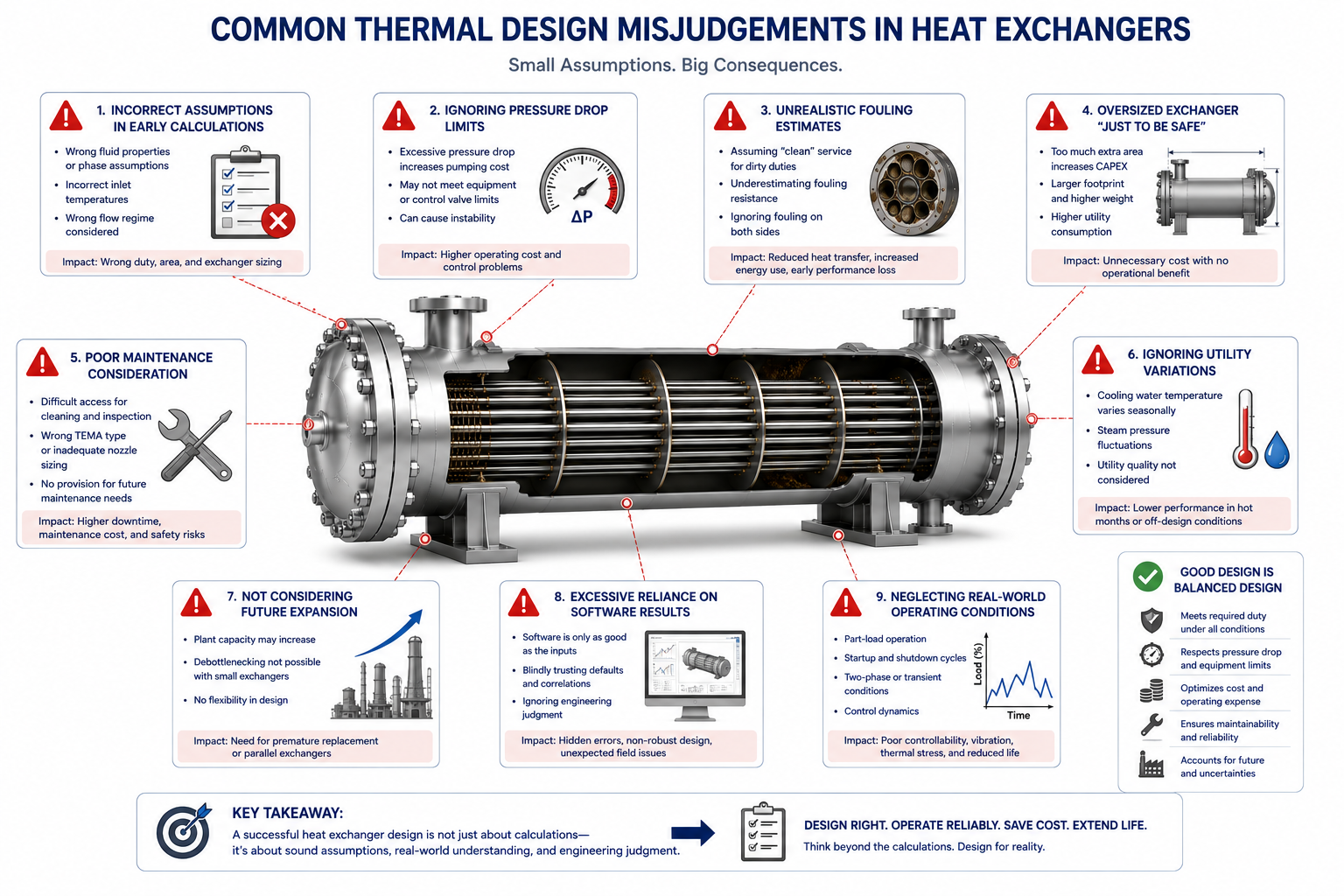
Most heat exchanger thermal design problems do not arise because engineers cannot perform the calculations. They arise because perfectly correct calculations are applied with incorrect assumptions, unrealistic expectations, or incomplete engineering judgment.
Table of Contents
Thermal Design Is More Than Solving Equations
Successful heat exchanger design requires engineering judgment as much as mathematical accuracy.
Modern thermal design software has made calculations faster than ever.
Engineers can calculate:
- heat duty
- overall heat transfer coefficient
- pressure drop
- required surface area
- outlet temperatures
within minutes.
Yet operating plants continue to experience exchangers that:
- miss the required duty
- foul much faster than expected
- create excessive pressure drop
- consume more utilities than anticipated
- become plant bottlenecks
In many cases, the calculations themselves are correct.
The real problem lies in the assumptions made before those calculations began.
Experienced engineers understand that thermal design is not simply about obtaining the correct numerical answer.
It is about asking whether that answer will still make sense after years of plant operation.
This article discusses some of the most common thermal design misjudgements that occur during heat exchanger design and explains how experienced engineers avoid them.
Assuming Process Data Will Never Change
The design basis is a starting point—not a guarantee of future plant operation.
Many young engineers treat the process datasheet as permanent.
They assume:
- flow rates will remain constant
- feed composition will never change
- utilities will always be available at design conditions
Industrial plants rarely operate that way.
Over time:
- production increases
- raw materials change
- operating philosophy evolves
- utility conditions fluctuate
Designing with no flexibility for these changes often creates future operating problems.
Experienced engineers always ask:
What is likely to change during the life of this exchanger?
Focusing Only on Heat Duty
Meeting the required heat duty does not automatically produce a good exchanger.
One of the most common mistakes is considering the design complete once the calculated heat duty is satisfied.
However, a successful exchanger must also satisfy:
- allowable pressure drop
- maintenance requirements
- fouling behaviour
- mechanical constraints
- lifecycle cost
An exchanger that transfers the required heat but requires cleaning every few weeks is rarely considered a successful design.
Thermal duty is only one part of exchanger performance.
Using Handbook Values Without Question
Reference tables provide guidance, not final design values.
Engineering handbooks contain useful ranges for:
- overall heat transfer coefficient
- fouling resistance
- fluid velocities
Some designers simply select a value from these tables without evaluating whether it suits the actual process.
Real heat transfer depends on:
- fluid properties
- exchanger geometry
- operating conditions
- maintenance philosophy
Reference values are excellent starting points.
They should never replace engineering judgment.
Ignoring the Hydraulic Side of the Design
Excellent heat transfer can become a poor design if pressure drop is excessive.
Many design improvements increase fluid velocity.
Higher velocity generally improves:
- turbulence
- heat transfer coefficient
- overall U
Unfortunately, it also increases:
- pressure drop
- pumping power
- operating cost
- erosion risk
Thermal performance and hydraulic performance must always be optimized together.
Ignoring one usually compromises the other.
Underestimating Fouling Behaviour
Every exchanger becomes dirtier with time.
Some engineers assume that fouling develops slowly or uniformly.
Actual fouling depends on:
- fluid composition
- operating temperature
- flow velocity
- maintenance practices
If fouling is underestimated:
- heat transfer declines rapidly
- pressure drop rises
- cleaning frequency increases
Conversely, assuming unrealistically high fouling may produce an unnecessarily expensive exchanger.
The challenge is selecting realistic fouling assumptions.
Treating Design Software as the Final Decision
Software performs calculations. Engineers make design decisions.
Modern software can quickly determine:
- heat transfer coefficients
- exchanger geometry
- pressure drop
- thermal performance
What software cannot determine is whether:
- the process data are realistic,
- maintenance will be practical,
- future expansion is likely,
- operating flexibility is sufficient.
The quality of thermal design still depends on engineering experience.
Designing Only for Clean Conditions
A clean exchanger represents only the beginning of its operating life.
Many preliminary calculations begin with clean heat transfer surfaces.
That is appropriate.
The mistake occurs when engineers focus only on clean performance and give insufficient attention to how the exchanger will perform after:
- fouling develops,
- utilities fluctuate,
- equipment ages.
A successful exchanger performs satisfactorily throughout its operating cycle—not only immediately after cleaning.
Assuming Bigger Always Means Better
Oversizing an exchanger can create new operating problems.
Some designers believe adding extra surface area solves every uncertainty.
An oversized exchanger may lead to:
- higher capital cost
- larger plot requirements
- increased equipment weight
- unnecessary utility control problems
- overcooling during reduced production
The objective is not the largest exchanger.
It is the most appropriate exchanger.
Ignoring Maintenance During Thermal Design
Maintenance accessibility is part of thermal performance.
An exchanger eventually requires:
- inspection
- cleaning
- tube replacement
- maintenance shutdowns
Designs that ignore these practical requirements often become expensive to operate.
Questions such as:
- Can the tube bundle be removed?
- Is mechanical cleaning possible?
- How long will maintenance take?
should be considered during thermal design—not after procurement.
Designing for Normal Operation Only
Plants spend surprisingly little time operating exactly at normal conditions.
Industrial plants experience:
- startup
- shutdown
- reduced production
- peak production
- utility disturbances
An exchanger designed only for one operating condition may become difficult to operate during all others.
Experienced designers evaluate the expected operating range rather than a single operating point.
Forgetting the Effect of Utility Variations
Utility systems are process systems too.
Cooling water temperature changes.
Steam pressure varies.
Air cooler performance depends on weather.
Ignoring these variations during thermal design often results in exchangers that perform well during one season but struggle during another.
Understanding utility behaviour is as important as understanding process behaviour.
Assuming Every Vendor Will Produce the Same Design
Different vendors may satisfy the same thermal requirements using different solutions.
A process datasheet does not dictate one unique exchanger.
Different vendors may choose different:
- shell diameters
- tube lengths
- tube diameters
- baffle spacing
- pass arrangements
All may satisfy the required heat duty.
Comparing only heat duty without reviewing the complete design can lead to poor vendor selection.
Ignoring Future Plant Expansion
Today’s spare capacity may become tomorrow’s production requirement.
Many plants eventually undergo:
- debottlenecking
- capacity expansion
- feedstock changes
Designing with absolutely no operational flexibility can make the heat exchanger the first equipment limiting future production.
Reasonable flexibility should be considered whenever future expansion is anticipated.
Optimizing Individual Parameters Instead of the Whole Design
Heat exchanger design is a balancing exercise.
Engineers sometimes attempt to maximize:
- U
- velocity
- correction factor
- compactness
individually.
In reality, improving one parameter often worsens another.
For example:
Increasing velocity may:
- improve heat transfer,
but also:
- increase pressure drop,
- increase erosion,
- increase operating cost.
Good thermal design balances competing objectives rather than maximizing a single variable.
Common Characteristics of Experienced Thermal Designers
Experienced engineers ask different questions before accepting a thermal design.
Rather than asking:
“Does the calculation work?”
they ask:
- Will this exchanger still perform after two years?
- How easily can it be cleaned?
- What happens if production increases?
- What happens during summer?
- Is the pressure drop acceptable after fouling?
- Can operators maintain stable control?
These questions often determine the long-term success of the exchanger.
Operator Perspective
Operators quickly recognize thermal design weaknesses because they experience them every day.
Common operational symptoms include:
- increasing outlet temperatures
- excessive utility consumption
- frequent cleaning
- unstable temperature control
- production limitations
Many of these issues originate from design assumptions made years before commissioning.
Owner Perspective
Good thermal design minimizes lifecycle cost rather than simply reducing purchase price.
For plant owners, avoiding common thermal design misjudgements helps achieve:
- reliable production
- lower utility consumption
- fewer shutdowns
- easier maintenance
- longer equipment life
The financial benefits often continue throughout the entire operating life of the exchanger.
Final Perspective
Most thermal design failures are not caused by incorrect equations.
They are caused by incorrect assumptions, unrealistic expectations, or overlooking practical operating realities.
A successful heat exchanger design balances:
- thermal performance,
- hydraulic performance,
- maintenance,
- operating flexibility,
- future plant requirements,
- and lifecycle economics.
The engineers who consistently produce reliable heat exchanger designs are rarely the ones who perform the fastest calculations.
They are the ones who recognize where engineering judgment matters more than mathematics.
Explore the complete series in the Heat Exchanger Engineering Hub.

A practicing chemical engineer with 17+ years of experience in process design, project execution, commissioning, and plant operations. Focused on practical engineering judgment beyond textbook explanations.