
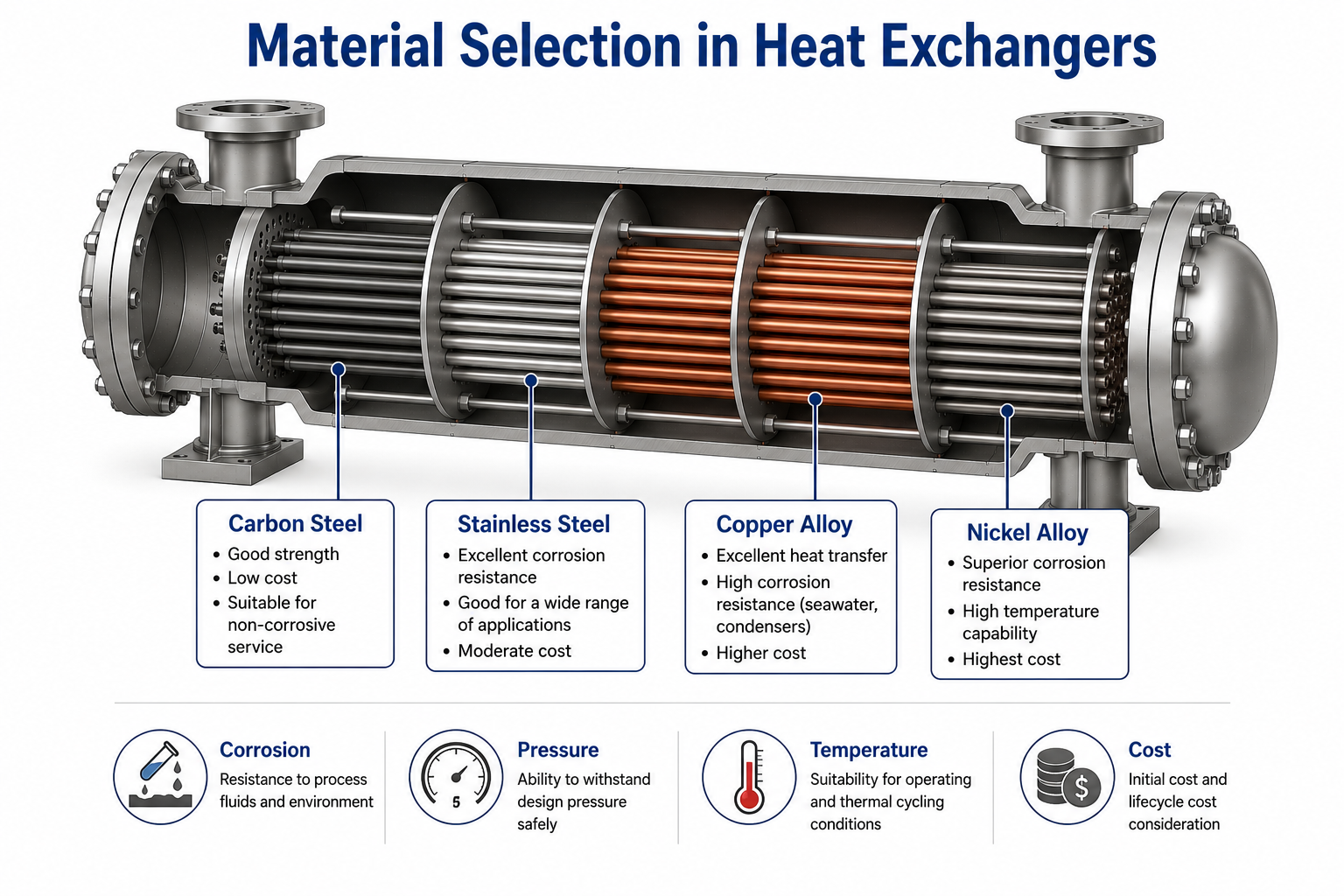
Choosing materials for a shell-and-tube heat exchanger is one of the most critical engineering decisions in the design process. While corrosion resistance is often the first consideration, it is only one part of a much larger picture. Mechanical strength, operating pressure, temperature, thermal expansion, fabrication, fouling, erosion, maintenance, and lifecycle cost all influence material selection. The best material is not necessarily the most corrosion-resistant—it is the one that provides the best overall performance throughout the exchanger’s operating life.
One of the most common questions during heat exchanger design is:
“Which material should we use?”
Many engineers instinctively begin by examining the corrosiveness of the process fluids.
That is certainly important.
However, if material selection were based only on corrosion, every exchanger handling aggressive chemicals would simply be built from exotic alloys.
Industrial reality is far more complex.
A heat exchanger must simultaneously withstand:
- internal pressure,
- operating temperature,
- thermal cycling,
- flow-induced erosion,
- vibration,
- fabrication stresses,
- maintenance activities,
- and years of continuous operation.
Material selection therefore becomes a multidisciplinary engineering decision rather than a simple corrosion problem.
Understanding this broader perspective helps process engineers communicate more effectively with mechanical engineers, materials specialists, and equipment vendors while making better design decisions.
Table of Contents
Corrosion Resistance Is Only the Starting Point
Preventing corrosion is essential, but it is not the only objective of material selection.
Corrosion determines whether a material can survive chemical exposure.
However, engineers must also ensure that the selected material can safely withstand:
- design pressure,
- operating temperature,
- mechanical loading,
- thermal expansion,
- cyclic operation,
- fabrication processes.
A material that offers excellent corrosion resistance may still prove unsuitable if it lacks adequate mechanical or manufacturing characteristics.
Material selection therefore begins with corrosion but never ends there.
Pressure and Temperature Influence Material Choice
Every material has operating limits beyond which its mechanical properties begin to change.
As operating temperature increases:
- material strength may decrease,
- creep resistance becomes important,
- thermal stresses increase.
Similarly, higher operating pressures require materials capable of safely resisting:
- internal pressure,
- flange loading,
- tubesheet stresses,
- piping loads.
The selected material must therefore satisfy both chemical compatibility and mechanical design requirements.
Mechanical Strength Matters Throughout the Equipment
Different heat exchanger components may require different mechanical properties.
A shell-and-tube heat exchanger consists of several major components, including:
- shell,
- tubes,
- tubesheets,
- channel,
- nozzles,
- flanges,
- bolts.
Each component experiences different mechanical loads.
For example:
The tubes require:
- adequate strength,
- resistance to vibration,
- good heat transfer characteristics.
The shell requires:
- pressure containment,
- structural rigidity,
- weldability.
The tubesheet must withstand:
- pressure differences,
- thermal expansion,
- tube loading,
- gasket compression.
For this reason, a single exchanger often contains multiple materials rather than one uniform material throughout.
Thermal Expansion Affects Material Compatibility
Materials that expand at different rates create additional mechanical challenges.
Different metals have different coefficients of thermal expansion.
When two dissimilar materials are joined together:
- one may expand faster,
- the other may expand more slowly.
During repeated heating and cooling, these differences create:
- thermal stresses,
- joint loading,
- weld fatigue,
- gasket deformation.
Engineers therefore evaluate thermal expansion behaviour whenever different materials are combined within the same exchanger.
Ignoring this interaction may reduce long-term reliability even when corrosion resistance is excellent.
Heat Transfer Performance Also Influences Material Selection
Some materials transfer heat better than others, but thermal conductivity is only one design parameter.
Materials such as copper alloys possess excellent thermal conductivity.
This can improve heat transfer performance.
However, they may also have limitations related to:
- pressure capability,
- corrosion resistance,
- mechanical strength,
- cost.
Stainless steels generally have lower thermal conductivity but often provide:
- superior corrosion resistance,
- higher strength,
- longer service life.
The final choice depends on achieving the best overall engineering balance rather than maximizing thermal conductivity alone.
Erosion Can Be More Dangerous Than Corrosion
High-velocity fluids gradually remove material even when chemical corrosion is minimal.
Certain services involve:
- suspended solids,
- catalyst particles,
- sand,
- scale,
- high fluid velocity.
These conditions may produce:
- tube wall thinning,
- local wear,
- premature leakage.
Materials selected for erosive service must therefore possess adequate resistance to mechanical wear as well as chemical attack.
Ignoring erosion has resulted in many premature tube failures despite excellent corrosion resistance.
Fabrication Considerations Influence Material Selection
The best material is of little value if it cannot be fabricated economically and reliably.
Engineers must consider whether the selected material can be:
- welded,
- formed,
- expanded into tubesheets,
- machined,
- inspected,
- repaired.
Some alloys require:
- specialized welding procedures,
- heat treatment,
- strict fabrication controls.
These requirements increase:
- manufacturing complexity,
- project cost,
- fabrication time.
Good material selection balances performance with practical manufacturability.
Fouling Behaviour Differs Between Materials
Surface characteristics influence how deposits accumulate over time.
Certain materials provide smoother internal surfaces that reduce:
- deposit adhesion,
- scaling,
- biological growth.
Others may encourage:
- localized corrosion beneath deposits,
- fouling accumulation,
- difficult cleaning.
Expected fouling behaviour should therefore be considered alongside corrosion resistance during material selection.
Maintenance and Repair Should Influence Material Choice
Some materials are significantly easier to inspect and repair than others.
During the exchanger’s operating life, engineers may need to:
- replace tubes,
- repair welds,
- plug damaged tubes,
- perform non-destructive testing.
Materials that are difficult to weld or repair may increase:
- maintenance cost,
- shutdown duration,
- repair complexity.
Ease of maintenance is therefore another important consideration during material selection.
Material Selection Is Closely Linked to Cost
The most expensive alloy is not necessarily the most economical engineering solution.
Exotic alloys generally provide excellent resistance to aggressive environments.
However, they also increase:
- equipment cost,
- fabrication cost,
- maintenance cost,
- spare part cost.
Conversely, selecting an inexpensive material that requires frequent replacement may increase lifecycle expenditure even further.
Experienced engineers therefore evaluate:
- capital cost,
- maintenance cost,
- equipment life,
- production losses,
- replacement frequency.
The objective is to achieve the lowest total lifecycle cost rather than the lowest purchase price.
Common Materials Used in Shell-and-Tube Heat Exchangers
Each material offers a different balance between thermal performance, corrosion resistance, strength, and cost.
Some commonly used materials include:
Carbon Steel
Often selected for:
- non-corrosive services,
- moderate temperatures,
- economical construction.
Advantages:
- low cost,
- high strength,
- excellent weldability.
Limitations:
- poor corrosion resistance.
Stainless Steel
Commonly selected where:
- corrosion resistance,
- cleanliness,
- moderate temperatures,
are important.
Advantages:
- excellent corrosion resistance,
- good mechanical strength,
- long service life.
Limitations:
- higher cost,
- lower thermal conductivity than copper alloys.
Copper Alloys
Often used where:
- high thermal conductivity,
- cooling water service,
are priorities.
Advantages:
- excellent heat transfer,
- good thermal performance.
Limitations:
- limited compatibility with certain process fluids,
- susceptibility to erosion in high-velocity service.
Nickel-Based Alloys
Selected for:
- highly corrosive environments,
- severe chemical service,
- high temperatures.
Advantages:
- exceptional corrosion resistance,
- high-temperature capability.
Limitations:
- very high cost,
- specialized fabrication requirements.
Material Selection Should Never Be an Isolated Decision
The best material emerges from collaboration across engineering disciplines.
Effective material selection requires input from:
- process engineers,
- mechanical engineers,
- corrosion specialists,
- metallurgy experts,
- inspection engineers,
- equipment vendors.
Each discipline contributes information about:
- process chemistry,
- mechanical loading,
- fabrication,
- inspection,
- lifecycle reliability.
The final decision reflects the combined engineering perspective rather than a single design criterion.
Common Misunderstandings About Material Selection
Many material selection errors occur because only one engineering factor is considered.
“The Most Corrosion-Resistant Material Is Always the Best”
Corrosion resistance alone does not guarantee:
- mechanical strength,
- manufacturability,
- affordability,
- long-term reliability.
“Using Exotic Alloys Eliminates Maintenance”
Even premium materials remain vulnerable to:
- fouling,
- erosion,
- vibration,
- fatigue,
- improper operation.
Material selection cannot eliminate all maintenance requirements.
“One Material Should Be Used Throughout the Exchanger”
Different components experience different operating conditions.
Using multiple materials is often the most practical engineering solution.
“Material Selection Is Only a Metallurgical Decision”
Process conditions, thermal behaviour, mechanical loads, maintenance philosophy, and economics all influence material selection.
It is a multidisciplinary engineering decision.
Operator Perspective
Operators benefit from materials that provide stable, reliable performance over long operating periods.
Appropriate material selection reduces:
- unexpected leaks,
- corrosion failures,
- maintenance frequency,
- shutdowns,
- operational uncertainty.
Reliable materials contribute directly to consistent plant performance.
Owner Perspective
Material selection determines equipment value over decades of operation.
For plant owners, selecting the appropriate material provides:
- longer equipment life,
- reduced maintenance costs,
- fewer replacements,
- improved reliability,
- lower lifecycle cost.
Choosing the correct material is often one of the highest-return investments made during exchanger design.
Final Perspective
Selecting materials for a shell-and-tube heat exchanger is not about finding the strongest metal or the most corrosion-resistant alloy.
It is about finding the material—or combination of materials—that best satisfies all the demands placed on the equipment throughout its service life.
Pressure, temperature, thermal expansion, vibration, erosion, fabrication, maintenance, reliability, and lifecycle cost all influence the final decision.
The most successful heat exchangers are built not from the most expensive materials, but from the materials that provide the right balance of performance, durability, and practicality for the specific process they are designed to serve.
Explore the complete series in the Heat Exchanger Engineering Hub.

A practicing chemical engineer with 17+ years of experience in process design, project execution, commissioning, and plant operations. Focused on practical engineering judgment beyond textbook explanations.