
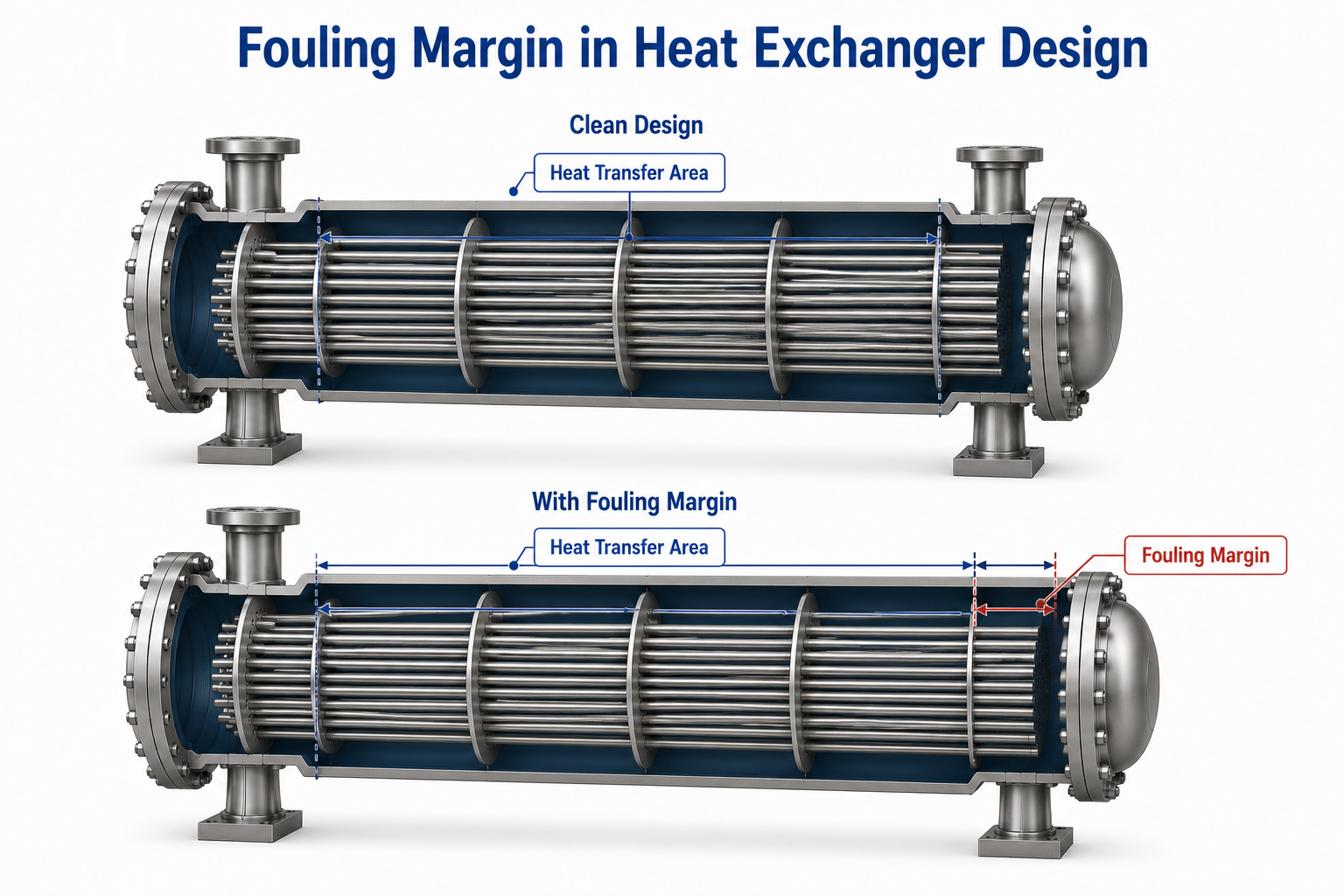
Every heat exchanger gradually loses thermal performance as deposits accumulate on its heat transfer surfaces. While the fouling factor represents the expected additional thermal resistance, the fouling margin is the practical design response to that resistance. Engineers intentionally provide extra heat transfer area so that the exchanger can continue meeting its required duty even after normal fouling develops. Without this design margin, many exchangers would fail to satisfy process requirements long before their scheduled maintenance shutdowns.
A common question during heat exchanger design is:
“If we already include a fouling factor in the calculations, why do we also need a fouling margin?”
The answer lies in understanding the difference between a design assumption and a physical design solution.
The fouling factor is a numerical value used in thermal calculations.
The fouling margin is the additional heat transfer capability built into the exchanger to compensate for that calculated thermal resistance.
In simple terms:
- the fouling factor tells the engineer how much performance may be lost,
- the fouling margin provides the additional capacity needed to absorb that loss.
This philosophy reflects one of the fundamental principles of engineering design:
Equipment should continue performing acceptably not only when it is new, but throughout its expected operating life.
Table of Contents
What Is Fouling Margin?
Fouling margin is the additional heat transfer capability intentionally built into an exchanger to offset expected performance deterioration.
When thermal calculations include fouling resistance, the required heat transfer area increases.
Instead of manufacturing the smallest possible exchanger, engineers intentionally provide:
- additional tube surface area,
- larger tube bundles,
- longer tubes,
- or increased exchanger size,
so that the exchanger can continue achieving its required heat duty after deposits develop.
The exchanger therefore begins its life with more heat transfer capability than is immediately required.
Why Clean Design Is Not Enough
A heat exchanger designed only for clean conditions begins losing performance from the day fouling starts.
Immediately after commissioning:
- surfaces are clean,
- heat transfer is highest,
- pressure drop is lowest.
As operation continues:
- deposits accumulate,
- thermal resistance increases,
- heat transfer decreases.
If no fouling margin exists, the exchanger may no longer achieve the required outlet temperatures well before the next maintenance shutdown.
Designing for clean conditions alone therefore creates unnecessary operational risk.
Fouling Margin Compensates for Future Performance Loss
The additional heat transfer area gradually becomes useful as fouling develops.
When the exchanger is new, some of its installed heat transfer capacity remains effectively unused.
As fouling increases:
- overall heat transfer coefficient decreases,
- available thermal performance declines,
- the additional design margin is gradually consumed.
Eventually, the exchanger performs close to its original design duty despite the presence of moderate fouling.
Only after fouling exceeds the anticipated level does thermal performance begin falling below the design requirement.
Fouling Margin Extends Operating Campaigns
Extra design capacity allows longer operation between cleaning shutdowns.
Without fouling margin:
- cleaning may become necessary after only a short operating period.
With an appropriate design margin:
- maintenance intervals become longer,
- shutdown frequency decreases,
- production availability improves.
This is especially valuable for:
- continuous process plants,
- refineries,
- petrochemical complexes,
- API manufacturing facilities,
where shutdowns are expensive and carefully planned.
Fouling Margin Improves Operational Flexibility
Real process plants rarely operate exactly as originally designed.
Operating conditions often change because of:
- production increases,
- feedstock variation,
- seasonal utility temperatures,
- process optimization,
- equipment ageing.
A reasonable fouling margin provides additional flexibility to accommodate these variations without immediately compromising thermal performance.
This makes the exchanger more tolerant of real operating conditions rather than ideal design assumptions.
Fouling Margin Is Not Simply “Oversizing”
Thoughtful engineering differs from unnecessary conservatism.
Some engineers mistakenly describe fouling margin as simply making the exchanger larger.
In reality, the additional area is carefully calculated.
Its objective is not to maximize size but to ensure reliable long-term performance.
An exchanger with an appropriate fouling margin is:
- neither unnecessarily oversized,
- nor insufficiently sized.
Instead, it represents an engineering balance between capital cost and operational reliability.
Too Little Fouling Margin Creates Operational Problems
Insufficient design allowance often leads to premature performance deterioration.
If the fouling margin is too small:
- outlet temperatures drift,
- utility consumption increases,
- cleaning frequency rises,
- production rates may decrease,
- operating costs increase.
The exchanger may technically remain in service while no longer satisfying process requirements.
Correcting this deficiency after installation is usually far more expensive than providing an adequate margin during design.
Too Much Fouling Margin Has Its Own Disadvantages
Excessive conservatism also carries penalties.
An unnecessarily large fouling margin may result in:
- larger shell diameter,
- additional tubes,
- increased weight,
- higher material cost,
- greater plot space,
- increased fabrication cost.
In some cases, excessive heat transfer area may also reduce operating velocities, which can actually encourage additional fouling in certain services.
The objective is therefore to select an appropriate margin rather than the largest possible margin.
Fouling Margin Depends on Process Service
Different applications require different design allowances.
For example:
Cooling water exchangers often require different margins than:
- crude oil preheaters,
- reactor feed exchangers,
- condensers,
- solvent recovery systems,
- steam heaters.
Factors influencing the required fouling margin include:
- expected fouling rate,
- operating campaign length,
- maintenance philosophy,
- fluid cleanliness,
- water quality,
- process criticality.
The selected margin should always reflect the intended service.
Fouling Margin Works Together with Maintenance
Design cannot eliminate the need for cleaning.
Even exchangers with generous fouling margins eventually require:
- mechanical cleaning,
- chemical cleaning,
- bundle inspection,
- tube plugging,
- maintenance shutdowns.
The fouling margin simply delays the point at which fouling begins affecting production.
It is therefore one component of an overall fouling management strategy.
Good Design Balances Thermal Performance and Economics
The best exchanger is not the largest one—it is the one that delivers the lowest lifecycle cost.
Engineers must balance:
- capital investment,
- operating efficiency,
- maintenance cost,
- production availability,
- energy consumption,
- expected equipment life.
Providing too little margin increases operating expenditure.
Providing too much increases capital expenditure.
The optimum design minimizes the total cost over the exchanger’s entire service life.
Common Misunderstandings About Fouling Margin
Because fouling margin is intentionally invisible during normal operation, its purpose is often misunderstood.
“Fouling Margin Means Oversized Equipment”
The exchanger is not oversized.
It is appropriately sized to continue meeting performance requirements after expected fouling develops.
“If We Add Enough Margin, Cleaning Is Unnecessary”
Fouling margin delays performance deterioration.
It does not prevent deposits from accumulating.
Routine maintenance remains essential.
“Every Heat Exchanger Needs the Same Fouling Margin”
Different services, operating conditions, and maintenance strategies require different design allowances.
There is no universal fouling margin suitable for every application.
“More Margin Always Means Better Reliability”
Excessive margin increases equipment cost and may introduce new operating challenges.
Engineering optimization—not maximum conservatism—produces the best design.
Operator Perspective
Operators may never see the fouling margin directly, but they benefit from its presence every day.
A well-designed fouling margin provides:
- stable outlet temperatures,
- fewer cleaning shutdowns,
- improved process consistency,
- greater operating flexibility,
- reduced utility fluctuations.
These advantages become increasingly valuable as the exchanger ages.
Owner Perspective
Fouling margin is an investment in long-term plant reliability rather than an unnecessary capital expense.
For plant owners, an appropriate fouling margin results in:
- fewer production interruptions,
- lower energy costs,
- improved equipment availability,
- controlled maintenance frequency,
- reduced lifecycle cost.
The modest increase in initial investment often pays for itself many times through improved operational performance.
Final Perspective
Designing a heat exchanger for perfectly clean operation is rarely sufficient for an industrial plant expected to operate continuously for years.
By intentionally adding a fouling margin, engineers acknowledge that deposits will eventually form and thermal performance will gradually decline.
The additional heat transfer area built into the exchanger allows it to continue satisfying process requirements despite this inevitable deterioration.
A properly selected fouling margin is therefore not wasted capacity.
It is carefully planned operating capacity reserved for the future.
It reflects one of the defining characteristics of good engineering: designing equipment not only for ideal conditions on the day of commissioning, but for the realities of long-term industrial operation.
Explore the complete series in the Heat Exchanger Engineering Hub.

A practicing chemical engineer with 17+ years of experience in process design, project execution, commissioning, and plant operations. Focused on practical engineering judgment beyond textbook explanations.