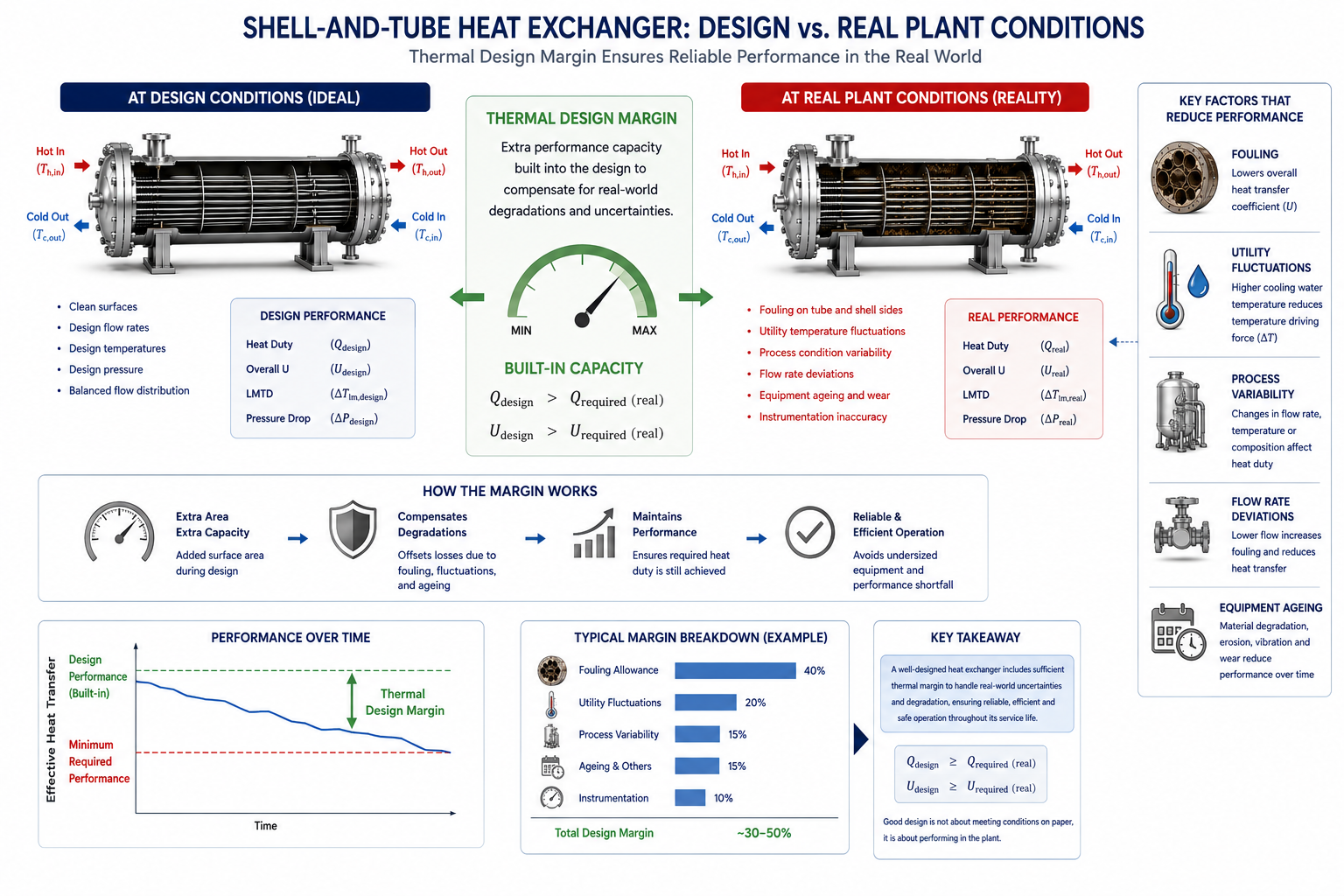
A design margin is not extra safety built into a heat exchanger for the sake of caution. It is a carefully considered allowance that helps the exchanger continue meeting process requirements despite fouling, operating variations, and the inevitable uncertainties of real plant operation.
Table of Contents
Why Engineers Add Design Margin
Every thermal calculation is based on assumptions. Design margin exists because real plants rarely operate exactly as those assumptions predict.
Imagine a heat exchanger designed to cool a process stream from 120°C to 80°C.
The thermal calculations are correct.
The exchanger satisfies the required heat duty.
The vendor confirms the performance.
Everything appears perfect.
Six months after startup:
- cooling water temperature rises during summer,
- a thin fouling layer develops,
- production increases slightly,
- process composition changes.
Individually, none of these changes seems significant.
Together, they reduce the exchanger’s thermal performance.
If the exchanger had been designed with no operating margin, it might already be unable to achieve the required outlet temperature.
This is why engineers include a design margin.
Not because they expect the calculations to be wrong, but because they know plant conditions will eventually change.
What Is a Thermal Design Margin?
A thermal design margin is additional heat transfer capability beyond the minimum calculated requirement.
The required heat duty represents the minimum performance needed under the specified design conditions.
A design margin provides additional capacity so the exchanger can continue operating satisfactorily when conditions become less favourable.
That additional capability may compensate for:
- gradual fouling
- minor process variations
- utility fluctuations
- property uncertainties
- normal equipment ageing
The important point is that a design margin is planned.
It is not accidental oversizing.
Design Margin Is Different from Fouling Allowance
These two terms are closely related but they are not the same.
Young engineers often use design margin and fouling allowance interchangeably.
They serve different purposes.
A fouling allowance specifically accounts for the gradual loss of heat transfer caused by deposits on the heat transfer surface.
A design margin is broader.
It considers additional uncertainties such as:
- future operating flexibility
- process variability
- utility changes
- calculation uncertainties
- long-term plant performance
An exchanger may include both a fouling allowance and a thermal design margin.
Neither replaces the other.
Why Plants Rarely Stay at Design Conditions
Most exchangers spend very little time operating exactly at their original design point.
The process datasheet reflects one operating case.
Real plants experience:
- production increases
- reduced production during maintenance
- seasonal weather changes
- changing feed composition
- utility variations
- equipment ageing
Consequently, the exchanger constantly operates under slightly different conditions.
The design margin helps absorb these changes without immediately affecting process performance.
Process Data Are Never Perfect
Even the best process data contain uncertainty.
During thermal design, engineers rely on information from:
- process simulations
- laboratory analysis
- operating experience
- previous projects
Although this information is carefully reviewed, it still represents the best available estimate at that stage of the project.
Actual plant behaviour may differ because:
- fluid properties change
- process chemistry evolves
- operating philosophy changes
- production requirements increase
The design margin provides flexibility for these uncertainties.
Utility Conditions Can Change Throughout the Year
Utilities are rarely as stable as the design calculations assume.
Consider cooling water.
During design, engineers may assume:
- a specific inlet temperature
- constant flow rate
- predictable water quality
In practice:
- summer increases water temperature
- cooling tower performance varies
- pump performance changes
- water fouling develops
Similarly:
Steam systems may experience:
- pressure fluctuations
- condensate return issues
- varying plant demand
The heat exchanger must continue performing even when utilities are no longer ideal.
Fouling Gradually Consumes Available Performance
Every exchanger slowly loses thermal efficiency unless it is cleaned regularly.
One of the primary reasons for including a thermal margin is the unavoidable development of fouling.
As deposits accumulate:
- heat transfer resistance increases,
- overall heat transfer coefficient decreases,
- outlet temperatures begin to drift.
Without any additional thermal capacity, the exchanger may fail to meet process requirements long before the next scheduled shutdown.
The design margin delays this performance loss.
Future Production Increases Are Often Expected
Today’s design capacity may become tomorrow’s normal operating condition.
Many process plants eventually increase production after commissioning.
The reasons include:
- market demand
- process optimization
- debottlenecking projects
- improved upstream performance
If engineers know such expansion is likely, they may incorporate reasonable thermal flexibility into the exchanger.
This approach often postpones expensive equipment replacement.
However, the margin should remain realistic rather than excessive.
More Margin Is Not Always Better
An oversized exchanger creates its own engineering and economic problems.
One common misconception is:
“If some margin is good, more margin must be even better.”
Industrial experience shows otherwise.
Excessive margin may result in:
- larger shell diameter
- longer tubes
- increased equipment weight
- higher fabrication cost
- additional plot space
- higher structural loads
Oversized exchangers may also create operational challenges.
For example:
At low production rates, excessive surface area may lead to:
- overcooling
- poor temperature control
- unstable process operation
The objective is to provide sufficient margin—not unlimited margin.
Design Margin Must Be Balanced with Pressure Drop
Additional thermal capacity should not create unacceptable hydraulic penalties.
One way to increase thermal margin is by adding more heat transfer surface.
Another approach is increasing fluid velocity.
Higher velocity generally improves heat transfer.
However, it also increases:
- pressure drop,
- pumping power,
- operating cost,
- erosion potential.
Therefore, engineers optimize both:
- thermal performance,
- hydraulic performance.
Neither should dominate the design.
Different Services Require Different Margins
The required design margin depends on the process rather than a universal rule.
Not every exchanger requires the same level of flexibility.
For example:
A clean cooling water exchanger may operate predictably for years.
A crude oil exchanger may experience:
- heavy fouling,
- varying feed composition,
- changing refinery throughput.
Similarly, a pharmaceutical plant operating under tightly controlled conditions may require a different design philosophy from a refinery processing multiple crude sources.
Experienced engineers therefore evaluate each service individually rather than applying one standard margin everywhere.
Vendors and Clients May Have Different Expectations
Thermal design is often a collaborative process between the engineering company, the client, and the equipment manufacturer.
During vendor discussions, questions frequently arise such as:
- Should additional area be included?
- How much fouling is expected?
- Is future expansion anticipated?
- What operating flexibility is required?
Different organizations may have different philosophies.
The final design usually reflects:
- project requirements,
- operating experience,
- company standards,
- lifecycle economics.
Software Does Not Decide the Design Margin
Thermal software performs calculations. Engineers decide how much flexibility the exchanger should have.
Modern thermal design software can calculate:
- required surface area,
- pressure drop,
- overall heat transfer coefficient,
- exchanger geometry.
What it cannot determine is:
- how uncertain the future process may be,
- whether production will increase,
- how well maintenance will control fouling,
- how conservative the client wishes to be.
These remain engineering decisions.
Common Mistakes When Applying Design Margin
Most mistakes arise from treating design margin as a fixed percentage rather than an engineering decision.
Adding Margin Without Understanding the Process
Some engineers automatically increase exchanger area without analysing:
- operating conditions,
- fouling behaviour,
- utility stability.
This may unnecessarily increase project cost.
Ignoring Future Plant Operation
Designing only for today’s production rate may create a thermal bottleneck after future expansion.
Where future growth is reasonably expected, some additional flexibility may be justified.
Double Counting Margin
Sometimes engineers:
- apply conservative fouling resistance,
- increase heat transfer area,
- add extra operating margin,
all for the same uncertainty.
This results in excessive oversizing.
Each allowance should address a different purpose.
Reducing Margin Solely to Lower Capital Cost
An exchanger with almost no operating flexibility may satisfy procurement budgets but create years of operational limitations.
Short-term savings can easily become long-term operating expenses.
How Experienced Engineers Decide the Right Margin
They evaluate the entire operating environment rather than relying on a standard value.
Before finalizing a thermal design, experienced engineers consider questions such as:
- How stable is the process?
- How quickly does fouling develop?
- Will production increase?
- How reliable are the utilities?
- How often will cleaning occur?
- What happens if ambient conditions change?
- How costly would exchanger replacement be?
The answers help determine whether additional thermal capacity is justified.
Operator Perspective
Operators appreciate design margin because it provides operational flexibility rather than perfect design-point performance.
A heat exchanger with reasonable thermal margin is more likely to:
- maintain outlet temperature,
- tolerate utility fluctuations,
- remain effective between cleaning intervals,
- support production changes.
Operators may never calculate the design margin, but they benefit from it every day.
Owner Perspective
A realistic design margin often produces lower lifecycle cost than designing exactly to the minimum requirement.
For plant owners, appropriate thermal margin can provide:
- improved reliability,
- fewer production interruptions,
- lower maintenance frequency,
- greater operational flexibility,
- delayed capital replacement.
Excessive margin, however, increases investment without delivering proportional value.
The objective is always optimization.
Final Perspective
A thermal design margin is not an admission that the calculations are inaccurate.
It is an acknowledgement that industrial plants are dynamic systems.
Process conditions change.
Utilities fluctuate.
Fouling develops.
Production increases.
Equipment ages.
The role of the design margin is to provide enough flexibility for the exchanger to continue performing reliably despite these inevitable changes.
The most successful heat exchanger designs are not those with the largest margins.
They are the ones with margins that are appropriate for the process, balanced with cost, pressure drop, maintenance strategy, and long-term plant operation.
Explore the complete series in the Heat Exchanger Engineering Hub.
A practicing chemical engineer with 17+ years of experience in process design, project execution, commissioning, and plant operations. Focused on practical engineering judgment beyond textbook explanations.